The UK Education System Explained: A Parent’s Guide
The UK education system can feel like a maze of acronyms and unfamiliar terminology, even for parents who grew up in it themselves. Key Stages, SATs, GCSEs, the EBacc, foundation tier, higher tier: each one matters at a different point, and missing the right moment to pay attention can leave your child at a disadvantage.
This guide walks you through every stage of education in England, from age 3 to 18, in plain language. By the end, you will know exactly what your child is doing at each age, which tests and exams they face, and when the key decision points are.
How the UK Education System Works
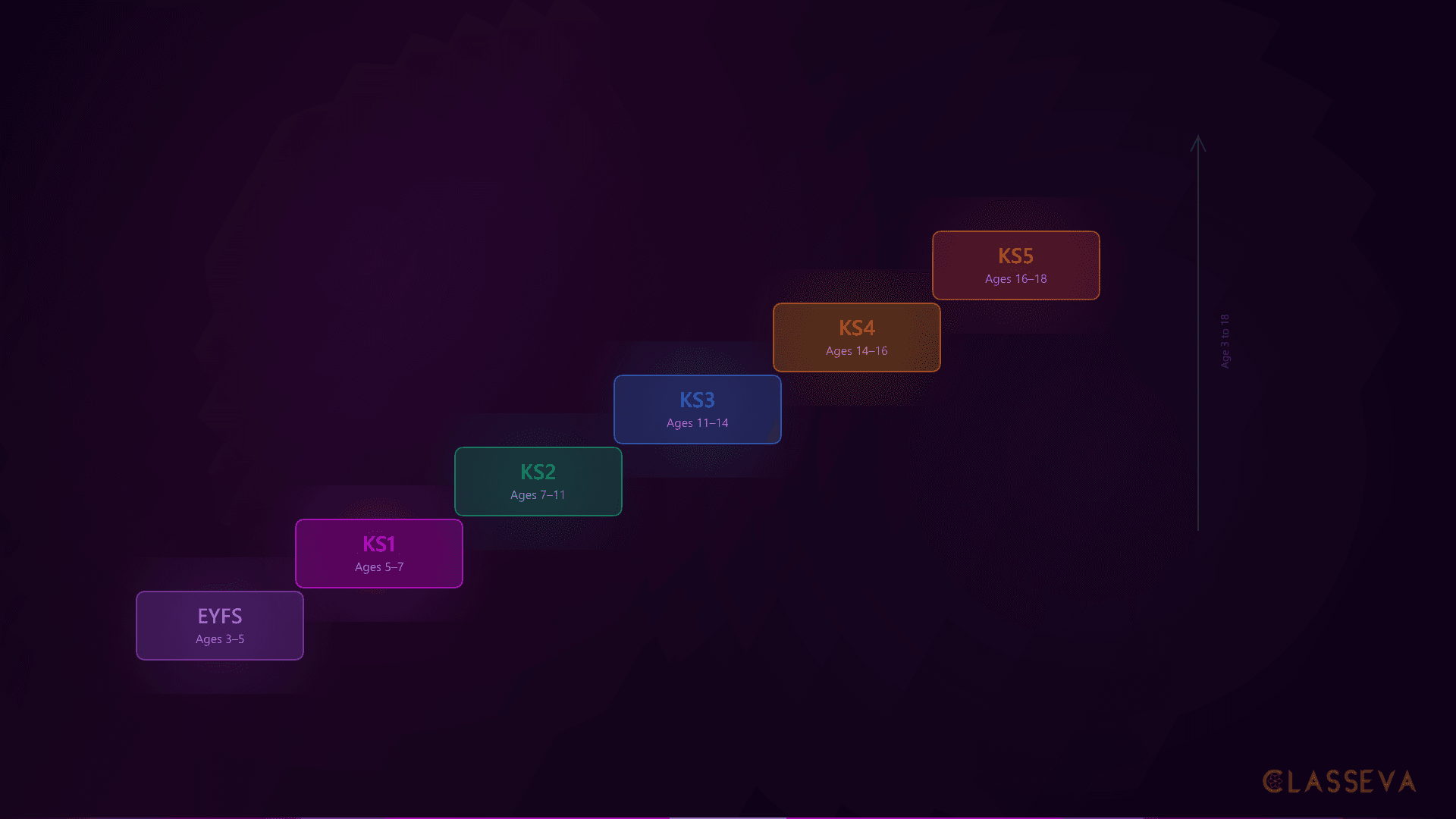
The system in England divides a child's education into stages based on age. Each stage has its own curriculum expectations, and some include national assessments. Here is the complete picture:
| Stage | Ages | Year Groups | School Type |
|---|---|---|---|
| EYFS | 3–5 | Nursery, Reception | Nursery / Primary |
| Key Stage 1 | 5–7 | Years 1–2 | Primary |
| Key Stage 2 | 7–11 | Years 3–6 | Primary |
| Key Stage 3 | 11–14 | Years 7–9 | Secondary |
| Key Stage 4 | 14–16 | Years 10–11 | Secondary |
| Key Stage 5 | 16–18 | Years 12–13 | Sixth Form / College |
The structure of the English education system from Nursery to sixth form.
One thing that caught me off guard when I first started working in the tutoring industry was how many parents were confused by this structure. People would ask, “What Key Stage is Year 8?” or “When do GCSEs actually start?” These are completely reasonable questions, and the fact that so many parents ask them tells you the system could do a better job of communicating itself.
Early Years Foundation Stage (Ages 3\u20135)
Before your child enters the formal Key Stage structure, they pass through the Early Years Foundation Stage (EYFS). This covers Nursery (age 3\u20134) and Reception (age 4\u20135). Learning at this stage happens primarily through structured play, and the focus is on building communication, physical coordination, personal and social skills, and early literacy and numeracy.
Reception is the first compulsory school year. By the end of it, teachers assess each child against the EYFS Profile, checking whether they have reached the “expected level of development” across 17 areas. This is a teacher assessment, not a formal test, and results are shared with parents and passed to the Year 1 teacher.
If your child is in Nursery or Reception, the best thing you can do is read with them daily and practise counting in everyday situations (stairs, items at the supermarket, setting the table). These habits build the foundation for everything that follows.
Key Stage 1: Ages 5\u20137 (Years 1\u20132)
Key Stage 1 covers the first two years of primary school. The core subjects are English, Maths and Science. Your child will learn to read fluently, write in sentences, understand basic number operations and begin exploring the world through simple science investigations.
The Phonics Screening Check
In Year 1, every child takes the Phonics Screening Check. This is a short, one-to-one assessment where the child reads 40 words aloud to their teacher, including some “nonsense words” designed to test pure decoding ability rather than memorisation. Children who do not meet the expected standard retake it in Year 2.
At the end of Year 2, teachers make assessments of each child's attainment in English and Maths. Formal KS1 SATs were replaced by teacher assessments from 2023, so there is no high-stakes test at this stage. The results are reported to parents and passed on to KS2 teachers.
Key Stage 2: Ages 7\u201311 (Years 3\u20136)
Key Stage 2 spans the final four years of primary school. The curriculum broadens significantly: alongside English, Maths and Science, your child will study History, Geography, Art, PE, Music, Design and Technology, Computing, and a modern foreign language from Year 3.
KS2 SATs in Year 6
The KS2 SATsare the first major national tests your child will sit. They take place in May of Year 6 and cover English Reading, English Grammar Punctuation and Spelling (GPS), and Maths (three papers: arithmetic, and two reasoning papers). Results are reported as scaled scores, where 100 is the “expected standard.”
Secondary schools use SATs results to organise classes in Year 7, often placing students into sets for Maths and English. From my conversations with parents during my time in the tutoring industry, SATs cause more anxiety than they probably should. They are important for secondary school planning, but they do not determine your child's GCSE grades or future path. For a detailed breakdown, see our complete KS2 SATs 2026 guide.
The Multiplication Tables Check
In Year 4, children take the Multiplication Tables Check (MTC). This is an on-screen test of 25 questions, each requiring a times tables answer (up to 12 × 12) within 6 seconds. The government expects all children to know their times tables fluently by the end of Year 4. Results are shared with parents but are not published publicly.
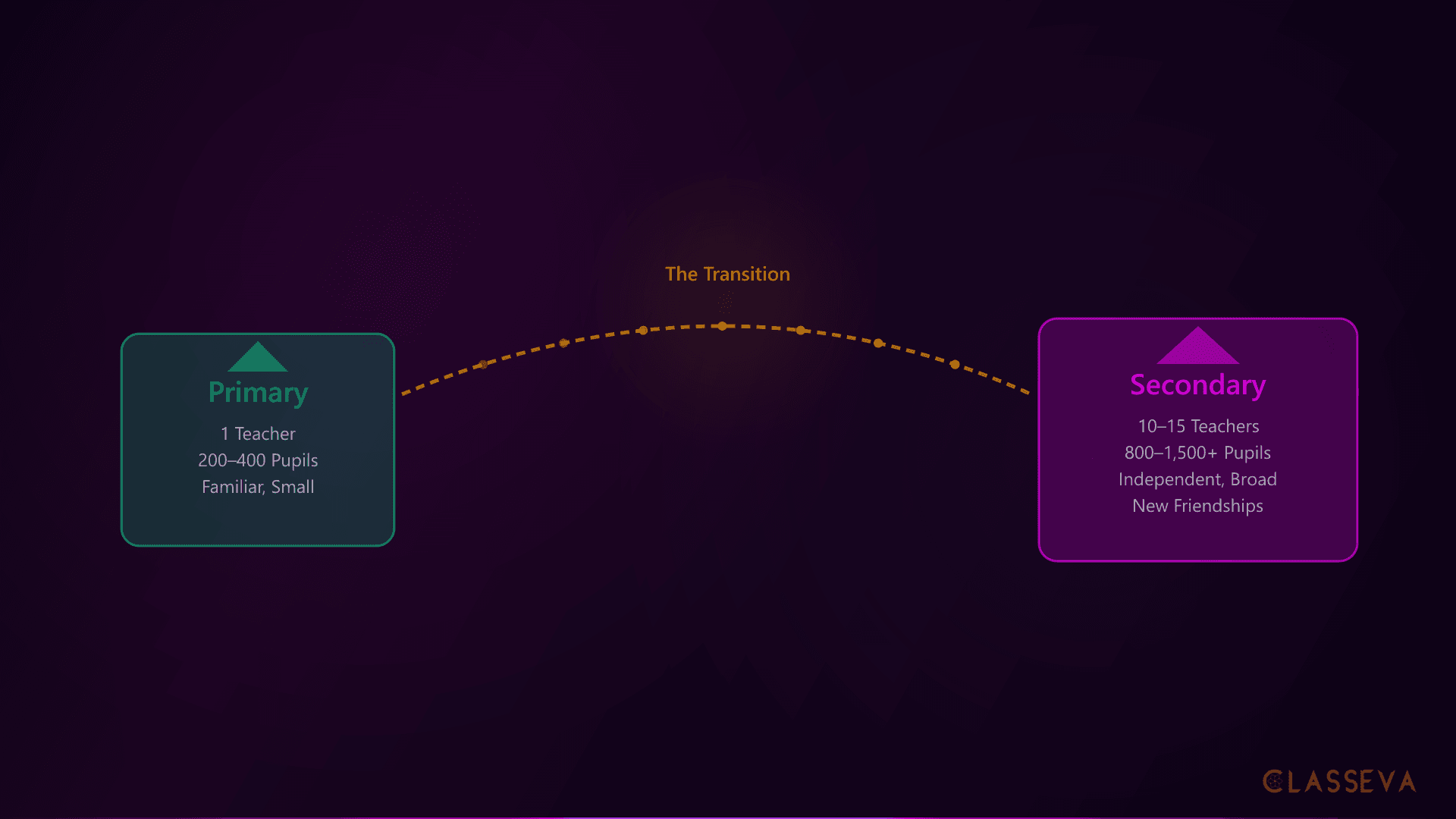
The transition from primary to secondary school happens between Year 6 and Year 7. This is one of the biggest changes in your child's education: new school, new teachers, multiple classrooms, and a much larger student body. Most schools run transition programmes, but parents should expect an adjustment period.
Key Stage 3: Ages 11\u201314 (Years 7\u20139)
Key Stage 3 covers the first three years of secondary school. Students study a broad range of National Curriculum subjects: English, Maths, Science, History, Geography, Modern Foreign Languages, Art, Music, PE, Design and Technology, Computing, Citizenship, and Religious Education.
There are no national exams at KS3. All assessment is internal, managed by the school. This makes KS3 the “quiet” stage that many parents pay least attention to, but it is actually where crucial foundations are laid for GCSE success.
Choosing GCSE Options
At the end of Year 9 (sometimes during Year 8 at some schools), students choose their GCSE options. This is a significant moment: alongside the compulsory core (English, Maths, Science), they typically select 3 to 4 optional subjects. These choices can influence sixth form pathways, university applications and career options.
Having worked with hundreds of families in the tutoring sector, one of the patterns I noticed most often was parents not engaging with the options process early enough. By the time they realised a particular subject combination was limiting their child's future choices, the deadline had passed. Our guide to choosing GCSE options covers this in detail.
Key Stage 4: Ages 14\u201316 (GCSEs)
Key Stage 4 is when things get serious. This is the GCSE stage, covering Years 10 and 11. Your child will typically study 8 to 10 subjects, with all exams taken at the end of Year 11 in May and June.
The compulsory core includes English Language, English Literature, Maths, and Science (either Combined Science, worth two GCSEs, or Triple Science, worth three). PE and RE are compulsory to study but not always examined. Beyond these, your child's optional subjects fill the remaining slots.
The 9\u20131 Grading System
Since 2017, GCSEs in England have used a 9 to 1 grading scale, replacing the old A* to G letters. Grade 9 is the highest (awarded to roughly the top 2\u20133% of students), and grade 1 is the lowest pass. A U means ungraded. The key thresholds every parent should know:
Grade 4: Standard Pass
- •Equivalent to a low C under the old system
- •Minimum for most apprenticeships
- •Students below 4 in English or Maths must resit in sixth form
Grade 5: Strong Pass
- •Government benchmark for a "strong pass"
- •Roughly equivalent to a high C / low B
- •Minimum entry for most sixth form courses
For a deeper dive into what each grade means and how it maps to the old system, see our complete guide to the GCSE 9\u20131 grading system. GCSE Results Day 2026 is Thursday 20 August.
Many parents assume that a grade 4 is a “fail” because it sounds low. It is not. Grade 4 is officially a standard pass, and grade 1 is the lowest passing grade. The numbering simply provides more differentiation at the top end, which is exactly why the system was changed.
Key Stage 5: Ages 16\u201318
After GCSEs, students enter Key Stage 5, typically in sixth form (attached to their secondary school) or at a sixth form college or FE college. Since 2015, all young people in England must remain in education, training or an apprenticeship until their 18th birthday.
Post-16 Pathways
The post-16 landscape offers more choice than most parents realise. A-Levels are the most well-known route, but they are far from the only one:
| Pathway | What It Involves | Grading | Best For |
|---|---|---|---|
| A-Levels | 3 subjects studied in depth over 2 years | A* to E | University-bound students |
| BTECs | Vocational courses with coursework and some exams | Distinction* to Pass | Students preferring practical learning |
| T-Levels | 80% classroom, 20% industry placement (315+ hours) | Distinction* to Pass | Students targeting specific industries |
| Apprenticeships | Work-based learning with off-the-job training | Pass / Distinction | Students ready to enter the workplace |
The four main post-16 pathways available in England.
A-Levels are graded A* to E, with all exams at the end of Year 13. A-Level Results Day 2026 is Thursday 13 August. For students aiming at university, UCAS applications are submitted during Year 13, with an October deadline for Oxbridge and Medicine, and a January deadline for most other courses. See our guide to the best A-Level subject combinations for advice on choosing wisely.
The National Curriculum
The National Curriculum is a framework set by the government that specifies what subjects must be taught and what content should be covered at each Key Stage. It applies to all state-maintained schools in England. Crucially, it tells schools what to teach but not how to teach it, giving teachers flexibility in their methods.
There is an important caveat: academies and free schools are not legally required to follow the National Curriculum. Since the majority of secondary schools in England are now academies, this means most secondary students are technically in schools that could deviate from the curriculum. In practice, nearly all still follow it broadly because they enter students for the same GCSEs and A-Levels.
Private (independent) schools set their own curriculum entirely. Some follow the National Curriculum closely; others take a very different approach but still prepare students for GCSEs and A-Levels (or iGCSEs and the IB in some cases). For the official framework, see the GOV.UK National Curriculum page.
UK School Types at a Glance
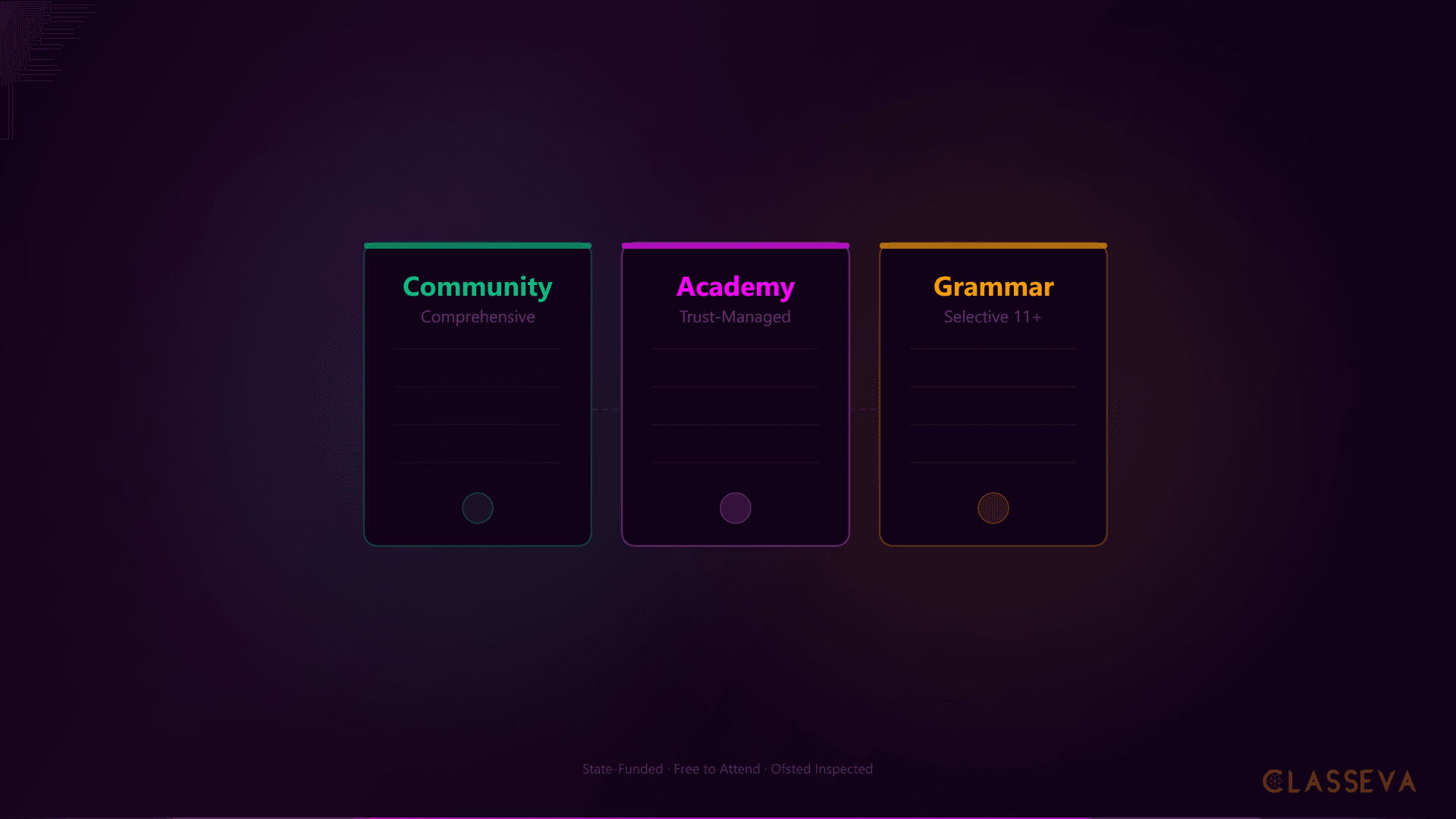
State Schools (Free)
- •Community schools: run by the local authority, follow the National Curriculum
- •Academies: independently run, funded by government, don’t have to follow the curriculum
- •Grammar schools: selective by entrance exam (11+), state-funded
- •Free schools: set up by groups of parents, teachers or charities, government-funded
Private Schools (Fee-Paying)
- •Independent schools: set their own curriculum, fees typically £10,000–£40,000+ per year
- •"Public schools" (confusingly, this means private in the UK, e.g. Eton, Harrow)
- •Some offer bursaries and scholarships for lower-income families
- •May use iGCSEs instead of GCSEs, or the International Baccalaureate instead of A-Levels
Key Dates for 2026
If your child has exams or national tests this year, these are the dates to mark in your calendar:
| Event | Date(s) | Who |
|---|---|---|
| KS2 SATs | 11–14 May 2026 | Year 6 (age 10–11) |
| GCSE exams | May–June 2026 | Year 11 (age 15–16) |
| A-Level exams | 11 May–23 June 2026 | Year 13 (age 17–18) |
| A-Level Results Day | Thursday 13 August 2026 | Year 13 students |
| GCSE Results Day | Thursday 20 August 2026 | Year 11 students |
Key assessment and results dates for the 2025/26 academic year.
If your child does not achieve at least a grade 4 in English or Maths at GCSE, they are required to continue studying those subjects and resit them during sixth form or college. This applies regardless of which post-16 pathway they choose. For full details, see GOV.UK school admissions and requirements.
The Two Biggest Decision Points
Throughout the entire Key Stage journey, there are two moments where parental awareness and involvement matter most. Getting these right gives your child a much stronger foundation for what comes next.
GCSE Options (End of Year 9)
Your child chooses 3 to 4 optional subjects alongside the compulsory core. This decision can open or close doors for A-Level choices and university courses. Research the options thoroughly, attend the school’s options evening, and make sure your child understands which subjects are needed for their likely post-16 pathway. If they are unsure, keeping a broad spread (one humanity, one language, one creative/practical) preserves flexibility.
Post-16 Pathway (End of Year 11)
After GCSEs, your child chooses between A-Levels, BTECs, T-Levels or an apprenticeship. This is not just an academic decision; it is about understanding your child’s strengths, learning style and career interests. A student who thrives with coursework may do better with BTECs than A-Levels. A student interested in engineering might benefit more from a T-Level with its industry placement than from traditional classroom-based study.
One mistake I saw repeatedly when working with tutoring families was parents treating the post-16 decision as purely academic. They would push for A-Levels because “that's what you do,” without considering whether their child was better suited to a more vocational or applied pathway. The best outcomes happened when parents matched the pathway to the student, not the other way around.
Primary parents: Read with your child daily, practise times tables, and do not panic about SATs. They matter for Year 7 setting, not for life.
Secondary parents:Download your child's exam board specification (free on the exam board website). It tells you exactly what can appear on each paper. Most parents have never seen it, and knowing it gives you the ability to ask much better questions about revision progress.
Sixth form parents: Understand the UCAS timeline if your child is university-bound. The personal statement, predicted grades and reference all come together in Year 13, but the groundwork starts in Year 12.
The UK education system is structured but not always well explained. If you have read this far, you now have a clearer picture than most parents of what each stage involves, which tests and exams your child faces, and where the biggest decisions lie. For subject-specific detail, explore our GCSE options guide, our KS2 SATs guide, or start a free AI tutoring session on Classeva to help your child with any subject across the curriculum.