How to Use Past Papers Effectively for GCSEs
Past papers are free. Every exam board publishes them online. They replicate the exact format, timing, question styles, and mark allocation your child will face in the real exam. No textbook, revision guide, or app comes close. Yet the majority of GCSE students either ignore past papers entirely or use them wrong: peeking at the mark scheme after two minutes, skipping difficult questions, or saving every paper until the night before.
During my time in the tutoring industry, I tracked what separated students who improved rapidly from those who plateaued. The single biggest differentiator was not hours spent revising. It was whether they used past papers as a revision tool, not just as a final check. The students who treated past papers as part of their revision process, doing them, marking them, analysing mistakes, and revising the gaps, consistently outperformed students who spent far more hours with textbooks open.
Why Past Papers Are the Ultimate GCSE Revision Tool
How to use past papers for GCSE revision is one of the most searched questions parents ask during exam season, and for good reason. Past papers combine three of the most effective revision strategies into a single activity: active recall (retrieving information from memory), exam technique practice (learning how to structure answers for marks), and gap identification (discovering exactly which topics need more work).
They ARE the Exam
This is the point most students miss. A past paper is not a rough approximation of what the exam might look like. It is the exam, just from a different year. The format is identical. The timing is identical. The mark allocation is identical. The question styles follow the same patterns. Whether your child sits AQA, Edexcel, or OCR, the exam board recycles question structures year after year. A student who has worked through five past papers will recognise the patterns immediately when they open the real exam.
Re-reading notes creates familiarity. Past papers create exam readiness. Familiarity makes your child feel confident. Exam readiness makes them actually perform. These are not the same thing.
Recall Under Pressure
Dunlosky et al. (2013) rated practice testing as the highest utility revision technique across all ages, subjects, and test formats. Past papers are the most authentic form of practice testing available because they force recall under realistic time pressure. Your child cannot look up the answer. They cannot check their notes. They have to retrieve what they know, structure it into the correct format, and do it within the time limit.
That statistic comes from a landmark study by Roediger and Karpicke (2006), which found that students who tested themselves from memory retained four times more information after one week than students who simply re-read the material. Past papers are the most powerful form of this self-testing effect.
The 5-Step Past Paper Method for GCSE Revision
Most students treat past papers as a one-step activity: do the paper, check the score, move on. That captures about 20% of the value. The real power of past papers as a revision strategy for GCSEs comes from what you do after the paper. Here is the full method.
Step 1: Do the Paper Under Exam Conditions
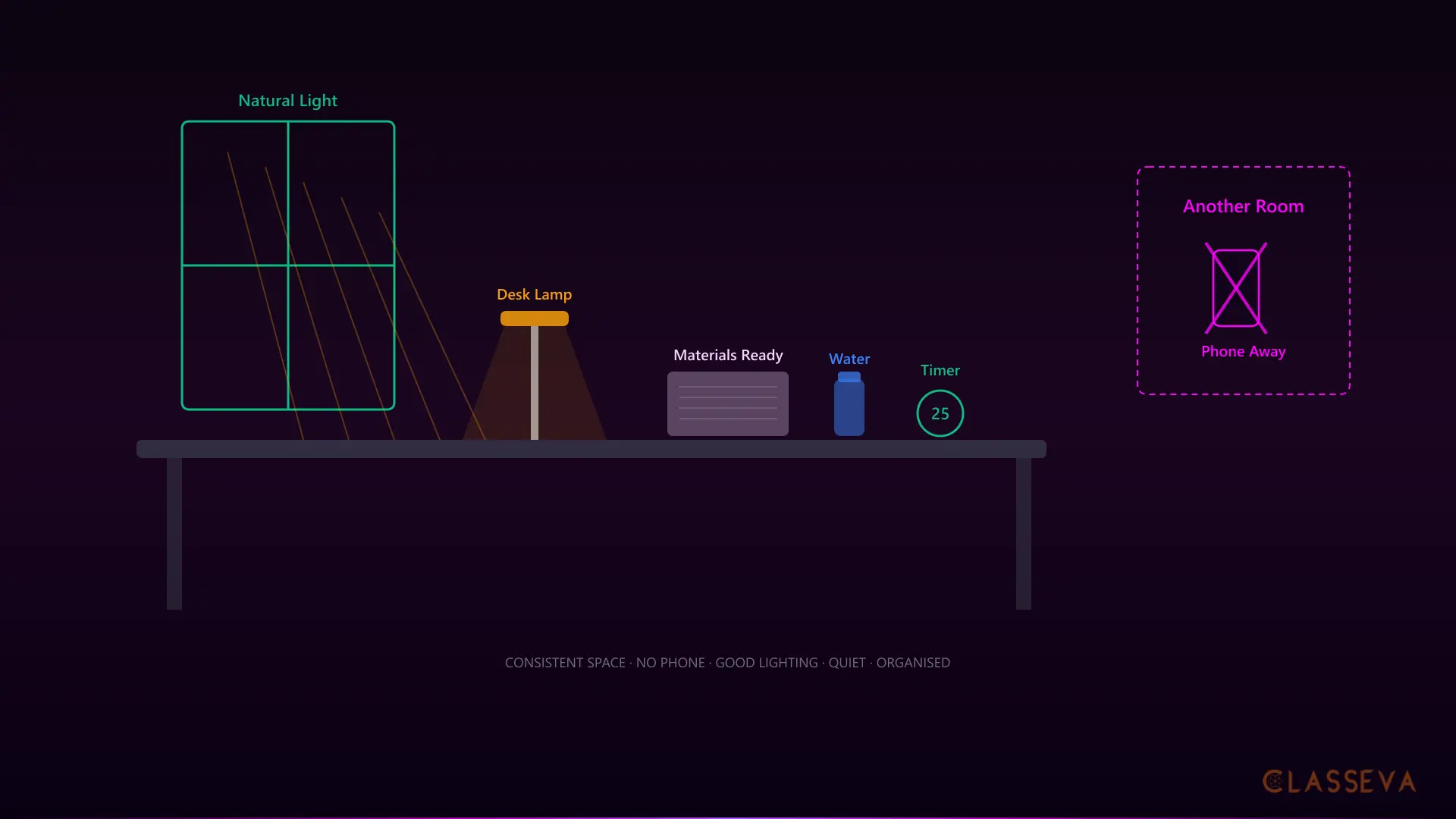
Full time limit. No notes. No phone. No peeking at the mark scheme. Use a timer: if the paper is 1 hour 30 minutes, your child gets exactly that. Write on paper, not a screen, because this replicates the real exam experience. If they cannot answer a question, they should move on and come back to it. Learning to skip and return is itself a critical exam skill.
Checking the mark scheme during the paper. Even a quick glance destroys the active recall benefit. The moment your child reads the answer, their brain switches from effortful retrieval to passive recognition. The struggle of trying to remember is exactly what builds the memory trace. Remove the struggle and you remove the learning.
Step 2: Mark It Yourself Using the Mark Scheme
Download the official mark scheme from the exam board website and mark every answer honestly. No benefit of the doubt. For each question where marks were lost, the mark scheme reveals why:
Knowledge Gap
- •Did not know the content
- •Could not recall the fact or method
- •Fix: Go back and revise this specific topic
Technique Issue
- •Knew the content but answered incorrectly
- •Wrong structure, missing key words, incomplete working
- •Fix: Study the mark scheme answer format
There are also time management issues (ran out of time, rushed the final questions) and reading comprehension issues (misread the question, answered the wrong thing). Each type of mistake requires a different fix. This is why simply checking a score is not enough.
Step 3: Analyse Your Mistakes
This step separates students who improve from those who stagnate. Create a mistakes log: a simple notebook or document with three columns for every mark lost.
| Topic | What Went Wrong | Correct Answer |
|---|---|---|
| Quadratic equations | Forgot to factorise before solving | x² + 5x + 6 = (x+2)(x+3), so x = -2 or x = -3 |
| Osmosis | Described diffusion instead of osmosis | Movement of water molecules through a partially permeable membrane from dilute to concentrated |
| Source analysis (History) | Only described the source, did not evaluate reliability | Must comment on provenance: who wrote it, when, and why |
| Creative writing | Ran out of time, no conclusion | Plan for 5 minutes, write for 35 minutes, check for 5 minutes |
Example mistakes log entries. Over multiple papers, patterns emerge that show exactly where to focus revision.
After three or four papers, patterns become unmistakable. “I keep losing marks on chemical equations.” “I never score full marks on 6-mark English questions.” “I run out of time on Paper 2 every single time.” These patterns tell your child exactly where to spend their revision hours.
If your child finds it difficult to be objective about their own work, sit with them during marking. You do not need subject knowledge to help: just read the mark scheme answer and compare it to what they wrote. The mark scheme does the heavy lifting.
Step 4: Revise the Gaps
Use the mistakes log to create targeted revision sessions. Instead of vaguely “revising biology”, your child now knows they need to revise osmosis, cell division, and photosynthesis equations specifically. Go back to the textbook, revision guide, or other revision resources for those specific topics. Make flashcards for facts that were not recalled. Practise the specific question types that caused problems.
This is the critical difference between random revision and targeted revision. Random revision hopes you happen to cover your weak spots. Targeted revision, guided by past paper evidence, guarantees it.
Step 5: Redo or Do a New Paper
After revising the gaps, attempt another paper on the same subject. Your child's score should improve. If the same mistakes recur, that topic needs deeper work. If new mistakes appear, add them to the log and continue the cycle. Aim for at least 3 to 5 past papers per subject before the real exam.
The first past paper is almost always the worst score. This is completely normal and expected. The value of that first paper is not the score itself. It is the information it generates about what your child knows and does not know. If your child scores 40% on their first attempt, that means 60% of the syllabus has been identified as needing focused revision.
When to Start and How to Pace Past Papers
The most common timing mistake is saving all past papers until the final week. By then, there is no time to learn from the mistakes. The whole point of past papers is to discover weaknesses early enough to fix them.
The Three-Phase Approach
Start practice exam papers for GCSE revision about 4 to 6 weeks before exams. Structure the available time in three phases, each building on the last.
Weeks 1 to 2: Familiarisation Phase
Do papers untimed with notes available. The goal is to learn the format, understand question types, and identify which topics need the most work. This is also when your child discovers which command words (describe, explain, evaluate, compare) the exam uses and what each one requires.
Weeks 3 to 4: Building Speed
Do papers under timed conditions, but keep notes nearby as a safety net. If your child gets stuck, they should attempt the question first, then check notes only as a last resort. This phase builds both speed and confidence. Mark every paper and update the mistakes log.
Weeks 5 to 6: Full Simulation
Do papers under strict exam conditions. Full time. No notes. No breaks. This is the closest simulation of the real exam your child can get. By this point, they should be familiar with the format, confident with most topics, and focused on eliminating the final weak spots.
One detail parents often overlook: after every paper in every phase, your child must mark, analyse, and revise the gaps. Doing five papers without reviewing a single one is five missed opportunities to improve. The paper itself is only half the activity.
Subject-Specific Past Paper Tips
The 5-step method works for every GCSE subject, but each subject has specific pitfalls worth knowing about. These are the patterns I saw repeatedly when working with students across different subjects.
Maths
Work through every question, including the ones that seem easy. Accuracy matters in maths more than any other subject because silly mistakes on straightforward questions waste marks that could have been guaranteed. Show all working, even when you can do the calculation in your head. Exam boards award method marks for working, so a student who shows the correct approach but makes an arithmetic slip can still earn 2 out of 3 marks. A student who writes only the final answer and gets it wrong scores zero.
GCSE maths mark schemesoften award “M1” (method mark) for showing the correct approach, then “A1” (accuracy mark) for the correct answer. If your child shows working, they can still earn the M1 even with a wrong final answer. Without working, both marks are lost.
English
Time management is the biggest issue in English exams. Students typically write too much on early questions and rush through the final section. Before starting, your child should note how many marks each question is worth and allocate time proportionally. A 4-mark question does not need the same length answer as a 16-mark essay.
For creative writing sections, plan for 5 minutes, write for 35 minutes, and check for 5 minutes. Many students skip the planning stage, but a brief plan prevents the rambling, unstructured responses that examiners penalise.
Science
Learn the command words. This is the single most impactful tip for GCSE science. “Describe” means state what happens. “Explain” means state what happens and why. “Evaluate” means weigh up both sides and reach a conclusion. “Compare” means identify similarities and differences. Students lose marks constantly because they describe when the question asks them to explain. The mark scheme makes this distinction brutally clear.
| Command Word | What It Requires | Common Mistake |
|---|---|---|
| Describe | State what happens | Giving a reason when none was asked for |
| Explain | State what happens AND why | Only describing, not giving the reason |
| Evaluate | Weigh both sides, reach a conclusion | Only giving one side of the argument |
| Compare | Identify similarities AND differences | Only giving differences, forgetting similarities |
| Suggest | Use knowledge to propose an answer | Giving a textbook answer instead of reasoning from context |
Command words from AQA, Edexcel, and OCR GCSE science mark schemes. Knowing these is worth several marks per paper.
History and Geography
Extended answer questions (8 to 12 marks) are where most marks are won and lost. Structure matters: introduction, developed points with specific evidence, and a conclusion. Each point needs a fact or example to support it. “The Treaty of Versailles was harsh” earns nothing without evidence: “Germany lost 13% of its territory and all overseas colonies, was limited to a 100,000-man army, and faced reparations of 132 billion gold marks.”
Practise these extended answers under timed conditions. Many students can write a good 12-mark answer with unlimited time, but under exam pressure they lose structure and leave out evidence. Past papers are the only way to build this skill.
Where to Find Free GCSE Past Papers
Every major exam board publishes past papers and mark schemes on their website at no cost. Your child's school should be able to confirm which exam board they follow for each subject. Once you know that, downloading the papers takes minutes.
| Exam Board | Website | What You Get |
|---|---|---|
| AQA | aqa.org.uk/find-past-papers-and-mark-schemes | Past papers, mark schemes, examiner reports |
| Edexcel (Pearson) | qualifications.pearson.com/past-papers | Past papers, mark schemes, specimen papers |
| OCR | ocr.org.uk/qualifications/past-papers | Past papers, mark schemes, practice papers |
| WJEC (Wales) | wjec.co.uk/qualifications/past-papers | Past papers, mark schemes, specimen materials |
All four major exam boards provide free past papers and mark schemes. Check which board your child's school uses for each subject.
If your child has worked through all available past papers, exam boards also publish specimen papers and practice papers that provide additional material in the same format. These are especially useful for subjects where the specification changed recently and only a few real past papers exist.
Download and print past papers in advance. Having a physical stack of papers ready to go removes a barrier to starting. If your child has to find, download, and print the paper each time, that friction becomes an excuse to delay. One parent I worked with printed a full set of papers for each subject at the start of revision season and kept them in labelled folders. Her daughter's scores improved markedly once the papers were always within arm's reach.
For additional practice, GCSE revision resources such as textbook question banks and evidence-based revision techniques can supplement past papers, especially during the early familiarisation phase when you are building content knowledge before attempting full papers.
How Parents Can Help with Past Papers
You do not need subject expertise to support your child's past paper practice. The most effective support is practical and logistical. One of the biggest obstacles I saw working with families was not a lack of motivation from the student, but a lack of structure around the process itself.
Six Ways to Support Past Paper Practice
Download and print past papers
Have a ready supply of papers for each subject. Remove the friction of finding and printing them each time. Organise them by subject in labelled folders.
Be the invigilator
Time your child during timed papers. Set a timer, ensure no phones or notes are visible, and let them know when 15 minutes remain. This makes the practice feel serious and realistic.
Help with marking
If your child finds it hard to be objective about their own answers, sit alongside them during marking. Read the mark scheme answer aloud and compare it to what they wrote. You do not need subject knowledge, just the mark scheme.
Celebrate improvement, not perfection
The first paper will almost certainly be a low score. Focus on the trend: "You got 48% last time and 57% this time, that is real, measurable progress." This reframes past papers as a learning tool rather than a source of stress.
Ensure they analyse, not just check
The most important habit to reinforce: after marking, your child must write down WHY they lost each mark and what the correct answer was. Checking a score takes 30 seconds. Analysing mistakes takes 20 minutes. The 20 minutes is where the learning happens.
Build past papers into the revision timetable
Help your child schedule regular past paper sessions into their revision timetable. One paper per subject per week, starting 4 to 6 weeks before exams, is a realistic and effective target.
Instead of asking “Have you revised?” (which invites a vague “yes”), try asking: “What did you score on your last past paper, and what are you going to do differently next time?” This question assumes they are using past papers and focuses on the process of improvement. It is the difference between monitoring effort and monitoring effectiveness.
If your child has not yet started building their revision routine, a structured GCSE revision timetable can help them fit past papers alongside other revision activities. For students who find the idea of past papers intimidating, combining them with active recall techniques in shorter sessions can build confidence before attempting full timed papers.
The A-Level past papers guide covers the same methodology for sixth form students, where papers tend to be longer and the marking more nuanced. The core 5-step method remains identical.
Past papers are not glamorous. They are not new. They do not require expensive apps or subscriptions. But used correctly, following the full cycle of do, mark, analyse, revise, and redo, they are the single most effective revision activity your child can do. Every exam board publishes them free. The mark schemes tell your child exactly what the examiner wants. The only thing standing between your child and significantly better exam results is the discipline to use them properly.