A-Level Past Papers: How to Use Them Effectively
The single most consistent pattern I noticed when working in tutoring was this: students who did past papers properly outperformed students who spent twice as many hours re-reading notes. Every time. The difference was not talent or intelligence. It was method. Most students know they should do A-Level past papers, but surprisingly few use them in a way that actually maximises their grades.
This guide explains exactly how to use past papers for revision at A-Level, covering a structured 3-phase approach, how to read mark schemes like an examiner, where to find A-Level past papers free from every exam board, and what most students get wrong. If your child is preparing for A-Levels and you want to give them a genuine advantage, this is the most important revision technique to understand.
Why Past Papers Are the Best Revision Tool
Re-reading notes feels productive. Highlighting a textbook feels productive. But decades of cognitive science research, including the landmark review by Dunlosky et al. (2013), consistently shows that retrieval practice (testing yourself from memory) and spaced repetition dramatically outperform passive re-reading. Past papers are the purest form of retrieval practice available to A-Level students, because they force your child to use knowledge in exactly the format the exam demands.
They Test Application, Not Just Recall
A-Level exams rarely ask students to simply state a fact. A Biology paper will not say “list the stages of mitosis.” It will present an unfamiliar scenario and ask the student to apply their knowledge of cell division to explain what they observe. Past papers train this skill. Textbook reading does not.
Question Patterns Repeat
Examiners draw from a fixed specification. There are only so many ways to test the same content, and question structures repeat across years. A student who has completed five or more past papers will start recognising common question types, the way marks are allocated, and the specific traps that appear regularly. This recognition saves time and reduces anxiety in the real exam.
They Expose Weak Topics Fast
One of the most common mistakes I saw was students revising topics they already understood because it felt comfortable, while avoiding the topics they found difficult. A past paper removes that choice. It tests everything, and the results make weak areas impossible to ignore. A student who scores 8 out of 20 on a question about organic reaction mechanisms now has concrete evidence of exactly where to focus next.
If your child says they have “revised everything” but has not done a past paper, ask them to try one. The result will show both of you exactly where the gaps are.
Where to Find Free A-Level Past Papers
Every major exam board publishes A-Level past papers free on their website, along with mark schemes and examiner reports. Your child does not need to pay for any of these. Here is exactly where to find them.
Exam Board Websites
| Exam Board | Where to Find Papers | What You Get |
|---|---|---|
| AQA | aqa.org.uk → Find Past Papers | Papers, mark schemes, examiner reports (2017 onwards) |
| Edexcel (Pearson) | qualifications.pearson.com → Past Papers | Papers, mark schemes, examiner reports (no login required) |
| OCR | ocr.org.uk → Past Papers | Papers, mark schemes, examiner reports (2017 onwards) |
All exam boards publish A-Level past papers completely free of charge.
The most important step is knowing which exam board your child sits. Each board structures its papers differently, uses different question styles, and has different mark scheme conventions. Practising AQA papers when your child sits Edexcel is better than nothing, but far less effective than using the correct board.
Current A-Level specifications were introduced in 2017. Papers from before this date may cover different content. Stick to 2017 onwards unless your child's teacher recommends specific older papers.
Third-Party Resources
Beyond the official exam board websites, two free resources are particularly valuable:
Physics and Maths Tutor
- •Papers sorted by topic AND by full paper
- •Covers all boards: AQA, Edexcel, OCR
- •All subjects, not just maths and physics
- •Completely free, no login required
Save My Exams
- •Topic-based questions extracted from real papers
- •Difficulty-graded: easy, medium, hard
- •Some content free, full access requires subscription
- •Useful for Phase 1 topic practice
Physics and Maths Tutor is particularly useful because it organises questions by topic across multiple years of papers. This means your child can practise, say, every past paper question on electromagnetic induction without having to search through dozens of full papers manually.
The 3-Phase Approach to Past Papers
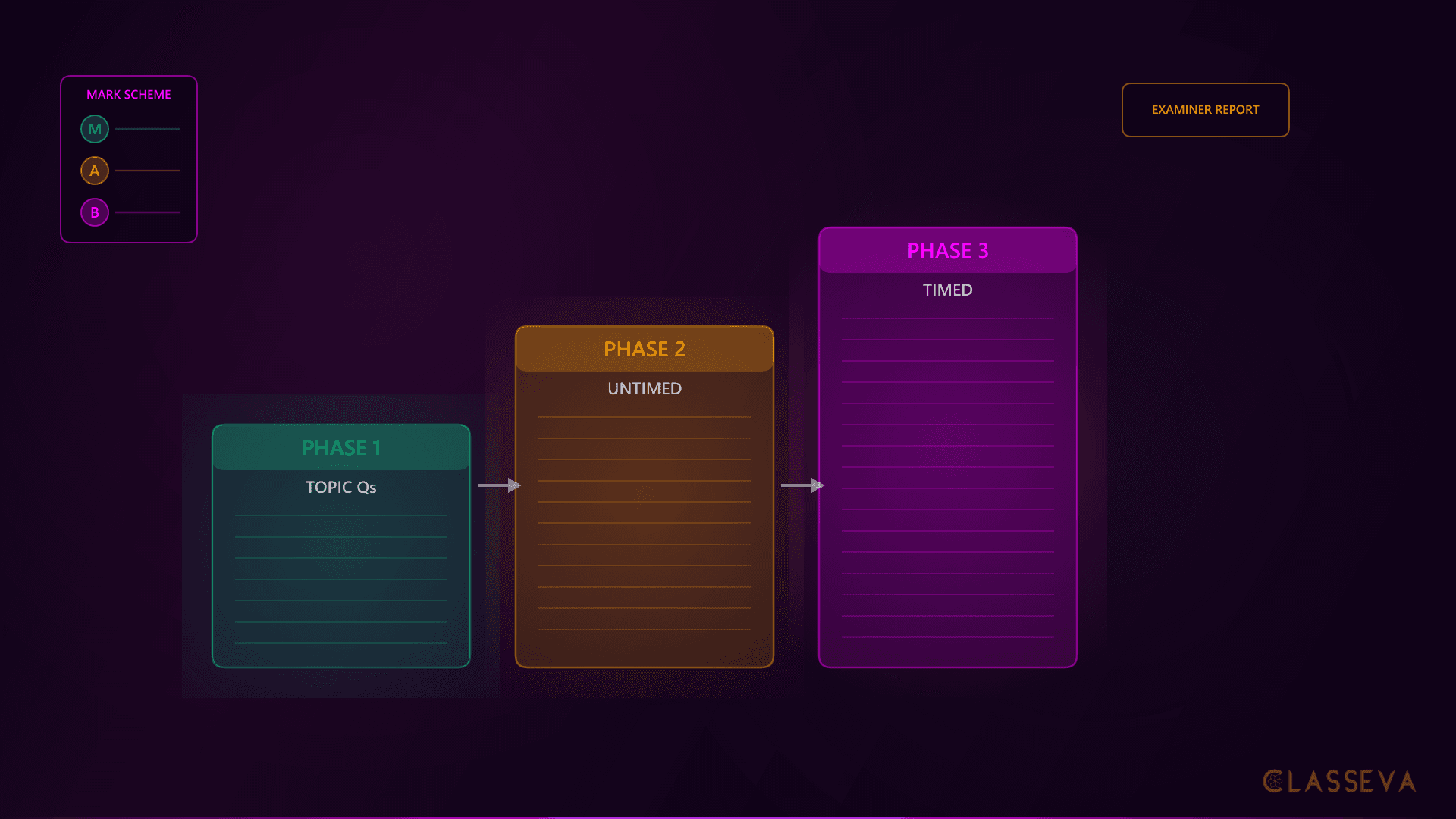
The biggest mistake students make is treating all past paper practice the same. Jumping straight into a timed, full paper in January when you have only revised two out of eight topics is demoralising and teaches very little. Instead, past paper revision technique works best as a progression through three distinct phases.
Phase 1: Topic Questions
In the early stages of revision (typically 8 or more weeks before exams), your child should use past paper questions sorted by topic, not full papers. After revising a topic, they immediately test themselves with past paper questions on that exact topic. This is learning, not testing. The goal is to connect textbook knowledge to how examiners actually ask about it.
Revise one topic
Use notes, textbook, or Classeva to work through the content for a single topic.
Attempt past paper questions on that topic
Use topic-sorted questions from Physics and Maths Tutor or Save My Exams. Do them without notes.
Mark using the official mark scheme
Be honest. If the answer does not contain the required terminology, it does not score.
Note what you got wrong
Write down the specific knowledge gaps or method errors. These become the focus of your next revision session on that topic.
Phase 2: Full Papers Untimed
Once your child has covered most of the specification (around 4 to 6 weeks before exams), move to completing full past papers. At this stage, allow extra time. The focus is on answer quality, not speed. This phase reveals which topics are still weak when encountered in the context of a full exam, rather than in isolation.
If your child scores below 60% on a full untimed paper, that is a signal they need more teaching on specific topics, not just more practice. Repeating papers without understanding the content will not improve scores.
Phase 3: Full Papers Timed
The final 2 to 3 weeks should be dominated by past papers under strict exam conditions: timed to the minute, no notes, no phone, no breaks. This is the most important phase. It trains exam stamina, time management, and the ability to make strategic decisions under pressure (which questions to attempt first, when to move on from a question you are stuck on).
After each timed paper, mark thoroughly using the mark scheme and the examiner report for that paper. Focus on distinguishing between marks lost due to timing (could answer it, ran out of time) and marks lost due to knowledge gaps (did not know the content). These require different fixes: timing issues need practice with pace, while knowledge gaps need targeted revision.
How to Use Mark Schemes Properly
A past paper without its mark scheme is only half useful. The mark scheme is where the real learning happens, because it shows your child exactly what examiners expect. Most students glance at the mark scheme to check their final answer. That misses the point entirely.
Method Marks: Marks for Working
In maths and science A-Levels, a significant proportion of marks are method marks(M marks). These are awarded for showing correct working or using the right approach, even if the final numerical answer is wrong. Many students do not realise this. A student who writes nothing because they cannot get the final answer throws away every method mark on that question. A student who writes their working, identifies the correct formula, and substitutes values correctly might earn 3 out of 5 marks on a question they thought they “got wrong.”
Always show working. In A-Level Maths, a correct final answer with no working can actually score zero markson some questions, because the examiner cannot verify the method was correct. The mark scheme for these questions specifies “M1 for [method], then A1 for [answer].” Without the method, neither mark is awarded.
The Keyword Trap in Written Subjects
In Biology, Chemistry, Psychology, and other written A-Level subjects, mark schemes often require very specific terminology. “The enzyme changed shape” might score zero while “the tertiary structure of the enzyme was altered, changing the shape of the active site” scores full marks. The difference is precision.
After marking a past paper, your child should compare their wording directly against the mark scheme wording. Where did they use vague language that the mark scheme requires to be specific? This habit, built over multiple papers, trains students to write with the precision that earns marks. It is one of the most valuable skills past papers develop, and it is entirely invisible without the mark scheme.
Examiner Reports: The Hidden Advantage
Examiner reports are the most underused free resource in A-Level revision. Published alongside every past paper by every exam board, these documents explain what students commonly got wrong, which questions had the lowest average marks, and what distinguished A* answers from C answers. They are the closest thing to having the examiner sit down and explain the paper to your child.
The most valuable sections of an examiner report are the comments on questions where the average mark was low. These are the questions that separate grade boundaries. If your child can learn to answer these questions well, they gain marks that most students drop.
Complete the past paper
Do the full paper (timed or untimed, depending on your phase).
Mark using the mark scheme
Be honest and precise. Match your wording to the mark scheme exactly.
Read the examiner report for that paper
Focus on questions you got wrong or partially right. What did the examiner say students commonly missed?
Note the patterns
After reading 3 or more examiner reports, you will see recurring themes: common misconceptions, frequently missed terminology, time management advice.
Common Mistakes Students Make with Past Papers
Doing past papers is not automatically effective. How your child uses them matters enormously. These are the mistakes I saw most frequently when working with A-Level students.
| Mistake | Why It Hurts | What to Do Instead |
|---|---|---|
| Saving papers for "later" | Students run out of papers before exams and have no practice material left | Start topic questions from week 1 of revision. Save 2 to 3 full papers for the final timed phase. |
| Doing papers without marking | Completing a paper is only half the exercise. The learning happens during marking. | Mark every paper using the official mark scheme. Review every mistake before moving on. |
| Only doing recent papers | Missing valuable practice. Older papers (within the same spec) are equally useful. | Use all papers from 2017 onwards. Start with older papers and save the most recent for timed practice. |
| Not reviewing mistakes | Repeating the same errors across multiple papers. No learning occurs. | Keep an error log. Record the topic, the mistake, and the correct answer. Review before the next paper. |
| Using predicted papers instead of real ones | Predicted papers may not match actual exam difficulty or question style. | Always prioritise real exam board papers. Use predicted papers as a supplement, not a replacement. |
The five most common mistakes students make when using A-Level past papers.
Exam boards typically publish papers from 2017 onwards for current specifications. That means your child has access to at least 7 years of papers per subject, per board. For a subject like AQA Biology with three papers, that is over 20 individual past papers available for free.
How Parents Can Help
You do not need to understand the content to help your child use past papers effectively. What parents can do is provide structure, encouragement, and practical support.
Practical Support
- •Help your child find and download papers from exam board websites
- •Print papers so they can practise on paper, as in the real exam
- •Set a timer for timed papers and enforce exam conditions (no phone, no breaks)
- •Ask which topics scored lowest and suggest focusing revision there
Knowing When to Escalate
- •Below 60% on untimed papers signals a teaching gap, not a practice gap
- •Consistently losing marks on the same topic means more revision on that topic is needed
- •If your child avoids certain papers or subjects, the avoidance itself signals a problem area
- •The final 2 weeks should be almost entirely past papers under timed conditions
One of the most helpful things you can do is ask specific questions. “How did the past paper go?” is less useful than “Which questions did you lose the most marks on?” or “Did you finish within the time limit?” These targeted questions help your child reflect on their performance in ways that drive improvement.
If your child needs extra support on topics where past papers reveal consistent gaps, AQA's past paper archive is the best starting point for AQA students, offering every paper with its corresponding mark scheme and examiner report. For broader resources and subject-specific revision strategies, our guides on the hardest A-Level subjects and how A-Level grade boundaries work provide useful context for understanding what scores your child should be targeting.
Do not wait until the final term. Help your child access past papers as soon as their teacher has covered enough content to attempt topic-based questions. Starting early means they can work through Phase 1 gradually, leaving time for the critical timed practice in Phase 3.