Active Recall: The Best Revision Technique Explained
If your child revises by re-reading their notes, highlighting textbooks, or copying out information, they are using methods that cognitive science consistently rates among the least effective revision techniques. The single most effective alternative is active recall: testing yourself on material from memory, without looking at your notes.
This is not a new idea. Decades of research point to the same conclusion. Yet most students have never heard of it, and most parents do not know how to help their child use it. During my time working in tutoring, I noticed a consistent pattern: students who tested themselves on material, even briefly, retained far more than those who spent hours passively re-reading the same pages. The difference was not about working harder. It was about working in a way that forces the brain to actually retrieve information.
What Is Active Recall?
Active recall(also called retrieval practice) means attempting to retrieve information from memory without looking at your notes, textbook, or any other source. Instead of reading a definition and thinking “yes, I know that,” you close the book and try to produce the definition from scratch.
The core principle is straightforward: every time your brain successfully retrieves a piece of information, the neural pathway for that memory becomes stronger. The more times you retrieve it, the more durable it becomes. This is why testing yourself is not just a way to check what you know. It is a learning event in itself.
Passive revision (re-reading, highlighting) puts information in front of your eyes. Active recall forces information out of your brain. Exams test the second skill, not the first.
The Testing Effect
The scientific name for this phenomenon is the testing effect. Dunlosky, Rawson, Marsh, Nathan, and Willingham (2013) published the definitive review: “Improving Students' Learning with Effective Learning Techniques” in Psychological Science in the Public Interest. They evaluated ten common study techniques and rated each one as high, moderate, or low utility.
Practice testing (active recall) received the highest possible rating. It was effective across all ages, all subjects, all test formats, and all ability levels. No other single technique matched its consistency.
Roediger and Butler (2011) confirmed that retrieval practice enhances long-term retention more than repeated study of the same material. The effect is not small. Students who tested themselves once on material remembered more one week later than students who studied the same material four times.
Why Re-Reading Doesn’t Work
Re-reading is the most popular revision method among UK students. It feels productive: you sit with your notes, you read through them, the content looks familiar. But that familiarity is precisely the problem. Dunlosky et al. (2013) rated re-reading as low utility, alongside highlighting and summarisation.
The Fluency Illusion
Cognitive psychologists call this the fluency illusion. When you re-read material, it feels familiar because your brain recognises it. You think, “Yes, I know this.” But recognition and recall are fundamentally different cognitive processes.
Recognition means seeing information and thinking it looks right. Recall means producing that information from a blank starting point. In an exam, your child is not asked “Does this answer look correct?” They are asked “Write the answer.” That requires recall, and re-reading does almost nothing to build it.
If your child says “I've revised this loads, I know it all” but struggles when you ask them to explain it without notes, they have fallen into the fluency illusion. The material feels known because it looks familiar, not because it can be retrieved.
Recognition vs Recall
One of the most telling observations from my time in tutoring was this: a student could read through their notes and nod along to every point, but when I turned the page over and asked “Right, tell me the three factors that affect rate of reaction,” they would freeze. The information was in their notes. It was not yet in their memory.
Re-Reading (Passive)
- •Eyes pass over information
- •Brain recognises content as familiar
- •Creates illusion of knowledge
- •Rated LOW utility (Dunlosky, 2013)
- •Comfortable and easy
Active Recall (Active)
- •Brain retrieves information from scratch
- •Each retrieval strengthens the memory
- •Reveals genuine gaps in knowledge
- •Rated HIGH utility (Dunlosky, 2013)
- •Challenging and effortful
| Revision Technique | Utility Rating | Why |
|---|---|---|
| Active recall (practice testing) | HIGH | Forces retrieval, strengthens memory with each attempt |
| Spaced repetition | HIGH | Optimal timing between review sessions |
| Interleaved practice | Moderate | Mixing topic types improves discrimination |
| Re-reading | LOW | Creates familiarity, not recall ability |
| Highlighting | LOW | Passive; no retrieval involved |
| Summarisation | LOW | Moderate effort but no retrieval practice |
Source: Dunlosky et al. (2013), Psychological Science in the Public Interest
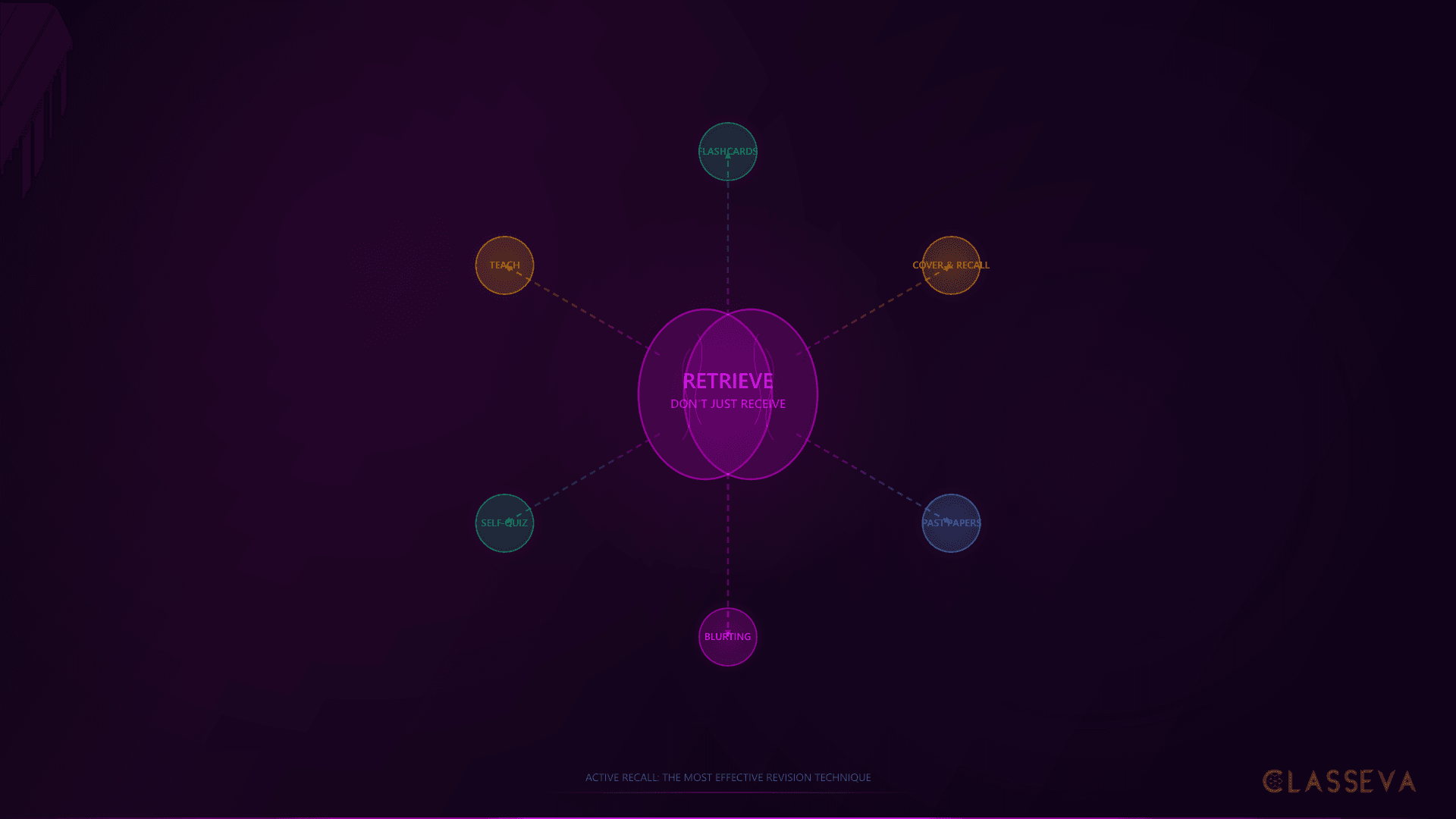
Six Active Recall Methods Your Child Can Use Today
The beauty of the active recall revision technique is its simplicity. Your child does not need expensive resources or special equipment. Every method below works with materials they already have. The critical ingredient is the same in each case: attempt to retrieve before checking.
1. Flashcards
Write a question on one side, the answer on the other. The key rule: read the question and attempt to recall the answer before flipping. If your child flips immediately and reads both sides, it becomes passive re-reading with extra steps.
Physical flashcards work well. Digital apps like Anki or Quizlet add the bonus of built-in spaced repetition algorithms that schedule cards at optimal intervals. For GCSE and A-Level students, Anki is particularly powerful because you can create custom decks for each exam board specification topic.
Encourage your child to write flashcards in their own words, not copied from textbooks. The act of rephrasing forces them to process the information, which itself is a form of elaboration that strengthens the initial memory.
2. Cover and Recall
This is the simplest active recall method and requires nothing except notes and a blank piece of paper. Read a section of notes. Close the book. Write down everything you can remember. Then check what you missed. Focus the next session on the gaps.
Cover-and-recall works for every subject, from GCSE biology cell structures to A-Level history essay plans. It takes no preparation and can be done in short bursts of 10 to 15 minutes.
3. Past Papers
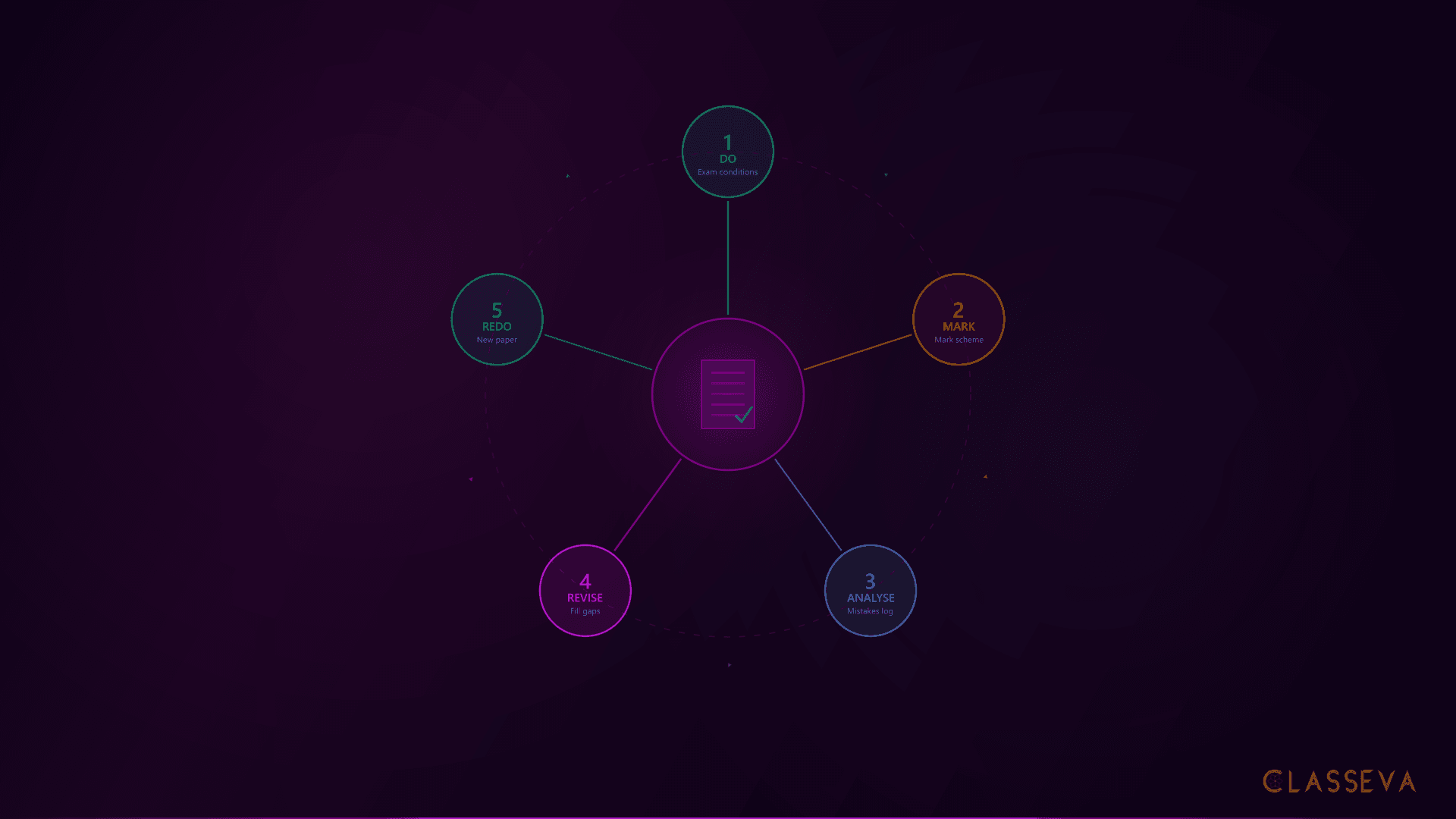
Past exam papers are the ultimate active recall tool because they combine retrieval practice with exam-format familiarity. Do them under timed conditions, from memory, without notes. Mark your answers against the mark scheme. Identify the gaps. Revise the gaps. Repeat.
For GCSE and A-Level students, past papers are free from the exam board websites: AQA, Edexcel (Pearson), and OCR all publish papers and mark schemes. If your child has not yet used a single past paper, this is where to start.
Past papers without mark schemes are only half the exercise. Mark schemes reveal exactly what examiners award marks for. Students who study mark schemes alongside past papers develop a much better sense of how to structure answers for maximum marks.
4. Blurting
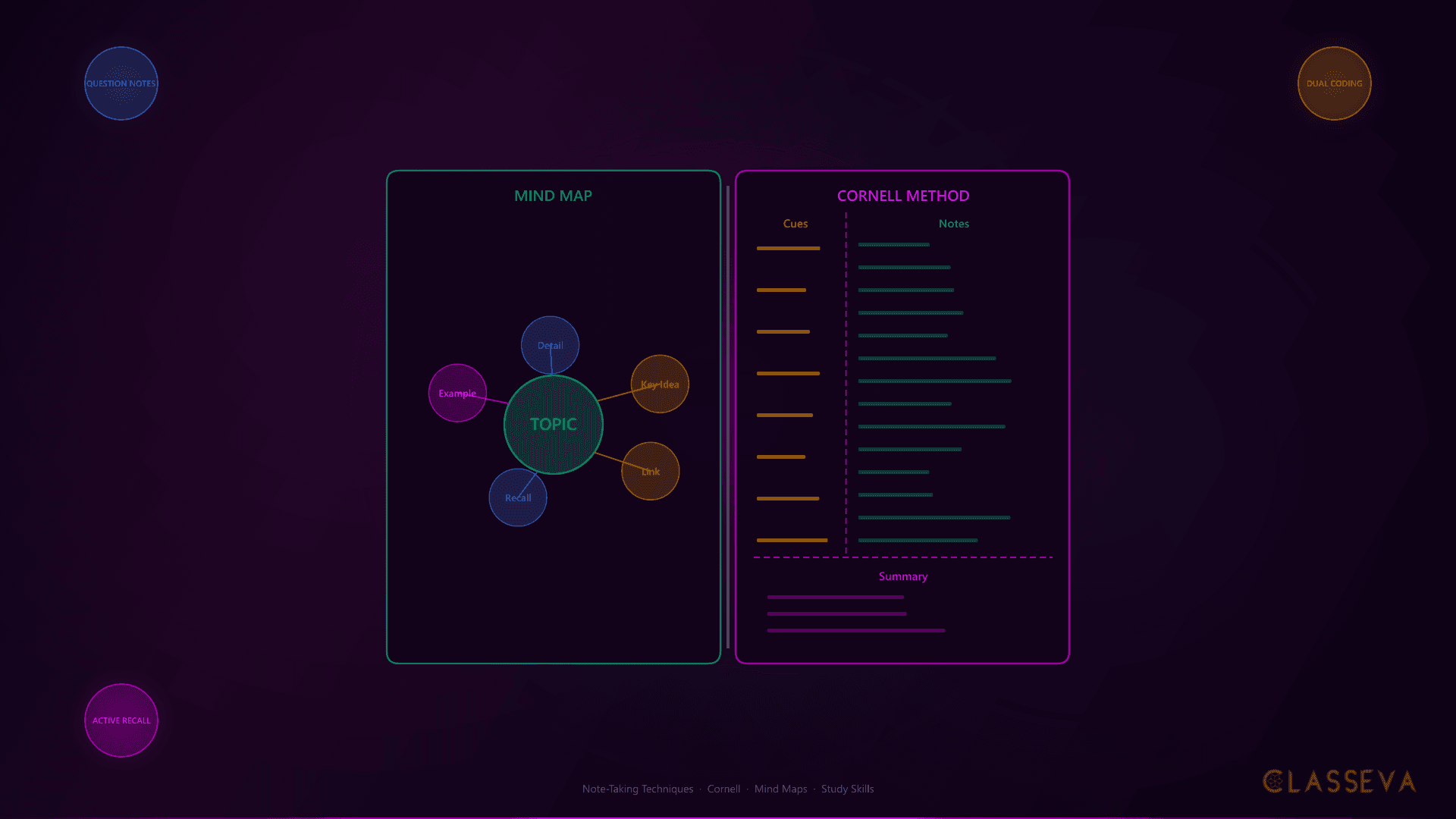
Write a topic in the centre of a blank page. Write down everything you can remember about that topic. No notes allowed. When you run out, check against your textbook or notes. Fill in the gaps using a different colour pen. Repeat after a few days and compare how much more you remember.
Blurting is popular with GCSE students because it is visual, fast, and immediately shows progress. The different colour pen makes gaps obvious at a glance.
5. Self-Quizzing
After studying a topic, close your notes and ask yourself questions: “What are the three causes of X?” “How does Y process work?” “What is the formula for Z?” If you cannot answer, that is the signal to study that specific point again.
Self-quizzing can happen anywhere. In the car. Before bed. Walking to school. It requires zero materials and takes seconds per question. The moment your child finishes reading about a topic, three quick self-quiz questions will do more for retention than reading the same page twice.
6. Teach Someone
Explaining a topic to another person forces you to retrieve and organise the information in a coherent way. If you can explain it simply, you understand it. If you get stuck, you have found a gap. The “someone” can be a parent, a sibling, a friend, or even an imaginary audience.
Research shows that people learn material better when they expect to teach it to others. Even the intention to teach changes how the brain encodes information, leading to better organisation and deeper understanding.
Why Active Recall Feels Harder (and Why That’s the Point)
The most common objection students have to active recall is that it feels difficult. Trying to remember something and failing is uncomfortable. Re-reading, by contrast, feels smooth and productive. This is exactly why most students default to re-reading and why parents need to understand the distinction.
The cognitive psychologist Robert Bjork coined the term “desirable difficulty” to describe this phenomenon. Learning that feels challenging is actually more effective in the long run. The effort of retrieval is what strengthens the memory. Easy revision creates weak memories. Challenging revision creates durable ones.
If your child says “I can't remember anything,” that is not a sign of failure. It is a sign that real learning is about to happen. The struggle to retrieve is the mechanism that builds stronger memories. Encourage them to keep trying before looking at the answer.
This is why I consistently saw students who used active recall outperform those who put in more hours with passive methods. A student spending 30 minutes testing themselves on flashcards would retain more than a student who spent two hours reading through the same notes. The method matters far more than the time spent.
How Parents Can Help at Home
You do not need to be an expert in your child's subjects to support effective revision. The most important thing parents can do is understand why active recall works and help create an environment where your child uses it consistently. One thing parents told me repeatedly during my time in tutoring was that they felt helpless because the curriculum had changed so much since their own school days. The good news is that active recall does not require you to know the content. You just need to know the method.
Six Ways to Support Active Recall
Explain the concept simply
Tell your child: "Testing yourself is the most effective way to revise. More effective than reading notes. The science is clear on this." Understanding why changes motivation.
Quiz your child regularly
At dinner, in the car, before bed. Quick questions on what they have been studying. "What did you learn about in biology today? Tell me three things." This is active recall in disguise.
Encourage flashcard creation
Help them make physical flashcards or set up digital decks. The act of creating flashcards is itself a form of active processing. Offer to test them using the cards.
Reframe the struggle
If your child says "I can't remember anything," respond with "That's exactly where the learning happens. The struggle is the point." This reframe is genuinely important and backed by research on desirable difficulty.
Redirect passive habits
If you see your child reading notes with a highlighter, gently suggest they try covering the page and recalling instead. Not as criticism, but as a more effective alternative.
Model it yourself
If you are learning something new, show your child how you test yourself. Children learn methods by seeing them used, not just by being told about them.
The simplest active recall intervention any parent can do: at dinner, ask your child to tell you one thing they learned today in each subject. If they can explain it clearly, they've just practised retrieval. If they struggle, they've identified what to revise next. Either way, it takes two minutes and costs nothing.
Combining Active Recall with Other Techniques
Active recall is powerful on its own, but it becomes even more effective when combined with complementary techniques. The Dunlosky et al. (2013) review rated two techniques as high utility: practice testing (active recall) and distributed practice (spaced repetition). Together, they address how to revise and when to revise.
The Revision Power Stack
| Combination | How It Works | Best For |
|---|---|---|
| Active recall + spaced repetition | Test yourself at increasing intervals (Day 1, Day 3, Day 7, Day 14) | Long-term retention of facts, definitions, and processes |
| Active recall + past papers | Full papers under timed conditions, marked against mark schemes | Direct exam preparation and time management |
| Active recall + flashcards + Anki | Digital flashcards with built-in spacing algorithms | Large volumes of content (vocabulary, science terms, dates) |
| Active recall + blurting + different colour pen | Brain dump, check, fill gaps, repeat after 3 days | Visual learners and essay-based subjects |
Combining active recall with other evidence-based methods creates a complete revision system
For GCSE and A-Level students, the ideal revision session combines several of these elements. A strong 45-minute session might look like this: five minutes of flashcard self-testing on previous topics, fifteen minutes working through interleaved practice questions from memory, ten minutes marking and identifying gaps, ten minutes of blurting on the weakest topic, and five minutes scheduling the next spaced review. That single session uses more active recall than many students use in an entire week of passive re-reading.
If your child is preparing for GCSEs, our GCSE revision techniques guide covers the full range of evidence-based methods, and our best revision resources for 2026 lists the tools that support these techniques. For A-Level students, the A-Level revision resources guide covers the same ground at a more advanced level.
If your child learns one revision method from this article, make it cover-and-recall. It requires zero preparation, works with any subject, and can be done in ten minutes. Read a section. Close the book. Write everything you remember. Check. That is active recall in its simplest form, and it is more effective than hours of re-reading.
Active recall is not a secret. The research has been publicly available for decades. The gap is not in the science; it is in awareness. Most students have never been explicitly taught how to revise effectively. Most parents do not know that the methods their children default to are among the least effective options. Now you know. The next step is putting it into practice, one retrieval attempt at a time.