Best A-Level Revision Resources 2026: Free and Paid
One of the most common questions parents asked when I worked in tutoring was not about revision techniques or timetables. It was simpler than that: “What should my child actually be using?” They knew the textbook was not enough. They could see their child was spending hours online. But they had no idea whether those hours were productive or wasted.
This guide is the answer. We have tested, compared, and ranked the best A-Level revision resources available in 2026, both free and paid, so you can steer your child towards the tools that genuinely help and away from those that do not.
The Only Resource Rule That Matters
Before we list any websites or apps, there is one principle that should guide every decision about A-Level revision tools 2026: the resource must match your child's exam board and specification. A beautifully designed Chemistry revision site that covers AQA content is actively harmful if your child sits Edexcel, because the topic order, depth, and emphasis differ between boards.
This sounds obvious, but having spoken to hundreds of parents, I know it is not. Many students revise from whichever resource appears first on Google without checking the exam board. They spend hours learning content that will never appear on their paper, or miss content that will.
Past Papers First, Everything Else Second
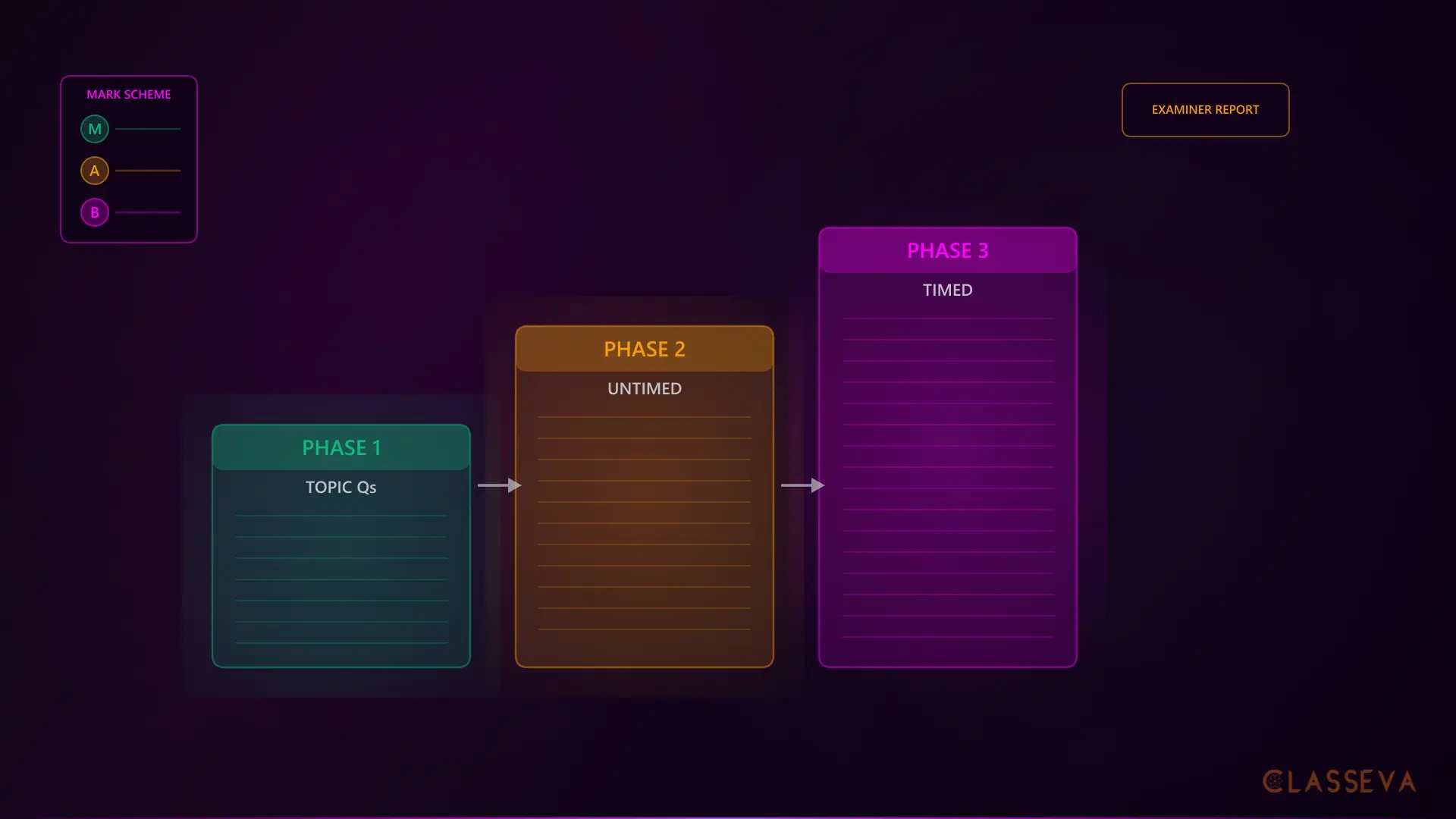
If your child uses only one revision resource, it should be past papers with mark schemes. Research from Dunlosky et al. (2013) identified retrieval practice (testing yourself from memory) as one of the most effective study techniques, and past papers are retrieval practice in its purest form. They test exactly the skills and knowledge the examiner will assess, in exactly the format the exam uses.
AQA, Edexcel (Pearson), and OCR all publish past papers, mark schemes, and examiner reports on their websites at no cost. This is the most valuable free revision material available, and most families do not know it exists. Bookmark your child's exam board page now.
Examiner Reports: The Overlooked Advantage
Examiner reports are published alongside past papers and mark schemes, yet almost nobody reads them. These documents explain, in the examiner's own words, exactly what students got wrong, what common mistakes were made, and what the best answers looked like. They are essentially a cheat sheet for understanding what the examiner wants.
When I saw students use examiner reports alongside past papers, the improvement was noticeable within weeks. Instead of just knowing what the right answer was, they understood why their answer did not earn full marks and how to restructure their responses. For essay-based subjects like English, History, and Psychology, examiner reports are arguably more valuable than the mark scheme itself.
Free A-Level Revision Resources
The good news for parents: the best free A-Level revision resources are genuinely excellent. Your child can build an effective revision toolkit without spending anything. Here are the platforms that consistently deliver results.
Physics and Maths Tutor
Physics and Maths Tutor is the single most widely used A-Level revision website in the UK, and for good reason. Despite the name, it covers far more than physics and maths: Biology, Chemistry, Economics, Business, Geography, Psychology, and Computer Science all have extensive resources. For each subject, you get past papers sorted by topic (so your child can drill specific weak areas), revision notes, summary sheets, flashcards, and video explanations across all major exam boards.
The topic-sorted past papers are particularly valuable. Rather than working through an entire past paper, your child can select “Organic Chemistry” or “Differentiation” and practise only the questions relevant to the topic they are revising. This turns a two-hour past paper into 20 minutes of focused retrieval practice.
Seneca Learning
Seneca Learning takes a different approach. Instead of static notes, it uses AI-powered spaced repetition to create personalised revision paths. The platform identifies what your child knows and does not know, then adjusts the difficulty and frequency of questions accordingly. It is particularly strong for Biology, Chemistry, Physics, Psychology, and Business.
The free version is comprehensive enough for most students. The premium tier (around five pounds per month) adds exam-style questions with model answers and detailed progress tracking that parents can view. If your child responds well to gamified, app-based revision, Seneca is the best free option available.
Isaac Physics and Isaac Computer Science
Created by the University of Cambridge, Isaac Physics and Isaac Computer Science offer high-quality practice questions that go beyond standard exam prep. These platforms are designed to develop deep understanding, not just exam technique. The questions are harder than typical A-Level questions, which makes them excellent for students targeting A* grades or preparing for university admissions tests like the PAT (Physics) or TMUA (Computer Science).
The Advanced Mathematics Support Programmeoffers free online resources and live classes for A-Level Maths and Further Maths. This is particularly valuable if your child's school has limited maths teaching capacity, or if they are the only Further Maths student and need external support.
YouTube Channels Worth Following
| Channel | Best For | Style |
|---|---|---|
| TLMaths | A-Level Maths (all boards) | Comprehensive video library covering every topic |
| Cognito | Sciences (Biology, Chemistry, Physics) | Short, clear explanation videos with diagrams |
| Primrose Kitten | Predicted papers and walkthroughs | Full paper walkthroughs with exam technique tips |
| Economics Help | A-Level Economics | Clear concept explanations with real-world examples |
All channels are free. Quality varies by topic, so encourage your child to sample before committing to a full video series.
YouTube is powerful but risky. The algorithm optimises for watch time, not learning. A student who opens YouTube to watch a 10-minute Maths video can easily lose an hour to unrelated content. If your child uses YouTube for revision, consider having them save specific videos to a playlist in advance, rather than searching live during revision sessions.
Freemium Resources Worth Upgrading
Some platforms offer a solid free tier with a paid upgrade that adds genuine value. These are the best A-Level revision apps and platforms where the premium version is actually worth considering.
Save My Exams
Save My Exams is the strongest freemium revision platform for A-Levels. It provides exam-board-specific revision notes, topic questions with model answers, and past paper resources across AQA, Edexcel, and OCR. The key differentiator is how tightly the content maps to each specification: every note page tells your child exactly which part of the specification it covers.
Save My Exams: Free Tier
- •Revision notes for most topics across most subjects
- •Some topic questions with answers
- •Past paper index and links
- •Exam board filtering (AQA, Edexcel, OCR)
Save My Exams: Paid Tier (~£5/month)
- •Full revision notes with deeper explanations
- •All topic questions with detailed model answers
- •Exam-style questions with examiner commentary
- •Progress tracking and topic completion checklists
My recommendation: start with the free tier and let your child use it for a week. If they find the style helpful and want access to model answers, the paid tier is good value. At around five pounds per month, it costs less than a single hour of private tutoring and provides far more content.
AI Tutoring Platforms
AI tutoring has matured significantly. Platforms like Classeva use AI to provide personalised, step-by-step help that follows your child's exact exam board specification. Unlike generic AI chatbots, dedicated tutoring platforms are grounded in curriculum data, which means they cannot go off-topic or teach irrelevant content.
AI tutoring is particularly effective for Maths and Science, where step-by-step worked solutions matter. Your child can ask “Show me how to differentiate using the chain rule” at 9pm on a Sunday and get an accurate, curriculum-aligned explanation immediately. That kind of on-demand support simply was not available five years ago.
AI tutoring is not a replacement for every situation. For complex essay subjects, extended writing feedback, and motivation during difficult periods, a skilled human tutor still has advantages. But for targeted question practice, worked examples, and specification-aligned content review, AI tutoring delivers equivalent quality at a fraction of the cost. See our guide on choosing A-Level subjects for more on matching resources to subjects.
Paid Resources: When to Spend
Free resources cover 80% of what your child needs. The remaining 20% is where strategic spending can make a difference. The key word is strategic: spending money on revision resources is only worthwhile when it solves a specific problem that free resources cannot.
Revision Guides and Textbooks
CGP revision guides (five to fifteen pounds each) remain the most popular physical revision resource in the UK, and with good reason. They are concise, well-structured, and exam-board-specific. Each guide condenses the specification into clear sections with practice questions and worked examples. For students who prefer reading from a physical book rather than a screen, CGP is the gold standard.
Oxford and Pearson also publish solid revision guides. The choice between them is largely a matter of preference: CGP uses a more informal, sometimes humorous tone; Oxford and Pearson are more formal. All three are accurate and specification-aligned. Buy the guide that matches your child's exam board, not the one with the best reviews on Amazon (reviews rarely specify the board).
Private Tutoring
Private tutoring costs between 25 and 80 pounds per hour, depending on the tutor's experience and the subject. Having worked in the tutoring industry, I can tell you the most effective use of tutoring is targeted, short-term blocks: 10 sessions specifically on organic chemistry mechanisms, or 6 sessions on exam technique for A-Level History essays. This focused approach addresses a known weakness and has a clear endpoint.
The least effective use is open-ended weekly sessions with no clear goal. I saw students tutored for months with no measurable improvement, because the sessions became homework help rather than strategic exam preparation. If you do invest in a tutor, insist on a specific plan: what topics will they cover, what measurable progress should you expect, and when will the sessions end?
What Is Not Worth Paying For
Generic “revision packs” from social media sellers are almost always repackaged free content with attractive branding. The same notes are available on Physics and Maths Tutor for free.
Expensive all-in-one platforms that charge 20 to 30 pounds per month rarely offer content that justifies the price over free alternatives. If the platform does not specify exactly which exam board and specification its content covers, it is not worth your money.
Any resource that promises guaranteed grades. No resource can guarantee an A or A*. Results depend on how your child uses the resource, not which resource they buy.
Best Resources by Subject
Different subjects benefit from different types of resources. Here is a quick-reference guide to the best A-Level revision resources for the most popular subjects. Each recommendation assumes your child already has access to past papers and mark schemes from their exam board.
Notice that past papers appear as the active recall tool for most subjects. This is not laziness; it is the evidence. For any subject with an exam component, practising under exam conditions is the most effective form of revision. Everything else supports that core activity.
For more on evidence-based revision strategies that work alongside these resources, see our guide to revision techniques that actually work. The principles apply equally at A-Level. If your child is taking A-Level Maths, the topic-sorted questions on Physics and Maths Tutor are particularly valuable for building fluency in weaker areas.
How to Build a Revision Toolkit
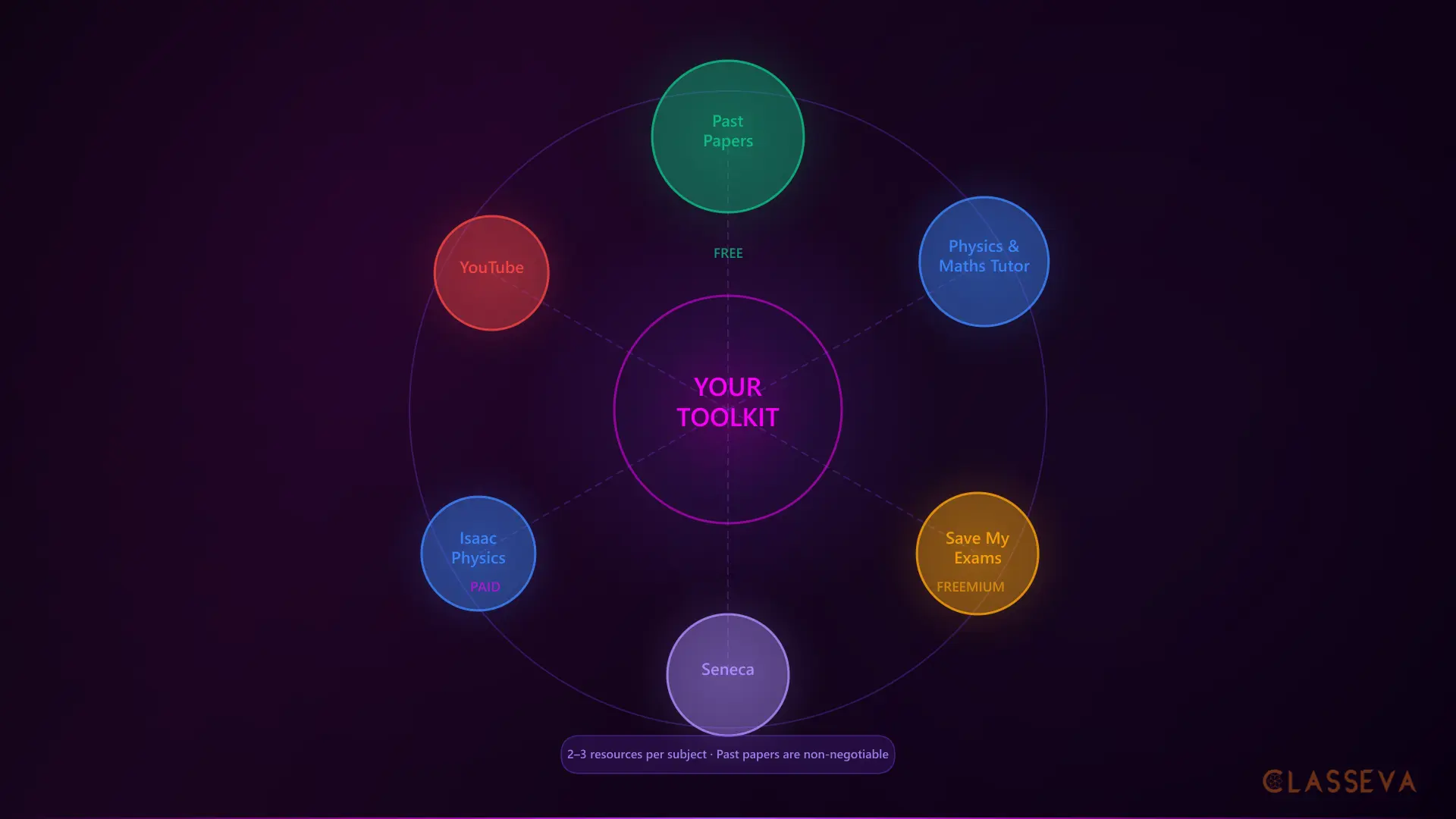
The biggest mistake students make with revision resources is using too many. Ten different websites, four apps, and a stack of unused revision guides does not mean effective revision. It means 80% of the time is spent deciding where to look and 20% is spent actually learning. Here is how to build a focused toolkit.
Start with past papers and mark schemes
Download these from your child's exam board website (AQA, Edexcel, or OCR). These are free and non-negotiable. Every other resource is supplementary to this.
Add one notes or question bank
Physics and Maths Tutor for Maths, Sciences, Economics, or Business. Save My Exams for Biology or Chemistry with exam-board-specific notes. Pick one per subject, not both.
Add one active recall tool
Seneca Learning for AI-driven spaced repetition, or Anki for custom flashcard decks. Active recall tools are most valuable for content-heavy subjects like Biology and Psychology where there is a large volume of facts to memorise.
Consider one paid resource if needed
A CGP revision guide for subjects where your child wants a physical reference book. Or 10 targeted tutoring sessions if there is a specific gap that free resources have not closed. Do not pay for general ongoing support when free platforms cover the same ground.
Delete everything else
If your child has bookmarked eight different websites for Biology, help them choose the best two and remove the rest. Revision time should be spent revising, not browsing.
Two to three resources per subject is the sweet spot. One for notes and content review, one for practice questions and past papers, and optionally one for active recall. This is true whether your child is taking A-Level Maths or English Literature. More than three resources per subject leads to fragmented revision and wasted time.
The resources listed here are a starting point. The best revision toolkit is the one your child actually uses consistently. A mediocre resource used every day will produce better results than a perfect resource opened once and forgotten. Encourage your child to try the free options first, settle on what works for them, and then commit to it.
For our curated list of GCSE-level resources, see the best GCSE revision resources for 2026.