A-Level Resits 2026: Rules, Dates, and Options
A-Level resits exist for a reason: not every student gets the grades they need on the first attempt. Whether your child missed a university offer by one grade, had a genuinely bad exam day, or simply was not ready in Year 13, resitting is a legitimate option. But it comes with rules that catch many families off guard.
From my experience in the tutoring industry, the families who struggled most with A-Level resits were the ones who made snap decisions on results day. The parents who took a week, weighed the alternatives, and understood the full 12-month commitment were far more likely to see the resit succeed. This guide gives you everything you need to make that decision clearly.
The Core Rules for A-Level Resits
The resit system for A-Levels is fundamentally different from GCSEs. At GCSE level, English and Maths have a dedicated November resit window. A-Levels have no equivalent. Understanding these three rules up front prevents the most common planning mistakes.
Summer Only, No Exceptions
A-Level exams are only offered in the May to June summer series. There is no November, January, or March sitting. If your child receives results in August 2026 and decides to resit, the next available exam window is May to June 2027. That is a minimum nine-month wait, and realistically a full academic year of preparation.
This is the single biggest difference from GCSEs, where Maths and English can be resat in November. Parents who are familiar with the GCSE resit process often assume A-Levels work the same way. They do not.
You Resit Every Paper
A-Levels are linear qualifications. This means the final grade is based on all papers sat together at the end of the course. There is no modular system where you can bank a good Paper 1 result and only retake Paper 2. When your child resits, they sit every paper from scratch, and the resit grade is based entirely on those new results.
If your child takes three papers for A-Level History (as with AQA), they must resit all three. Even if they scored well on Paper 1 and Paper 2 but underperformed on Paper 3, they cannot selectively retake. The resit grade replaces nothing; it stands as a separate, complete attempt.
Both Grades Stay on Record
Unlike some qualifications where a new result overwrites the old one, both A-Level grades appear on the certificate. A university admissions team or employer can see that your child sat the subject twice. In practice, most institutions look at the best grade, but transparency is built into the system.
GCSE Resits
- •November window available for English and Maths
- •Most recent grade replaces previous on certificate
- •Compulsory resit if below grade 4 (condition of funding)
- •College builds resit into timetable automatically
A-Level Resits
- •Summer series only (May to June)
- •Both grades remain visible on certificate
- •Entirely voluntary; no compulsory requirement
- •Student must arrange their own study and exam entry
The 12-Month Resit Timeline
One of the most important things to understand about A-Level resits is the time commitment. This is not a quick fix. Here is what a typical resit year looks like for a student receiving results in August 2026.
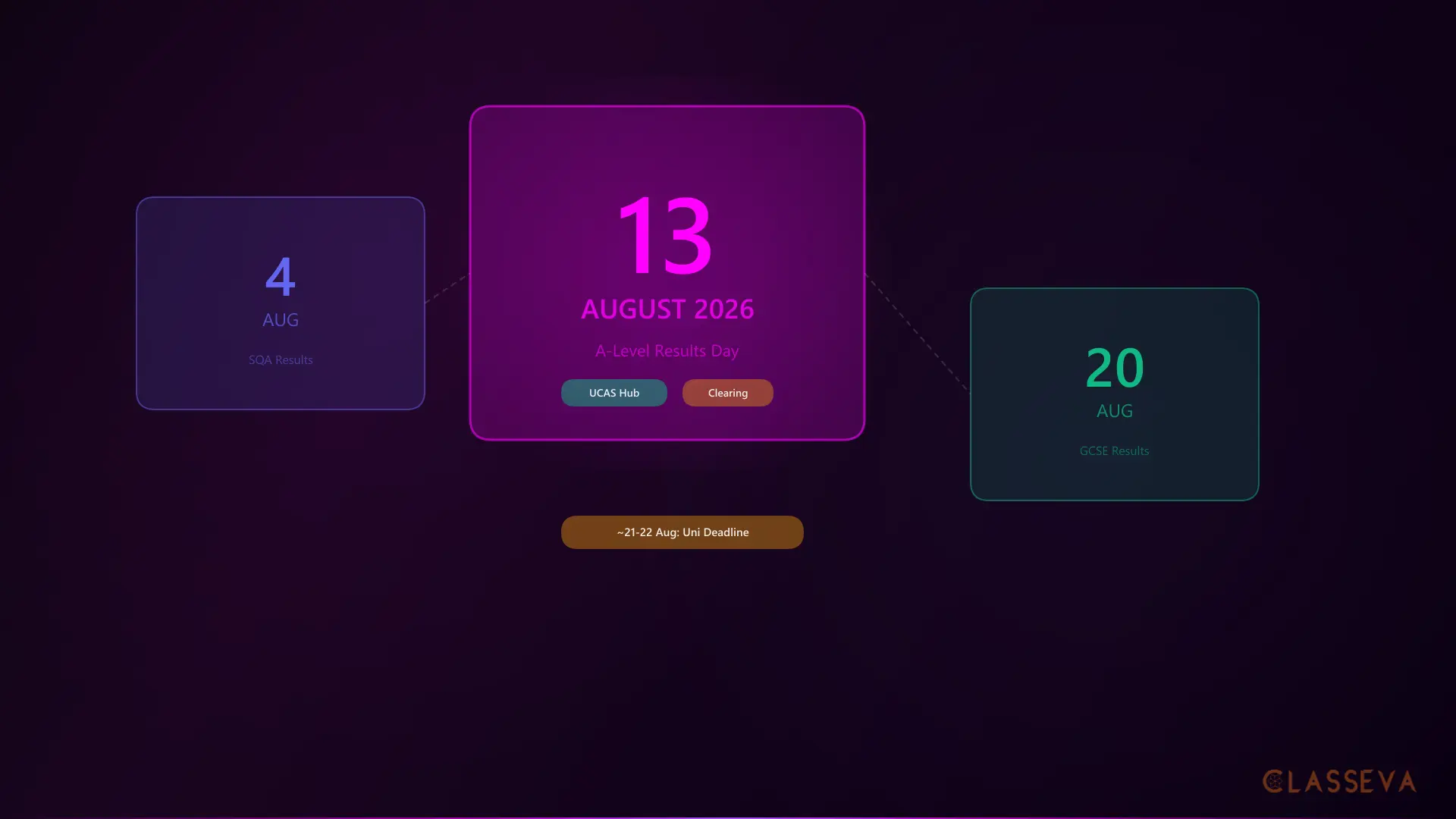
August 2026: Results Day
Your child receives their original A-Level results. Take at least a week before deciding whether to resit. Explore Clearing and other alternatives first.
September 2026: Enrol for resit
Register at a school, sixth form college, or independent exam centre. Entry deadlines vary but are typically between October and February.
September 2026 to May 2027: Revise
Seven to nine months of focused preparation. Self-study is possible but challenging without structured support.
May to June 2027: Sit the exams
Resit all papers for the subject. The exam is identical to what other Year 13 students are sitting that year.
August 2027: New results
Receive resit grades. If meeting the offer, begin university in September 2027.
Where to Resit A-Levels
Unlike GCSE resits, which are usually managed by the student's college or sixth form, A-Level resit options require more initiative from the family. There are two main routes.
Schools and Colleges
Some sixth form colleges accept resit students for a one-year intensive programme. This gives your child structured timetabling, access to teachers, and a peer group. If your child is under 19 at the start of the academic year, tuition is usually free at a state-funded institution. Ask the college directly whether they run a dedicated resit programme or integrate resitters into existing Year 13 classes.
Returning to their original school is sometimes possible, but not guaranteed. Many schools are reluctant to accommodate returning students due to timetabling constraints and limited space.
Independent Exam Centres
Private exam centres register candidates for exams without providing teaching. Your child self-studies (using textbooks, online resources, or a private tutor) and simply turns up to the centre on exam day. This is the most flexible option but also the most demanding, because the student is responsible for all their own preparation.
Each exam board maintains a list of approved centres. Search for “private candidate” on the AQA centre finderor contact the exam board your child's school originally used. Registration typically opens in September and closes between January and March, depending on the board and subject.
College (Structured)
- •Timetabled lessons with qualified teachers
- •Free for under-19s at state colleges
- •Peer group and social support
- •College handles exam registration
Independent Centre (Self-Study)
- •Maximum flexibility on study schedule
- •Exam entry fees only (£150 to £300)
- •Student arranges all their own revision
- •No teaching or pastoral support included
How Much Does an A-Level Resit Cost?
Cost depends entirely on which route your child takes. Here is a realistic breakdown.
| Cost Item | Typical Range | Notes |
|---|---|---|
| Exam entry fees | £150 – £300 per subject | Roughly £50 – £100 per paper; A-Levels typically have 2 to 3 papers |
| College tuition | Free (under 19) or £500+ (19+) | State colleges receive funding for under-19 students |
| Independent centre admin | £50 – £150 per subject | On top of exam entry fees |
| Private tutoring | £25 – £80 per hour | Optional; costs vary by subject and tutor experience |
| Textbooks and resources | £0 – £50 | Most students reuse materials from their first sitting |
Indicative costs for A-Level resits in 2026/27. Exam fees vary by board and subject.
How Universities View A-Level Resits
This is the question that worries parents most: will universities accept resit grades? The short answer is yes, most will. UCAS applications show all exam sittings, so universities can see both the original and resit results. The majority of institutions treat the best grade as the one that counts.
If your child is resitting to meet a conditional offer, contact the university's admissions office immediately after results day. Many universities will hold a deferred place conditional on the resit grade. Do not assume they will do this automatically; proactive communication is essential.
Competitive Courses and Oxbridge
Medicine, Dentistry, Veterinary Science, and many Oxbridge courses explicitly state a preference for first-sitting results in their admissions policies. This does not mean resitters are automatically rejected, but it does mean your child will need a strong personal statement and a clear explanation for why results improved. Extenuating circumstances (illness, bereavement, safeguarding issues) carry real weight in these decisions.
If your child is aiming for one of these courses, check the specific university's admissions page before committing to a resit. Some medical schools accept resitters; others do not. This varies by institution, and it changes year to year.
Five Alternatives to Resitting
Resitting is not the only path forward. For many students, one of these alternatives is faster, less stressful, or a better fit for their goals. Before committing to a resit year, consider every option.
1. UCAS Clearing
UCAS Clearing opens on results day and allows students to apply directly to courses with available places. Your child starts university in September, with no gap year. The trade-off is flexibility: they may not get their first-choice course or university, but they avoid a 12-month delay entirely.
Clearing has changed dramatically in recent years. It is no longer a last resort; many excellent courses at strong universities have Clearing vacancies. In 2025, over 36,000 students found university places through Clearing.
2. Foundation Years
Many universities offer a foundation year (sometimes called Year 0) that leads directly into the full degree. Foundation years typically have lower entry requirements than direct entry and are specifically designed for students whose A-Level grades do not meet the standard offer. Your child starts university on time and graduates one year later than the standard route.
Russell Group universities including Sheffield, Leeds, Liverpool, and Newcastle all offer foundation year programmes. These are not remedial courses. They teach degree-level introductory content and prepare students for the rigour of their chosen subject. Check UCAS for foundation year availability in Clearing.
3. Apprenticeships, Access Courses, and Gap Years
Degree apprenticeships combine paid employment with a university degree. They typically do not require specific A-Level grades and are available in engineering, technology, accounting, healthcare, and many other fields. Your child earns a salary from day one while studying part-time.
Access to Higher Education diplomas are one-year courses designed for adults returning to education. They are widely accepted for university entry and can be a strong alternative for students who want a fresh start with a different qualification format.
A productive gap year combined with a resit is also common. Your child could work, volunteer, or travel while preparing for the exams. The risk is that without structure, revision can slip. If choosing this route, establish a clear study plan before the gap year begins.
Remarks Before Resits
Before committing to a resit, check whether a remark(officially called a “review of marking”) could raise the grade without requiring a full year of preparation. Remarks cost between £10 and £50 per unit and are processed within approximately 20 days of the request.
A remark is most likely to succeed when your child's mark is close to a grade boundary. Schools receive detailed mark breakdowns on results day and can advise whether a remark is worth pursuing. If a remark changes the grade, the fee is refunded.
If your child has a conditional university offer that depends on the grade in question, request a priority remark through the school. Priority results typically arrive within 15 days, in time for deferred Clearing decisions. The school must submit the request; individual students cannot apply directly to the exam board.
| Option | Cost | Timeline | Best For |
|---|---|---|---|
| Remark (priority) | £10 – £50 per unit | ~15 days | Near a grade boundary with a uni offer at stake |
| Remark (standard) | £10 – £50 per unit | ~20 days | Near a grade boundary, no urgent deadline |
| Full resit | £150 – £300 per subject | 12 months | Significantly below target, needs more preparation |
Always check whether a remark could resolve the grade gap before committing to a full resit.
How to Decide Whether to Resit
The worst time to decide is results day itself. Emotions are high, information is incomplete, and the pressure to act immediately can lead to poor decisions. Here is a framework that helps.
Wait at least a week
Do not commit to a resit on results day. Explore Clearing, check foundation year availability, and let the initial shock settle.
Be honest about why grades were low
If the problem was insufficient revision, a resit will only help if your child commits to a fundamentally different approach. If it was a bad exam day or extenuating circumstances, a resit has a stronger chance of yielding a different result.
Check the university position
Contact the admissions office directly. Ask whether they will defer the offer conditional on resit grades. Get this in writing before planning a resit year.
Assess the alternatives
Is Clearing an option? Would a foundation year achieve the same outcome faster? Is the specific university genuinely non-negotiable, or has it become an emotional anchor?
Plan the study structure
Self-studying for a full year is extremely demanding. If your child does not have a realistic plan for structured revision, including access to teaching or tutoring, the resit may not improve results.
The Mental Health Dimension
This is something I noticed repeatedly during my time in the tutoring industry: resitting can be isolating. Friends move on to university or jobs while your child stays behind, preparing for exams they have already sat once. The academic challenge is manageable; the emotional one is often harder.
Make sure your child has a support network during the resit year. This might be a college peer group, a part-time job with social contact, a sports team, or regular time with friends. A resit year spent entirely alone in a bedroom revising is a recipe for burnout, not better grades.
Before committing, ask your child directly: “If we go through this again, what will you do differently?” If they cannot answer that clearly, a resit is unlikely to produce a meaningfully different result. The technique, not just the time, needs to change. Consider structured tutoring support to fill the specific gaps that led to the original result.
A-Level resits are a genuine second chance, not a consolation prize. But they require a full year of commitment, realistic expectations about cost and effort, and an honest assessment of whether resitting is truly the best route forward. For some students, it absolutely is. For others, Clearing, a foundation year, or a degree apprenticeship gets them to the same destination faster.
Whatever you decide, make the decision with full information and without panic. The grade boundary system means a few marks can separate one grade from the next, and understanding where your child sits relative to that boundary is the first step in deciding what comes next. If you are considering alternatives to the traditional A-Level route entirely, our guide to A-Levels vs BTECs covers the key differences.