Degree Apprenticeships Explained: Earn While You Learn
A degree apprenticeshiplets your child earn a full bachelor's or master's degree, collect a salary from day one, and graduate with zero student debt. The employer pays every penny of tuition. It sounds too good to be true, and yet these programmes have been growing rapidly since their launch in 2015. Level 7 (master's equivalent) apprenticeship starts alone increased by 40.7% in 2024/25, reaching 33,560.
The reason most parents still have not heard of degree apprenticeships is simple: schools do not promote them the way they promote UCAS. When I was working in tutoring, I saw the same pattern repeatedly. Parents assumed the only options after sixth form were university or “not university.” Nobody explained that a third route existed where their child could earn a degree from the University of Warwick while being paid £25,000 a year by a Big Four accounting firm.
This guide explains exactly how degree apprenticeships work, what your child earns, how to apply, and the honest trade-offs compared to the traditional university route.
What Is a Degree Apprenticeship?
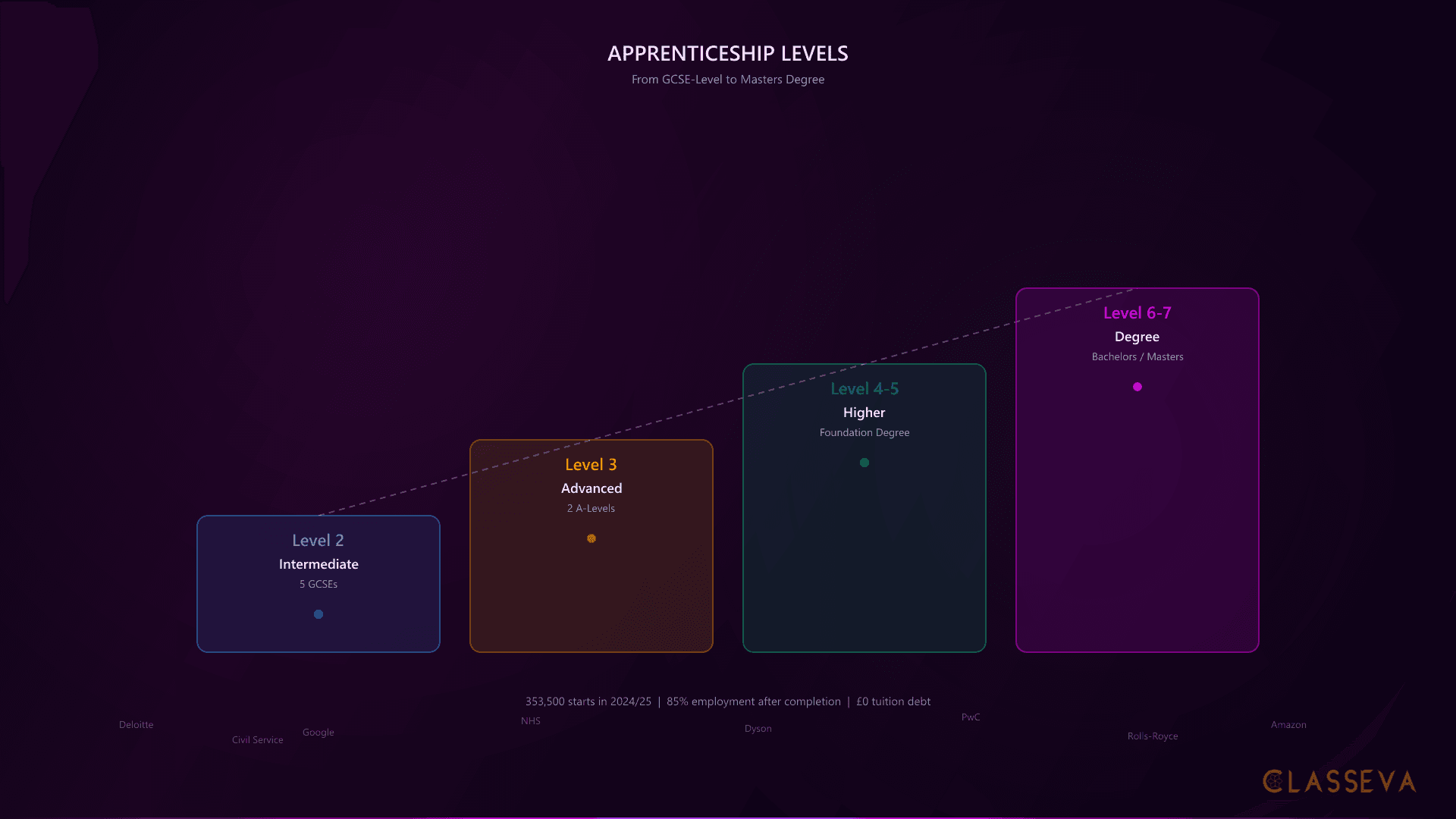
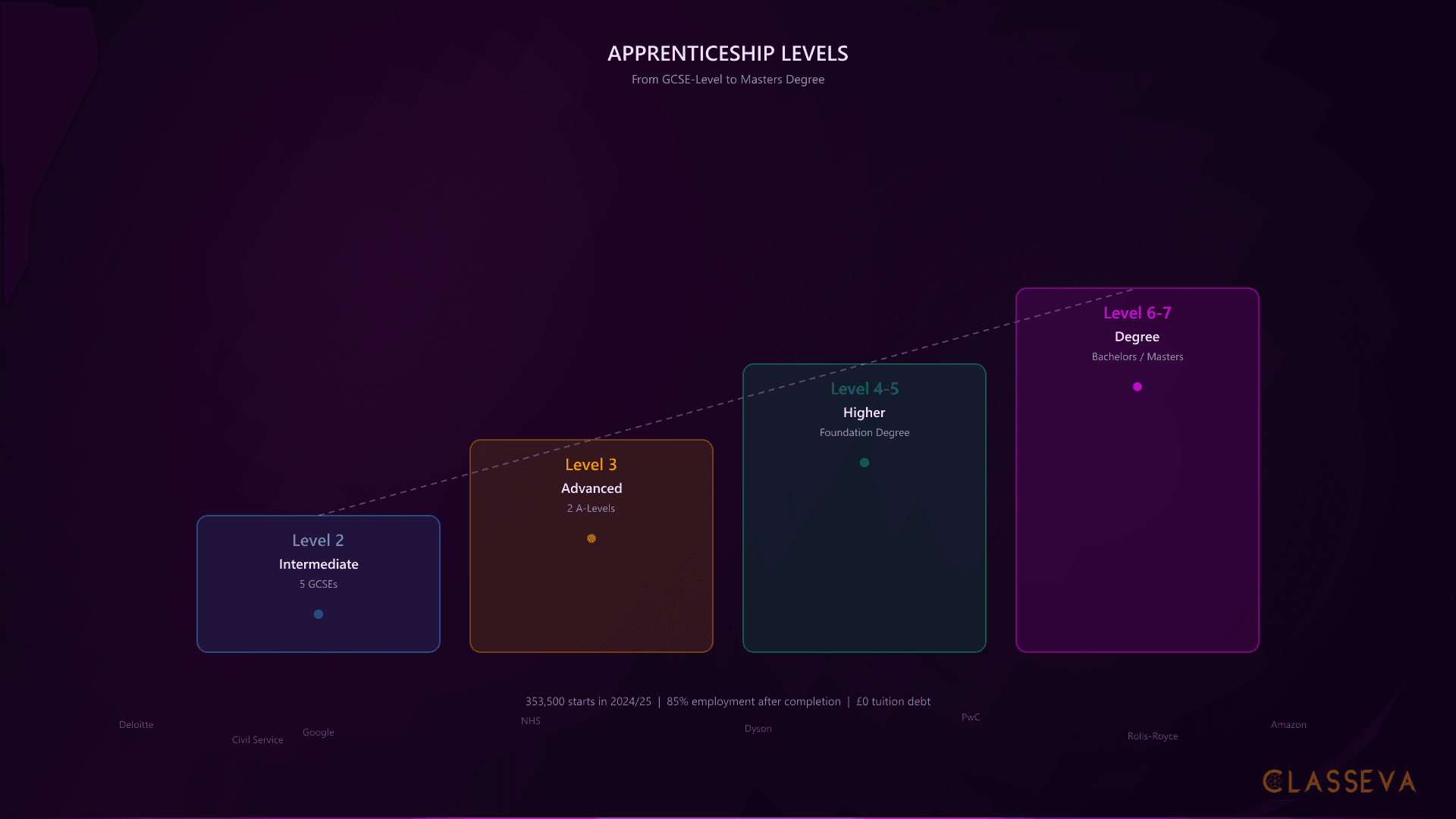
A degree apprenticeship is a Level 6 (bachelor's equivalent) or Level 7(master's equivalent) apprenticeship that combines full-time employment with part-time university study. Your child is an employee from day one, with a contract, a salary, holiday entitlement, and pension contributions. At the same time, they study towards a full degree at a partner university.
The critical detail that surprises most parents: the employer pays all university tuition fees. Your child pays nothing. This is not a loan, not a bursary, and not a scholarship. It is part of the apprenticeship funding model, backed by the government's Apprenticeship Levy.
Four in ten apprenticeship starts (39.8%) are now at Level 4 and above. Degree apprenticeships are no longer niche; they are a mainstream route to professional careers. From January 2026, Level 7 apprenticeships are only government-funded for 16 to 21 year olds (or care leavers and those with EHCPs under 25).
How the Structure Works
The typical split is 80% on-the-job training and 20% off-the-job study. That 20% happens at a partner university, which might be structured as one day per week on campus, block release (for example, one week per month at university), or a mixture of both with some online learning. The exact structure depends on the employer and programme.
Programmes typically last 3 to 6 years depending on the level and sector. A Level 6 chartered surveyor apprenticeship might take 5 years, while a Level 6 digital technology apprenticeship could be completed in 3 to 4 years. At the end, there is an End-Point Assessment (EPA) that confirms professional competence alongside the university degree.
Partner universities are not second-tier institutions. The list includes Russell Group universities such as Warwick, Manchester, Exeter, Leeds, and Bristol. The degree certificate your child receives is identical to one earned through the traditional full-time route. There is no asterisk, no “apprenticeship” label on it.
What Qualification Does Your Child Get?
On completion, your child walks away with three things: a full university degree (bachelor's or master's), 3 to 6 years of professional work experience, and in many cases a professional qualification (such as chartered accountant status, RIBA Part 1, or Chartered Engineer status). Many apprentices also receive a permanent job offer from their employer before they even finish the programme.
Compare that to a traditional graduate who finishes university with a degree, roughly £45,000 in student debt, and no guaranteed employment. The degree apprentice has a degree, money in the bank, a CV full of real experience, and often a confirmed job. It is a fundamentally different starting position.
The Financial Case: University vs Degree Apprenticeship
The financial difference between the university route and a degree apprenticeship is not marginal. It is transformative. This is the section that makes most parents sit up and pay attention, and rightly so.
The Numbers Over Three Years
Traditional University (3 years)
- •Tuition fees: £9,250/year = £27,750 total
- •Maintenance loan: ~£17,000 over 3 years
- •Average graduate debt: ~£45,000
- •Income during study: £0 (or minimal part-time)
- •Work experience: limited (holiday jobs, placements)
Degree Apprenticeship (3–4 years)
- •Tuition fees: £0 (employer pays)
- •Student debt: £0
- •Salary: £18,000–£30,000+/year
- •Total earned over 3 years: £54,000–£90,000+
- •Work experience: 3–4 years at a top employer
When you combine the debt avoided with the salary earned, the total financial difference can exceed £100,000 over four years. That is not a rounding error. It is life-changing money for a young person starting out. Of course, money should not be the only factor, but it deserves serious consideration.
The Long-Term Earnings Picture
One honest caveat: degree apprentices sometimes earn slightly less than graduate-entry peers in the first few years after qualification. An accounting firm might start a graduate at £32,000 while the apprentice who has been there for four years is on £28,000. However, this gap typically closes within 2 to 3 years, and the apprentice has already earned £80,000+ during their training period while the graduate was accumulating debt.
Research from the Sutton Trust and others consistently shows that after 5 years, degree apprenticeship graduates and traditional graduates in the same field earn comparable salaries. The difference is that the apprentice started from a net positive position, not a net negative one.
When comparing finances, do not just look at starting salary. Calculate the total financial position at age 25: salary earned minus debt accumulated. That is where the apprenticeship advantage becomes undeniable.
Which Sectors Offer Degree Apprenticeships?
Degree apprenticeships in the UK now span virtually every major professional sector. The days when apprenticeships meant only trades and manual work are long gone. Your child could be working at Goldman Sachs, Google, or the NHS while earning their degree.
Top Employers by Sector
| Sector | Example Employers | Typical Salary |
|---|---|---|
| Accounting and Finance | Deloitte, PwC, EY, KPMG, BDO | £20,000–£25,000 |
| Technology and Digital | Google, Amazon, Microsoft, IBM, BT | £22,000–£30,000 |
| Engineering | Rolls-Royce, BAE Systems, Dyson, Airbus | £18,000–£24,000 |
| Banking | JPMorganChase, Goldman Sachs, Barclays | £22,000–£30,000+ |
| Law | Pinsent Masons, CMS, DWF | £20,000–£25,000 |
| NHS and Healthcare | NHS Trusts (nursing, healthcare science) | £18,000–£22,000 |
| Civil Service | Government departments (fast-track) | £20,000–£25,000 |
| Construction | Balfour Beatty, Mace, Kier | £18,000–£22,000 |
Source: Degree Apprenticeships Guide, individual employer listings 2025/26
The engineering pathway has particularly strong apprenticeship options. Companies like Rolls-Royce and BAE Systems have been running degree apprenticeship programmes for years, and they are among the most established and well-structured in the country.
The legal sector is a newer entrant. Solicitor apprenticeships now allow your child to qualify as a solicitor without ever attending law school in the traditional sense. They work at a law firm, study part-time, and pass the Solicitors Qualifying Examination (SQE) at the end. Five years ago, this route barely existed.
Entry Requirements and How Competitive They Are
If your child is considering a degree apprenticeship for school leavers, they need to understand that competition for the best programmes is fierce. Some top schemes receive over 50 applications per place. That rivals the most competitive university courses, including medicine and Oxbridge entry.
Typical Academic Requirements
| Programme Type | A-Level Grades | GCSE Requirements |
|---|---|---|
| Big Four Accounting | ABB–AAA | English and Maths grade 6+ |
| Technology (Google, Microsoft) | BBB–AAB | English and Maths grade 5+ |
| Engineering (Rolls-Royce, BAE) | ABB–AAA (incl. Maths) | English and Maths grade 5+ |
| Banking (Goldman Sachs, JPMorgan) | AAA–A*AA | English and Maths grade 6+ |
| Law (Solicitor Apprenticeship) | ABB–AAA | English and Maths grade 5+ |
| NHS Nursing Degree | BCC–BBB | English, Maths, Science grade 4+ |
| Civil Service Fast-Track | BBB–ABB | English and Maths grade 4+ |
Requirements vary by individual employer. Always check the specific programme listing.
Notice that some programmes require specific A-Level subjects. Engineering apprenticeships almost always need A-Level Maths, and often Physics. If your child is still choosing their A-Level subjects, knowing which apprenticeships interest them can help shape that decision early.
Many families assume apprenticeships have lower academic requirements than university. For degree apprenticeships at top employers, the opposite is often true. A student who might comfortably get into a good university with BBB could be rejected by a competitive apprenticeship that expects AAA plus strong performance at assessment centres.
The Application Process
The application process for degree apprenticeships is typically more involved than a UCAS application. Most top employers use a multi-stage selection process.
Online application
CV, personal statement, and academic history. Many employers use their own application portals rather than a single centralised system.
Aptitude tests
Numerical reasoning, verbal reasoning, and sometimes situational judgement tests. These are similar to tests used by graduate schemes and are designed to filter large applicant pools.
Video interview
Pre-recorded or live video interviews where your child answers competency-based questions. Employers assess communication skills, motivation, and commercial awareness.
Assessment centre
A full day (sometimes two) of group exercises, individual presentations, and panel interviews. This is the final stage and typically where the strongest candidates are selected.
One thing I noticed when helping families prepare for these processes: the students who prepared specifically for assessment centres performed dramatically better than those who treated the application like a university form. Assessment centres reward different skills, including teamwork under pressure, commercial thinking, and the ability to present ideas clearly. These are not skills that A-Level revision develops automatically.
The Honest Trade-Offs
No guide to degree apprenticeships is complete without an honest look at what your child gains and what they sacrifice. The financial case is compelling, but money is not everything. Here is a balanced assessment.
What Your Child Gains
Gains
- •A full degree with zero tuition debt
- •3–6 years of professional work experience
- •A salary from day one (£18k–£30k+)
- •Professional network built during training
- •Often a permanent job offer on completion
- •Professional qualifications alongside the degree
Trade-Offs
- •Less flexibility: committed to one employer
- •No traditional campus student experience
- •Limited subject choice vs university
- •Harder to change direction mid-programme
- •Balancing full-time work and study is intense
- •Not available in every sector or location
What Your Child Gives Up
The biggest sacrifice is the traditional university experience. There is no freshers' week, no three years of living independently in a new city, no student union. Your child will be an employee first, attending university part-time. They will have work responsibilities, deadlines from their manager, and less free time than a full-time student.
Flexibility is the other real cost. At university, a student who decides after first year that they want to switch from accounting to history can usually do so. On an apprenticeship, changing direction means leaving the programme entirely and starting over. The commitment is real and should be made with genuine confidence in the chosen field.
That said, the students I saw thrive on apprenticeships were typically those who already knew roughly what they wanted to do. They were practical, career-focused, and motivated by the idea of learning through real work rather than lectures. If your child is the type who finds classroom learning frustrating and would rather be doing the job, an apprenticeship may suit their personality better than three years of lectures.
Your child can apply for UCAS university places and degree apprenticeships at the same time. The two processes are entirely separate. Many students apply for both and make their final decision once all offers are in. If you are weighing up A-Levels vs BTECs, both qualifications can lead to degree apprenticeship entry.
How to Apply and When to Start
There is no single centralised application system for degree apprenticeships. Unlike UCAS, which handles most university applications through one portal, apprenticeship applications are spread across multiple platforms.
The main routes are the GOV.UK Find an Apprenticeship portal, individual employer career websites, and increasingly UCAS, which now lists some degree apprenticeships alongside traditional university courses. The Degree Apprenticeships Guide is also an excellent resource that lists employers A to Z with direct links to their programmes.
Most top employers open applications between September and January for programmes starting the following autumn. That means your child should be researching options in Year 12 summer and ready to submit applications from September of Year 13. Leaving it until spring is too late for the most competitive programmes.
One practical point that catches families off guard: because there is no single deadline (unlike UCAS's January deadline), different employers have different closing dates. Some close in November, others stay open until March. Your child needs to track multiple deadlines simultaneously. A simple spreadsheet with employer names, opening dates, closing dates, and application links saves a lot of stress.
What Parents Should Do Now
If your child is in Year 11 or Year 12, now is the time to start exploring degree apprenticeships as a serious option alongside A-Levels and university applications. Here is a practical action plan.
Have the conversation early
Introduce degree apprenticeships as a real option, not a backup plan. Show your child the salary and debt comparison. Many students have never heard of this route because schools focus almost exclusively on UCAS.
Research sectors and employers together
Browse the Degree Apprenticeships Guide and GOV.UK portal together. Identify 5 to 10 programmes that match your child's interests. Check what A-Level subjects each employer requires and make sure subject choices align.
Treat applications as seriously as UCAS
Degree apprenticeship applications require strong personal statements, aptitude test preparation, and interview practice. These are not casual applications. Help your child prepare as rigorously as they would for a university interview.
Apply for both routes simultaneously
There is no rule against applying for university through UCAS and degree apprenticeships at the same time. Encourage your child to do both. Having options is always better than limiting choices prematurely.
Check the partner university
The university your child studies at matters. Confirm it is a reputable institution. A degree from Manchester or Warwick via an apprenticeship carries exactly the same weight as attending full-time. The degree certificate does not distinguish between routes.
Prepare for assessment centres
The assessment centre is where most candidates are eliminated. Practice group exercises, presentations, and competency-based interview questions. This is a different skill set from exam revision, and it needs dedicated preparation.
The single most important thing you can do as a parent is make sure your child knows this option exists. Too many talented students go to university by default, accumulating £45,000 in debt, without ever considering that they could have earned a degree debt-free while being paid. Whether a degree apprenticeship is the right choice depends on your child's personality, career goals, and preferences. But it should always be an informed choice, not one made through ignorance of the alternative.
If your child is still deciding on their post-16 path, our guide on GCSE grades needed for sixth form covers the academic requirements for continuing into A-Levels, which remain the most common entry qualification for degree apprenticeships.
Ask your child's school careers adviser specifically about degree apprenticeships. If they cannot name five current programmes, seek out information independently. Schools with strong university placement records sometimes underemphasise apprenticeship routes because they do not contribute to league table metrics in the same way.