How to Make Effective Flashcards for GCSE and A-Level
Flashcards are one of the most popular revision tools in the UK, and for good reason. When used correctly, they combine two of the most powerful learning techniques that exist: active recall and spaced repetition. Research from Dunlosky et al. (2013) ranked both techniques among the most effective strategies for long-term retention.
The problem is that most students use flashcards wrong. They write too much on each card, read both sides passively, and end up with a stack of 500 cards they never actually review. The flashcards become a procrastination activity disguised as revision rather than genuine learning. This guide covers exactly how to make flashcards that actually work for GCSE and A-Level exams, with subject-specific examples and practical advice for parents.
Why Most Flashcards Fail
From building Classeva and speaking to hundreds of families about revision habits, the single biggest pattern I see with flashcards is students confusing the act of making cards with actual learning. A student spends three hours colour-coding a beautiful set of 200 cards, feels productive, then never touches them again. Or worse, they flip through the stack reading both sides without ever testing whether they can recall the answer independently.
The Procrastination Trap
The reason this happens is that making flashcards feels like revision. It requires a textbook, a desk, and effort. But unless the student is processing the information (putting it in their own words, deciding what matters, formulating questions), it is no different from copying out notes. And unless they then test themselves using the cards, the cards are just expensive bookmarks.
Reading the front of a card, immediately flipping to check the back, and thinking “yep, I knew that.” This is recognition, not recall. Your brain recognises the answer when it sees it, but cannot produce it independently. The effort of retrieval is what builds memory. No effort means no learning.
The good news is that fixing these mistakes is straightforward. The five rules below will turn your child's flashcards from a passive activity into one of the most effective revision techniques available.
The Five Golden Rules of Effective Flashcards
These rules apply whether your child is using physical index cards or a digital app like Anki or Quizlet. They are based on decades of cognitive science research into how memory works, and they apply equally to GCSEs and A-Levels across every subject.
Rule 1: One Fact per Card
Each flashcard should test one specific piece of knowledge. This is the most common mistake students make: writing cards that are far too broad. A card asking “What are the causes of World War One?” requires an essay-length answer and is impossible to self-test quickly. A card asking “What was the 'blank cheque' assurance in WWI?” has a clear, verifiable answer: Germany's unconditional support for Austria-Hungary, July 1914.
Too Broad (Avoid)
- •"What are the causes of WWI?" (needs a full essay)
- •"Explain photosynthesis" (too many steps)
- •"Describe all of Macbeth’s character traits"
Specific (Effective)
- •"What was the blank cheque assurance?" (one fact)
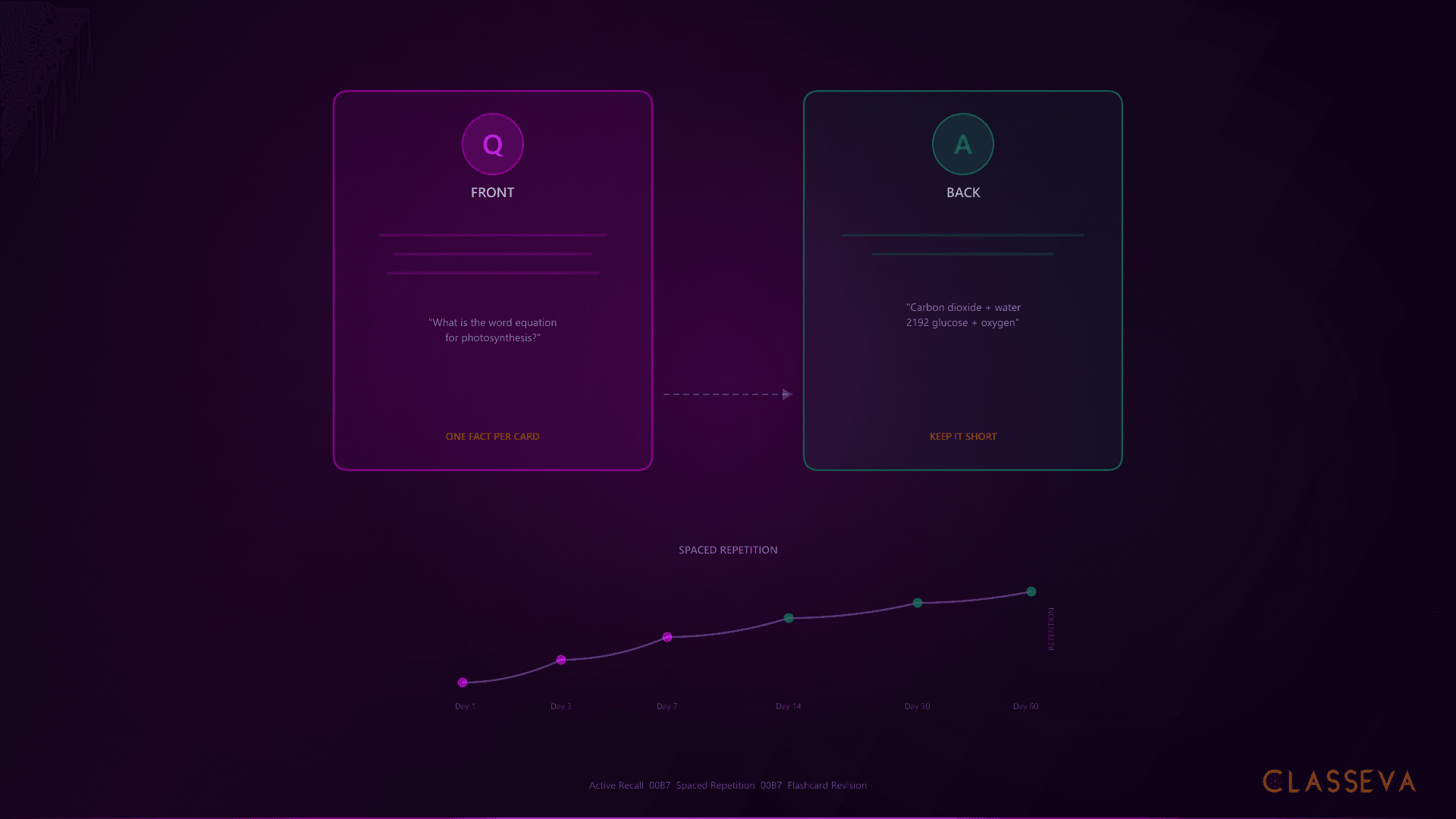
- •"What is the word equation for photosynthesis?" (one equation)
- •"What does Macbeth’s “vaulting ambition” quote reveal?"
Smaller, more specific cards mean faster review cycles and much more precise identification of knowledge gaps. If your child gets a broad card wrong, they do not know which part they did not know. With a specific card, the gap is immediately obvious.
Rule 2: Question on the Front, Answer on the Back
The front of the card should always be a clear question or prompt. The back should be a concise answer. This format forces active recall: the student must attempt to produce the answer from memory before flipping the card to check. Simply writing a key term on the front and its definition on the back works perfectly for vocabulary and terminology cards.
If your child's flashcards have information on both sides without a clear question, they are likely reading passively rather than testing themselves. Ask to see a few cards and check whether each one has a question they can answer without looking.
Rule 3: Use Your Own Words
Writing flashcards in your own words forces your brain to process and understand the information. Copying directly from a textbook is passive: you can write without thinking. The act of deciding what matters, condensing it, and rephrasing it in language that makes sense to you is itself a powerful learning activity. This is why parents should never make flashcards for their child. The creation process is part of the revision.
Rule 4: Keep Answers Short
The ideal answer length is one to three sentences maximum. If the answer is longer, break the card into multiple cards. You should be able to glance at the back and instantly verify whether your recall was correct. A card with a paragraph-long answer defeats the purpose: it takes too long to review, it is hard to self-mark, and it suggests the question was too broad in the first place.
Rule 5: Test Yourself, Don't Just Read
This is where most students go wrong, and it is the rule that makes the biggest difference. The correct process is: read the front of the card, look away or close your eyes, say or write the answer from memory, and then flip to check. The effort of retrieval (pulling the answer from memory rather than recognising it when you see it) is what strengthens the neural pathway.
If your child finds a card easy three times in a row, move it to a “known” pile and focus on the cards they struggle with. This is exactly what digital apps like Anki do automatically through spaced repetition algorithms.
Subject-Specific Flashcard Tips
Flashcards work differently depending on the subject. The best flashcard techniques for students adapt the format to match what each subject actually requires in the exam. Here are specific examples for the most common GCSE and A-Level subjects.
Sciences (Biology, Chemistry, Physics)
Science flashcards work best for definitions, equations, and process steps. For example: “What are the four stages of mitosis?” on the front, with “Prophase, Metaphase, Anaphase, Telophase” on the back. For equations, put the word equation or scenario on the front and the formula on the back.
| Card Type | Front (Question) | Back (Answer) |
|---|---|---|
| Definition | What is osmosis? | The net movement of water molecules through a partially permeable membrane from a dilute to a concentrated solution |
| Equation | What is the formula for kinetic energy? | KE = ½mv² |
| Process | Name the stages of mitosis in order | Prophase, Metaphase, Anaphase, Telophase (PMAT) |
| Required practical | How do you test a leaf for starch? | Boil in water, then ethanol, rinse, add iodine. Blue-black = starch present |
Example science flashcards following the one-fact-per-card rule
For diagrams (cell structure, circuit symbols, atomic diagrams), try a “draw from memory” approach. Put the diagram name on the front, sketch it from memory on scrap paper, then compare with the textbook. This is harder than standard cards but extremely effective for visual content.
English Literature
English Literature flashcards should focus on key quotes, character traits, and theme evidence. Put a character name on the front with the prompt “Key traits + evidence,” and list two to three traits with a supporting quote on the back. For themes, put the theme name on the front and specific textual examples on the back.
For AQA English Literature, students take closed-book exams for texts like An Inspector Calls and Macbeth. Flashcards are ideal for quote memorisation. Put the theme or character on the front, and the quote plus a brief analysis point on the back. Aim for 15 to 20 quotes per text.
History and Languages
History cards work well for dates, key figures, and cause-consequence pairs. Keep each card to one event or one figure: “Who was Aneurin Bevan and why was he significant?” on the front, “Labour Minister of Health who created the NHS in 1948” on the back.
For languages (French, German, Spanish), flashcards are arguably the single best revision tool. Put the target language word or phrase on the front and the English translation on the back. Reverse them periodically so your child practises producing the foreign language, not just recognising it. Verb conjugation cards (infinitive on front, conjugated forms on back) are particularly effective for GCSE language exams.
For maths, flashcards have a more limited role. They work for formulas, definitions, and method reminders (e.g., “Steps to complete the square”). But maths is primarily learned through practice problems, not recall of isolated facts. Use flashcards for formula recall, then practise applying those formulas on actual questions from past papers and revision resources.
Physical vs Digital Flashcards
One of the most common questions parents ask is whether their child should use paper flashcards or an app. The honest answer is that both work, and the best choice depends on your child's preferences and habits. Here is how they compare.
Physical Cards
- •Handwriting aids memory encoding (the "handwriting effect")
- •No screen time during revision
- •Tactile and easy to sort into piles
- •No automatic scheduling: your child must decide what to review
- •Easy to lose or damage
Digital Apps
- •Automatic spaced repetition scheduling
- •Progress statistics and weak-area tracking
- •Portable: revise from phone or tablet anywhere
- •Can include images, audio, and diagrams
- •Screen-based (potentially distracting for some students)
Many students find the best approach is a hybrid: create cards by hand (benefiting from the handwriting effect) and then transfer the most important ones into an app for automated spaced repetition review. This combines the memory benefits of handwriting with the scheduling power of algorithms.
Anki vs Quizlet: Which Is Better?
Anki and Quizlet are the two most popular flashcard apps among UK students. They serve different needs.
| Feature | Anki | Quizlet |
|---|---|---|
| Price | Free (desktop and Android). iOS app is paid. | Free tier with ads. Quizlet Plus for more features. |
| Spaced repetition | Powerful built-in algorithm (SM-2) | Basic scheduling in free tier |
| Ease of use | Steep learning curve, highly customisable | Very user-friendly, minimal setup |
| Pre-made decks | Community-shared decks available | Large library of pre-made decks |
| Best for | Serious, long-term revision | Beginners and casual review |
Anki vs Quizlet comparison for GCSE and A-Level students
Anki's algorithm automatically shows you cards you struggle with more frequently and cards you know well less often. Over time, this means your revision is always focused on your weakest areas. It takes 20 to 30 minutes to learn the interface, but once set up, it is the most efficient flashcard tool available. The Learning Scientists recommend spaced retrieval practice as one of the six most effective study strategies.
How Many Flashcards Do You Need?
Quality beats quantity every time. Having spoken with students who scored highly across their GCSEs and A-Levels, the pattern is consistent: the ones with 200 well-targeted cards outperformed those with 1,000 vague ones. The goal is not to cover everything. The goal is to cover the most important facts, definitions, quotes, and formulas for each subject.
Quality Over Quantity
For GCSEs, aim for 20 to 50 cards per subject covering the most important facts, quotes, equations, and definitions. Across eight or nine subjects, that is roughly 200 to 400 cards in total. For A-Levels, the content is deeper, so 50 to 100 cards per subject is a reasonable target.
Crucially, your child should cull their deck regularly. Once a card has been answered correctly three or four times in a row, move it out of the active rotation. The deck should always be focused on the weakest areas. This is exactly what apps like Anki handle automatically, and it is one of the strongest arguments for digital flashcards alongside physical ones.
How Parents Can Help with Flashcard Revision
Parents play a surprisingly important role in making flashcards effective. Not by creating the cards (that defeats the purpose), but by providing the testing partner that makes active recall work. When a parent holds the cards and reads the questions aloud, the student cannot cheat by glancing at the answer. This simple act turns a solo activity into genuine retrieval practice.
Practical Ways to Support Your Child
Provide the materials
Buy blank index cards or help your child set up Anki or Quizlet. Remove the barrier to getting started. A pack of 200 blank cards costs under £2.
Test them using their cards
Read the question aloud and let your child answer from memory. This provides the active recall practice that solo study often misses. Even 10 minutes of testing after dinner makes a difference.
Check the format, not the content
You do not need to understand GCSE chemistry to check whether a card has a clear question on the front and a short answer on the back. If the answer is a paragraph, it needs splitting into multiple cards.
Encourage ongoing creation
The best time to make flashcards is right after learning new content, not three weeks before the exam. Encourage your child to create a few cards after each lesson or homework session while the material is fresh.
Do not make the cards yourself
The process of deciding what matters, condensing it, and writing it in their own words is where much of the learning happens. Making cards for your child removes this entire benefit.
One of the most effective things you can do is spend 10 minutes each evening testing your child with their flashcards. Pick 15 to 20 cards at random, read the questions, and let them answer. Sort cards into “got it” and “needs work” piles. Next session, start with the “needs work” pile. This simple routine builds retrieval strength far faster than reading notes alone.
Flashcards are not the only revision resource your child needs, but they are one of the most versatile. Combined with past paper practice and a sensible revision strategy, a well-maintained flashcard deck gives your child a concrete, daily tool for building long-term retention across every subject.