GCSE French Topics and Tips: A Parent’s Guide
French is one of the most popular Modern Foreign Language GCSEs, and it is part of the EBacc group of subjects that the government has long encouraged schools to offer. Yet language entries have been falling for years, and French saw the largest drop of any major subject at A-Level in 2025 (down 9.1%). For parents, that raises a straightforward question: what exactly does the course involve, and how can you help your child do well?
This guide covers the full GCSE French topics list, the exam structure across all four skills, the tier system, and practical revision strategies that actually work.
What Is in GCSE French?
GCSE French is built around three broad themes that cover everyday life, the wider world, and future plans. Every exam board uses these same thematic areas, though they may label them slightly differently. All four skills (listening, speaking, reading, writing) are tested across all three themes, so your child needs to be able to understand and produce French on every topic.
The content is designed to be practical. Your child will not be translating classical literature. They will be describing their daily routine, discussing environmental issues, talking about their school, and explaining what they want to do after GCSEs. The vocabulary and grammar are grounded in real-world communication.
The Three AQA Themes
AQA GCSE French (8658) is the most widely used specification in England. It divides the GCSE French topics list into three themes:
These themes are not studied in isolation. In the speaking exam, for example, your child might be asked a question about their family (Theme 1), then switch to discussing their town (Theme 2), then explain their career plans (Theme 3), all within the same conversation. The topics overlap and interweave throughout the course.
The AQA specification document is freely available online and lists every single topic your child could be asked about. If your child does not know which exam board they are sitting, ask their school. From my experience working in tutoring, many students did not know their exam board until weeks before the exam, and this meant their revision was unfocused.
GCSE French Exam Structure
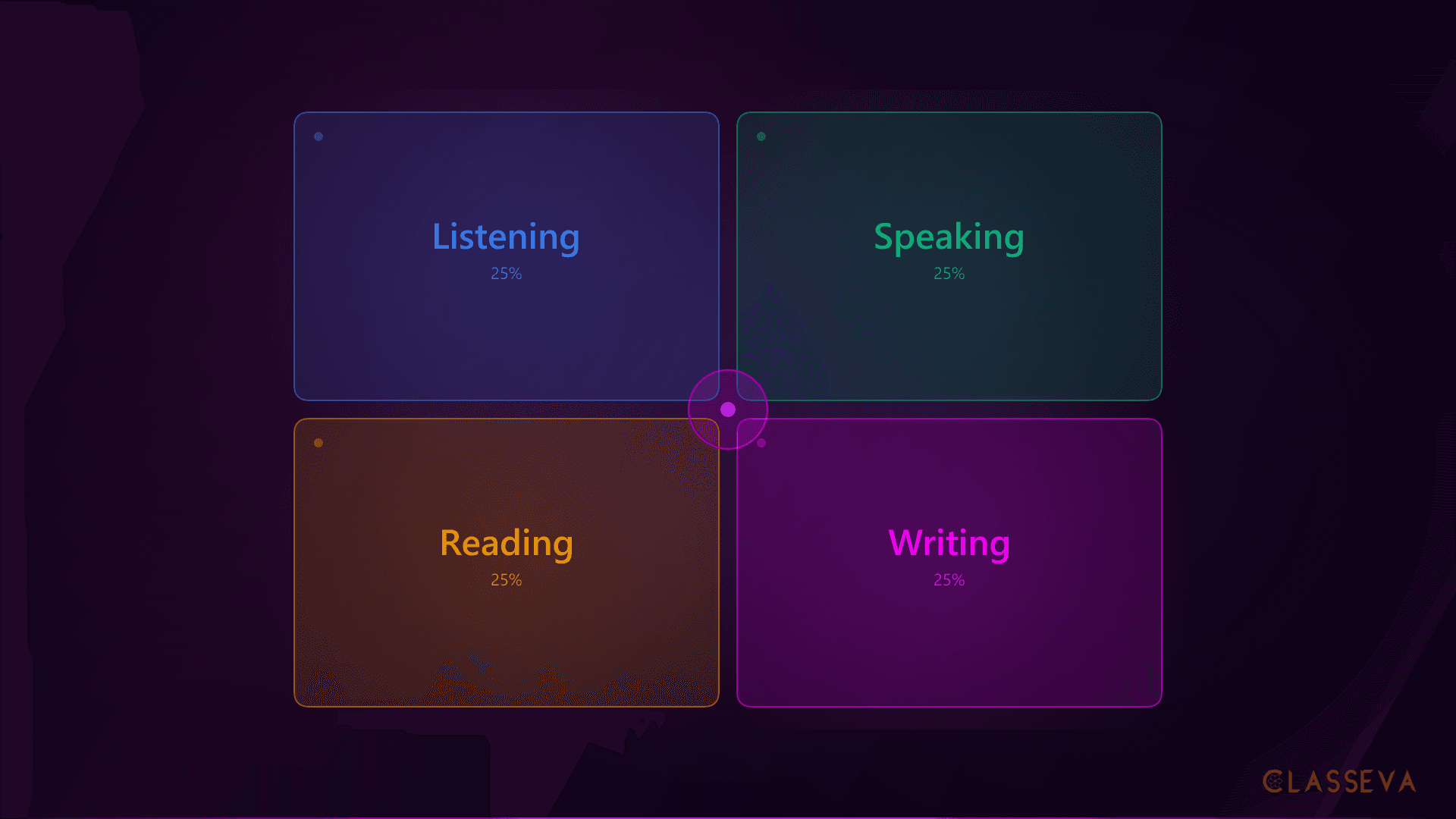
The GCSE French exam structure is the same across all major boards: four papers, each testing one skill, each worth exactly 25%. This equal weighting makes French unusual. In most GCSEs, one or two papers dominate; in French, every skill matters equally.
| Paper | Skill | Duration (Foundation / Higher) | Weighting |
|---|---|---|---|
| Paper 1 | Listening | 35 mins / 45 mins | 25% |
| Paper 2 | Speaking | 7–9 mins / 10–12 mins | 25% |
| Paper 3 | Reading | 45 mins / 1 hour | 25% |
| Paper 4 | Writing | 1 hour / 1 hour 15 mins | 25% |
Source: AQA GCSE French specification 8658. All four papers must be taken at the same tier.
Paper 1: Listening
Students listen to audio recordings of French speakers and answer comprehension questions. The recordings cover a range of contexts: announcements, conversations, interviews, and monologues. Questions are a mix of multiple choice, short answers, and (at Higher tier) identifying key details from longer passages.
The recordings are played twice. This matters because students often panic after the first play, not realising they will hear it again. Encourage your child to use the first listen to get the gist and the second to pick out specific details.
Paper 2: Speaking
The speaking exam is conducted by the student's own teacher, not an external examiner, and is recorded for moderation. It has three parts:
Role play
The student performs a scripted scenario (e.g. booking a hotel room, ordering food) following prompt cards. They must ask and answer questions in French.
Photo card
The student describes a photo and answers follow-up questions. They are given the photo and questions shortly before the exam to prepare.
General conversation
An open conversation covering two of the three themes. This is the longest section and where students can demonstrate their best French, using varied tenses and opinions.
The speaking exam is the paper students can prepare for most effectively. The conversation topics are drawn from the three themes, which are known in advance. Students who practise talking about each theme at home, even with a parent who does not speak French, build confidence and fluency.
Paper 3: Reading
Students read French texts and answer comprehension questions in English and French. The paper also includes a translation from French into English. Texts range from short notices and advertisements (Foundation) to longer articles and literary extracts (Higher).
The reading paper rewards students who have built strong vocabulary. Unlike listening, students can re-read passages as many times as they need. The translation section at Higher tier can be tricky because it requires precise understanding of grammar and idiom.
Paper 4: Writing
The writing paper includes structured writing tasks, an extended writing piece (a letter, article, or essay), and a translation from English into French. At Higher tier, the extended writing task is worth 32 marks and expects students to write around 150 words in French.
Examiners reward ambition. A student who attempts the conditional tense or subjunctive mood and makes some errors will often score higher than one who writes perfectly but only uses the present tense. Using varied tenses (present, past, future, conditional) and giving opinions with justifications are the keys to strong marks.
Foundation vs Higher Tier
Like maths and science, GCSE French is a tiered subject. Your child will be entered for either Foundation or Higher tier, and this decision affects all four papers. They cannot mix tiers (e.g. Higher for reading but Foundation for listening).
Foundation Tier
- •Targets grades 1 to 5
- •Maximum achievable grade: 5
- •Shorter exam durations
- •Simpler language in audio and texts
- •Safer option: very unlikely to get a U
Higher Tier
- •Targets grades 4 to 9
- •Access to the top grades (7, 8, 9)
- •Longer exam durations
- •More complex texts and faster audio
- •Risk: below grade 4 = ungraded (U)
The school, not the student, usually decides the tier. This is based on class performance, mock exam results, and teacher assessment. If your child is consistently scoring mid-grade 4 to 5 in practice papers, the tier decision becomes a genuine judgement call.
Some parents assume Higher tier is always better because it gives access to top grades. But a student who is not ready for Higher may fall below grade 4 and receive a U (ungraded), meaning they have no GCSE grade at all. Foundation tier is not a “lesser” option; a solid grade 5 on Foundation is a strong result that satisfies most sixth form entry requirements.
Why French Feels Harder Than Other GCSEs
During my time working in tutoring, parents regularly asked why their child seemed to find French so much harder than their other subjects. The answer is not that French is inherently more difficult. It is that the assessment demands are structurally different from almost every other GCSE.
The grading issue deserves special attention. For years, achieving a grade 7 in French required a higher percentage of marks than a grade 7 in most other subjects. This meant a student performing at the same relative level across subjects would often receive a lower grade in French. Ofqual recognised this and mandated more generous grading at key boundaries in 2023 and 2024. The effect has been noticeable: pass rates have climbed, and the gap between language grades and other subjects has narrowed.
Grading and Recent Results
GCSE French uses the standard 9 to 1 grading system. Grade 4 is a “standard pass” and grade 5 is a “strong pass.” The most recent 2025 results show improvement, though some of this reflects Ofqual's grading interventions rather than a sudden leap in student performance.
| Metric | 2024 | 2025 | Change |
|---|---|---|---|
| Grade 7+ | 28.0% | 29.7% | +1.7 pp |
| Grade 4+ (standard pass) | 71.2% | 72.9% | +1.7 pp |
| A-Level French entries | Baseline | Down 9.1% | Largest drop of any major subject |
Source: Tes, FFT Education Datalab (2025 results data).
The A-Level figure is worth noting. While GCSE pass rates are improving, fewer students are choosing to continue French beyond GCSE. The 9.1% drop in A-Level French entries in 2025 was the largest of any major subject. For parents of younger students, this is actually useful context: a strong GCSE French result stands out precisely because so few students continue the subject.
Modern Foreign Languages (including French) are EBacc subjects, which means schools are incentivised to enter students for a language GCSE. However, the EBacc is being scrapped, and language entries have been declining for years. Despite this, universities and employers continue to value language skills highly, particularly for international business, law, and diplomacy.
How Parents Can Help at Home
You do not need to speak French to help your child succeed. The most effective support is about creating the right conditions for practice, not teaching grammar yourself. Here are the strategies that, from my experience, make the biggest difference.
Daily Practice Over Cramming
Language learning is fundamentally different from revising for a content-heavy subject like history or biology. You cannot cram vocabulary into your memory the night before and expect it to stick. Research on spaced repetition shows that short, regular exposure to new words produces far better long-term retention than marathon sessions.
Fifteen minutes of French every day is worth more than two hours on a Saturday. This can be as simple as practising flashcards on an app like Anki or Quizlet, listening to a short French podcast, or watching a ten-minute clip of a French TV programme. The consistency matters more than the intensity.
Preparing for the Speaking Exam
The speaking exam is the component where preparation yields the highest returns. Your child already knows the topic areas (the three AQA themes). They know the format (role play, photo card, conversation). This means they can prepare and practise answers in advance.
List the common conversation topics
Family, hobbies, school, holidays, future plans, healthy living, where you live. These come up every year because they map directly to the three themes.
Write and learn model answers
For each topic, your child should prepare 5 to 6 sentences that use varied tenses (past, present, future) and include opinions with reasons. These do not need to be memorised word-for-word, but they provide a framework.
Practise speaking aloud at home
Even if you do not understand French, you can sit with your child while they talk through their prepared answers. The act of speaking aloud, rather than reading silently, is what builds fluency and reduces exam-day nerves.
Building Vocabulary
Vocabulary is the single biggest factor across all four papers. A student who knows more words will understand more of the listening recordings, read texts more accurately, write with greater range, and speak with more confidence. Flashcard apps with spaced repetition (Anki is free and excellent) are the most efficient way to build and retain vocabulary.
Watching French TV programmes or films with French audio and English subtitles is also genuinely effective for listening skills. Netflix and other streaming services offer French-language content. Even 20 minutes of passive exposure trains the ear to pick up common words and phrases.
The most useful question you can ask is specific: “Have you done a timed practice for the reading paper?” or “Which theme are you practising for speaking this week?” Parents who understand the exam structurecan ask targeted questions rather than a vague “Have you revised?”
The writing paper deserves a specific mention. Examiners are looking for students who show ambitionin their writing. Using three tenses (past, present, future) is the minimum expectation. Students aiming for the top grades should also attempt the conditional (“I would like to...”) and, at Higher tier, the subjunctive. The mark scheme explicitly credits students who try complex structures, even if they make errors in the process. Playing it safe with simple sentences caps the grade.
If your child is preparing for A-Level subject choices, a strong GCSE French grade opens doors. While language A-Levels are challenging, they are highly valued by universities, and the declining entry numbers mean competition for places on language degrees is lower than in many other subjects.
For more general revision strategies that apply to all subjects, including languages, see our guide to GCSE revision techniques that actually work.