GCSE Drama: Topics, Exam Structure, and Tips
GCSE Drama is one of the most practical subjects your child can take. Unlike most GCSEs where a written exam decides everything, drama splits the grade across devised performance, scripted extracts, and a written paper. Sixty per cent of the final grade comes from practical work, and one component is assessed by a visiting examiner who watches your child perform live.
This guide covers the full GCSE drama exam structure for AQA (the most common board), with Edexcel and OCR compared alongside. You will find every component explained, the set play options listed, and practical advice on how to support your child through a subject that is unlike anything else on their timetable.
Why GCSE Drama Is Different from Other Subjects
Most GCSEs are assessed almost entirely through written exams. Drama breaks that pattern completely. Your child will spend significant class time on their feet: rehearsing, devising, performing, and analysing live theatre. The written exam exists, but it tests practical understanding of how to stage, direct, and design performances, not abstract theory.
When I worked with students choosing their GCSE options, drama was consistently the subject parents had the most questions about. They understood what maths and science looked like, but the idea of a GCSE where a visiting examiner watches a live performance felt unfamiliar. The reality is that drama is assessed with the same rigour as any other subject. It simply values different skills.
What parents expect
- •Mostly acting and performing on stage
- •Assessed by the class teacher
- •Not much writing involved
- •A "soft" subject with easy marks
What actually happens
- •60% practical, 40% written exam (1h 45m)
- •Scripted performance marked by a visiting AQA examiner
- •Devising log alone is worth 60 marks of written analysis
- •Requires detailed knowledge of staging, design, and critical analysis
AQA GCSE Drama (8261): Full Breakdown
AQA GCSE Drama (8261) is the most widely taken drama specification in England. It has three components, each testing different skills. Here is exactly what your child will be assessed on.
Component 1: Understanding Drama (Written Exam)
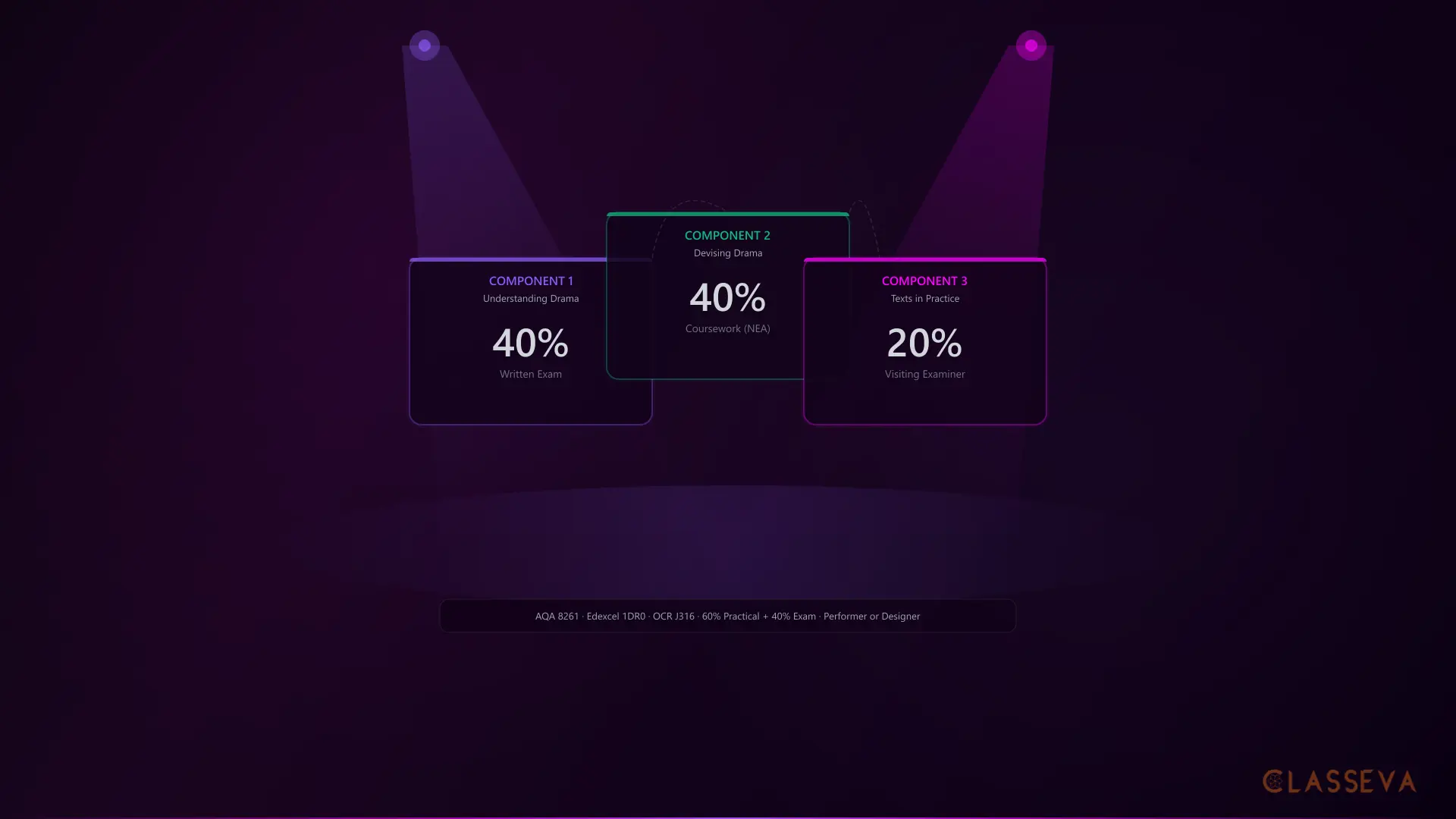
The written exam is 1 hour 45 minutes and worth 80 marks (40%) of the total grade. It has three sections, each testing different knowledge:
Section A is four multiple choice questions worth 4 marks. These test basic drama vocabulary and concepts. Section B is where the real work begins: students answer questions on a set play they have studied throughout the course. They must explain how they would perform specific roles, direct scenes, and use design elements such as lighting, sound, set, and costume. Section C requires an analytical evaluation of a live theatre production they have watched during the course.
Section B does not test memorisation of facts. It asks students to imagine they are performing, directing, or designing the set play. Questions might ask: “How would you use vocal skills to convey the character's emotions in this extract?” or “As a designer, explain how you would use lighting to create tension in this scene.”
Component 2: Devising Drama (Coursework)
Component 2 is worth 40% of the total grade and is assessed as coursework (Non-Exam Assessment). It has two parts: a devising log worth 60 marks and a devised performanceworth 20 marks. Your child's teacher marks both, and AQA moderates the grades.
The devised performance is an original piece of drama created from a stimulus provided by AQA. Students work in groups or as a duologue, building a performance from scratch. This is collaborative work: the group must research, develop, rehearse, and perform together.
The devising log is a written document in three sections: initial ideas and research, development and refinement, and analysis and evaluation. This is where most of the marks sit, and it is where many students underperform because they leave the writing until after the performance instead of documenting throughout the process.
Component 3: Texts in Practice (Visiting Examiner)
Component 3 is worth 20% of the total grade and is the most unusual element of GCSE Drama. Students perform two key extracts from one play (a different play from their Section B set play) and are assessed live by a visiting AQA examiner, not their class teacher.
Each extract is marked out of 20, giving a total of 40 marks. The visiting examiner watches every performance on the day and marks according to AQA's criteria. This external assessment ensures fair, consistent marking across all schools.
Your child will know the date of the visiting examiner well in advance. Schools prepare students thoroughly, but the live nature of the assessment adds genuine pressure. Encourage your child to rehearse their extracts regularly in the weeks beforehand, including performing for family members to build confidence with an audience.
Set Plays for AQA Drama
Schools choose one set play from the AQA-approved list. Your child will study this play in depth for Section B of the written exam. They need to know the plot, characters, themes, staging possibilities, and design elements inside out.
| Set Play | Playwright | Key Themes |
|---|---|---|
| Blood Brothers | Willy Russell | Class divide, fate, nature vs nurture |
| The Crucible | Arthur Miller | Hysteria, power, integrity under pressure |
| DNA | Dennis Kelly | Group dynamics, morality, peer pressure |
| 1984 | George Orwell (adapted by Robert Icke & Duncan Macmillan) | Surveillance, truth, totalitarianism |
| Noughts & Crosses | Malorie Blackman (adapted by Dominic Cooke) | Racism, forbidden love, inequality |
| Telling Tales | Various (compiled by AQA) | Anthology of short plays for comparison |
Blood Brothers and DNA are the most commonly chosen set plays in AQA Drama.
If your child mentions their set play at home, it is worth reading it yourself. You do not need to be a drama expert, but understanding the plot and characters means you can have meaningful conversations about the play and help quiz them on key scenes.
Edexcel and OCR at a Glance
While AQA is the most common board for GCSE Drama, some schools use Edexcel or OCR. All three boards follow the same 60/40 practical-to-exam split and include devising, scripted performance, and a written exam. The differences are in structure and weighting.
Edexcel Drama (1DR0)
Edexcel mirrors AQA's structure closely. Component 1 is devising (40%), Component 2 is performance from text (20%, externally assessed), and Component 3 is a written exam (40%, 1h 45m). The written exam covers a set text study and a live theatre evaluation, similar to AQA but labelled as “Theatre Makers in Practice”.
OCR Drama (J316)
OCR is the main outlier. It gives equal weight to devising and scripted performance(30% each) rather than the 40/20 split used by AQA and Edexcel. The written exam is slightly shorter at 1 hour 30 minutes (compared to 1h 45m for AQA and Edexcel) but still worth 40%. OCR calls its written exam “Drama: Performance and Response”.
Performer or Designer: Your Child Chooses
One of the most important decisions in GCSE Drama is whether your child will be assessed as a performer or a designer. This choice applies to both Component 2 (devising) and Component 3 (scripted performance), although students can choose different specialisms for each.
Performer
- •Assessed on acting: voice, movement, characterisation
- •Performs on stage in front of the visiting examiner
- •Devising log focuses on performance decisions
- •Best for students who enjoy being on stage
Designer
- •Specialises in lighting, sound, set, costume, or puppet
- •Creates design documents and practical designs
- •Devising log focuses on design choices and their impact
- •Ideal for students who prefer technical or creative work off stage
Parents often worry that a quiet or shy child will struggle in drama. The designer pathway is a genuine alternative. Students choosing costume design, lighting, or set design are assessed on their design skills and written justifications, not their stage presence. Some of the highest-scoring drama students are designers.
The Devising Log: Where Marks Are Won
From my experience working with students, the devising log is consistently the most underestimated part of GCSE drama coursework. In AQA, the log is worth 60 marks while the devised performance itself is worth 20 marks. That means the written log carries three times the weight of the actual performance.
The log has three required sections, and students need to write thoroughly throughout the devising process, not just at the end:
Section 1: Response to stimulus
Document initial ideas, research, and the group's response to the AQA-provided stimulus. Include mind maps, research notes, and early creative decisions.
Section 2: Development and collaboration
Record how the piece was developed and refined. Explain rehearsal techniques used, how the group resolved creative disagreements, and how the piece changed over time.
Section 3: Analysis and evaluation
Reflect on the final performance. Analyse what worked, what could be improved, and how well the piece communicated its intentions to the audience.
Many students treat the devising log as an afterthought, writing the entire document after the performance is done. This results in vague, generic reflection. Students who document their process as it happens, keeping notes after each rehearsal, score significantly higher because their log captures genuine development, not manufactured memories.
Live Theatre: A Compulsory Requirement
Every GCSE Drama student must attend at least one live theatre production during the course. This is not optional. Section C of the AQA written exam (or its equivalent on Edexcel and OCR) requires students to write an analytical evaluation of a live performance they have seen.
Schools typically organise theatre trips during Year 10 or early Year 11. However, if your child misses the school trip due to illness or other reasons, they will be at a serious disadvantage in the exam. You cannot write about a production you have not seen, and video recordings do not count as “live theatre”.
Contact the school immediately. If no alternative trip is planned, take your child to see a professional theatre production yourself. Local theatres, touring productions, and even high-quality fringe shows count. What matters is that it is a live performance with an audience, not a recorded one.
How Parents Can Help
GCSE Drama is collaborative, creative, and partly assessed at home through written coursework. There are specific, practical things you can do to support your child:
Be the audience
Offer to watch rehearsals of their scripted extracts at home. The visiting examiner assesses a live performance, so practising with an audience (even just family) builds confidence and reduces nerves.
Encourage ongoing log writing
The devising log is worth 60 marks. Ask your child regularly: "Have you written up your rehearsal notes?" Short, consistent entries throughout the devising process produce far better logs than a rushed write-up at the end.
Attend theatre together
Take your child to see live productions beyond the school trip. The more theatre they watch, the richer their Section C evaluation will be. Discuss the performance afterwards: what worked, what choices the director made, how lighting and sound contributed.
Read the set play
If your child is studying Blood Brothers or DNA, read the play yourself. Being able to discuss characters and themes at home reinforces their understanding for Section B of the written exam.
Respect the designer pathway
If your child chooses to be a designer rather than a performer, support that choice. Designing lighting, set, or costume for GCSE Drama is a legitimate and demanding specialism that develops skills valued in many careers.
Where GCSE Drama Leads
Parents sometimes wonder whether GCSE Drama is a “useful” subject for the future. The short answer: it develops skills that are valuable across every career, not just performing arts.
Drama builds confidence speaking to groups, the ability to work collaboratively under pressure, creative problem solving, and empathy through understanding characters and perspectives. These are exactly the skills employers and universities consistently say they want more of.
For students who want to continue with the subject, GCSE Drama leads directly to A-Level Drama and Theatre, BTEC Performing Arts, and degrees in Drama, Film, English, and Education. But it also complements subjects like English, Psychology, and History, where communication and analytical writing are central.
GCSE Drama is accepted by all sixth forms and colleges. While it is not part of the EBacc, it is a full GCSE that counts toward entry requirements. Students applying to competitive universities often cite their drama experience in personal statements as evidence of teamwork, resilience, and creative thinking.
If your child is still choosing their GCSE options, drama is worth serious consideration. It is one of the few subjects where your child creates, performs, and critically analyses their own work. That combination of practical skills and critical thinking is genuinely rare in the GCSE curriculum.