What A-Levels Do You Need for Nursing?
Nursing is one of the most popular degree choices in the UK, yet parents regularly tell me they are unsure what A-Levels for nursing actually involve. The confusion usually starts because they assume nursing requires the same subjects as medicine. It does not.
During my time working in the tutoring industry, I noticed a consistent pattern: families would plan their child's A-Level choices around the strictest possible degree requirements, then discover later that nursing was far more flexible. That flexibility is one of nursing's strengths, but only if you know about it early enough to take advantage.
This guide covers exactly which A-Levels universities expect, realistic grade targets, the alternative routes that many parents overlook, and a year-by-year timeline from Year 10 to UCAS application.
Which A-Levels Do Nursing Degrees Require?
The honest answer is that no single A-Level subject is universally required for nursing. This surprises most parents, especially those who have read about the strict Chemistry and Biology requirements for medicine. Nursing takes a deliberately broader view because the profession values a range of academic backgrounds.
That said, most universities expect at least one science or social science A-Level. According to NHS Health Careers, applicants typically need at least two (usually three) A-Levels or equivalent Level 3 qualifications.
Biology: The Closest to Essential
If there is one subject that comes closest to being a universal expectation, it is Biology. The human body is central to nursing practice, and a Biology A-Level gives your child a head start in understanding anatomy, physiology, and disease processes. Most university course pages list Biology as either required or strongly preferred.
Biology is the single most useful A-Level for nursing. If your child picks only one science, this should be it.
Other Accepted Subjects
Beyond Biology, universities accept a wide range of subjects. The most commonly listed include:
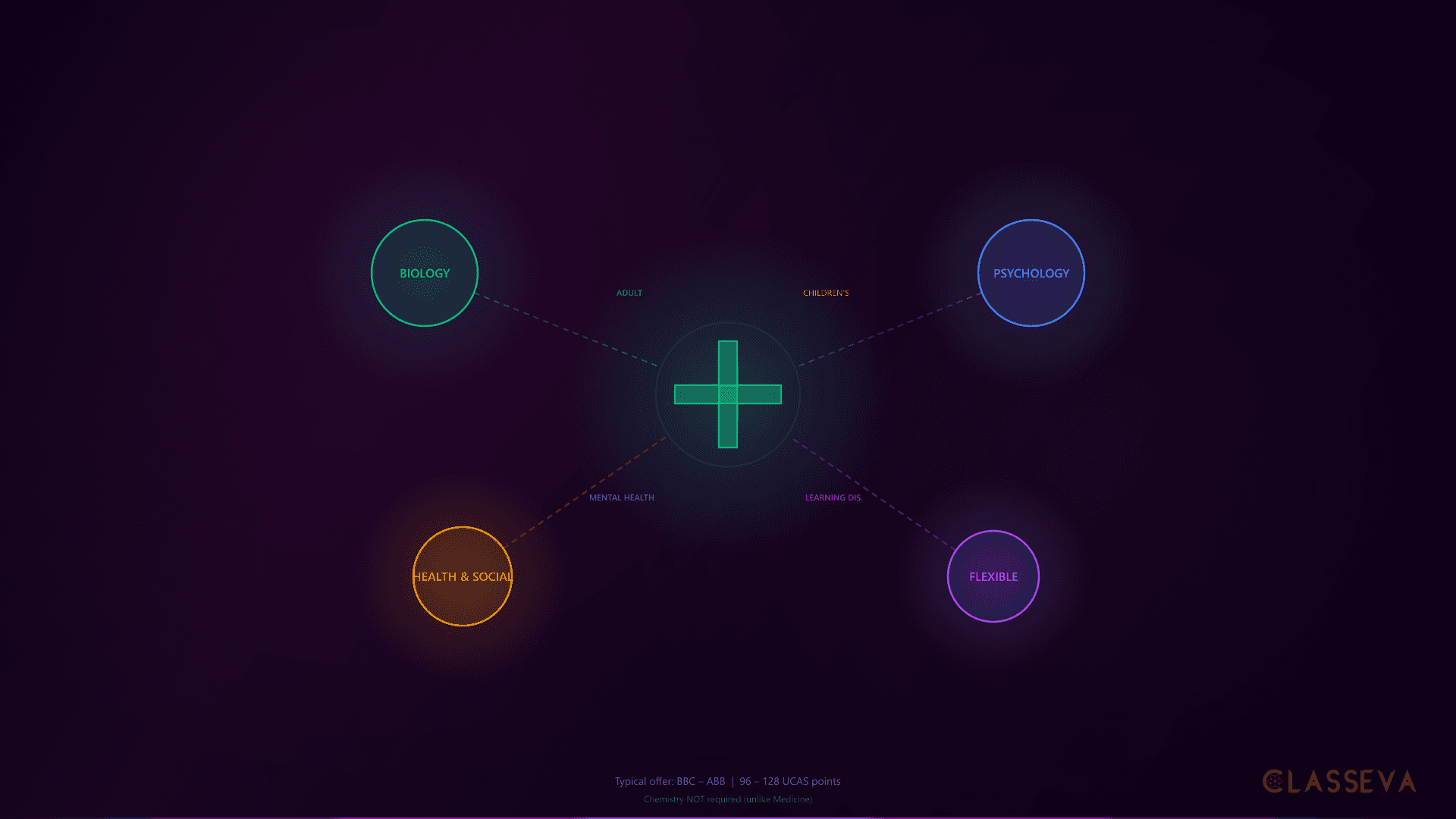
- Psychology – particularly valued for mental health nursing pathways
- Chemistry – useful but not required (unlike medicine)
- Health & Social Care – directly relevant to caring practice
- Sociology – helps with understanding health inequalities and patient contexts
- English – demonstrates communication skills, which are essential for nursing
The critical difference from medicine is this: nursing programmes value the type of student, not just the type of A-Level. A student with Psychology, English, and Sociology can be just as competitive as one with Biology and Chemistry, provided their grades and personal statement demonstrate genuine understanding of the profession.
Grade Requirements for Nursing
This is where the difference from medicine becomes stark. While medical schools routinely ask for AAA or A*AA, nursing degree entry requirements typically range from BBC to ABB. In UCAS points, that translates to 112 to 128 points, compared to the 144+ points expected for medicine.
The full range across UK universities is CCC (96 UCAS points) at the lower end to AAA (144 points) at the most competitive programmes. This means nursing is accessible to a much broader range of students than many parents realise.
University Examples
| University | Typical Offer | UCAS Points | Subject Requirements |
|---|---|---|---|
| Leeds Trinity University | CCC–ABB | 96–128 | No specific subjects required |
| University of Essex | BBB–BBC | 112–120 | Minimum 2 full A-Levels |
| University of Leeds | BBB | 120 | One science or social science preferred |
| University of Manchester | BBB–ABB | 120–128 | Biology or another science preferred |
| King's College London | ABB–AAB | 128–136 | Biology or a science required |
Source: University prospectuses and The Uni Guide (2025 entry)
Do not let your child rule out top universities. Even King's College London only asks for ABB, which is significantly lower than the A*AA required for their medical programme. Nursing is competitive on personal qualities, not just grades.
Best A-Level Combinations for Nursing
Since nursing programmes are flexible, the “best” combination depends on your child's strengths and which nursing specialism interests them. Here are three strong options that keep the widest range of programmes open.
Widest Access
- •Biology + Psychology + one other
- •Keeps almost every nursing programme open
- •Ideal if your child is unsure about specialism
Science-Strong
- •Biology + Chemistry + one other
- •Also opens doors to Midwifery and Biomedical Science
- •Best if considering multiple healthcare careers
Caring Focus
- •Psychology + Health & Social Care + one other
- •Suits students drawn to the behavioural side
- •Particularly strong for Mental Health Nursing
The “one other” in each combination can be almost anything: English, Sociology, a language, or even a creative subject. Universities care that your child can handle degree-level academic work and has genuine motivation for nursing, not that they have three sciences.
For broader guidance on picking A-Level subjects, our guide to choosing A-Level subjects walks through the decision-making process in detail.
Nursing Specialisms and Subject Choices
Parents often ask whether their child needs to choose a nursing specialism before picking A-Levels. The short answer is no. Specialisation happens at degree level, not at A-Level. All four nursing fields typically share the same entry requirements.
The Four Nursing Fields
Adult Nursing is the most common pathway and accounts for the majority of nursing degree places. Science A-Levels are preferred. Children's Nursing has similar requirements but focuses on paediatric care. Mental Health Nursing is a growing field where Psychology A-Level is particularly valued. Learning Disability Nursingis the most specialist field, and both Psychology and Health & Social Care are useful preparation.
Students on specialist nursing programmes (Mental Health and Learning Disability) may receive additional financial support through the NHS Learning Support Fund, with payments of up to £8,000 per year.
Alternative Routes into Nursing
One of the things that surprised me most when I worked in tutoring was how few parents knew about the alternative routes into nursing. There are more pathways into this profession than almost any other healthcare career, and some of them do not require A-Levels at all.
BTEC and Access Courses
BTEC Level 3 Extended Diplomas are widely accepted by nursing programmes. Typical grade requirements are DMM (Distinction, Merit, Merit) to DDM. A BTEC in Health and Social Care is the most directly relevant, but Applied Science BTECs are also accepted.
Access to Higher Education Diplomas are one-year courses specifically designed for mature students or those who did not take traditional A-Levels. They are accepted by virtually every university that offers nursing degrees. This is a common route for career changers and parents returning to education.
For a deeper comparison of these qualification types, see our A-Levels vs BTECs guide.
Nursing Degree Apprenticeships
Nursing Degree Apprenticeships allow students to earn while they learn over a four-year programme. The employer (typically an NHS Trust) sponsors the study, so there are no university tuition fees. Competition for these places is high, but they offer an excellent route for students who want to start working in healthcare immediately.
A-Levels + Degree
- •3-year university degree
- •Standard student finance
- •NHS bursary of £5,000+/year
- •Full-time study with clinical placements
BTEC + Degree
- •BTEC then 3-year degree
- •Equivalent UCAS points accepted
- •Same NHS bursary available
- •Practical skills from BTEC are an advantage
Apprenticeship
- •4-year earn-while-you-learn
- •No tuition fees
- •Paid salary from day one
- •Highly competitive entry
Beyond A-Levels: What Else Matters
A-Level grades get your child through the door, but nursing admissions look at the whole person. Having spent time working with students preparing university applications, I can tell you that the personal statement and interview carry more weight for nursing than for many other degree courses.
GCSEs
English Language, Maths, and usually a Science at grade 4/C or above. These are non-negotiable at every university.
Work experience
Time spent in a healthcare setting (hospital, care home, GP surgery, or voluntary organisation) is expected. It does not need to be formal; even regular volunteering at a local care home demonstrates commitment.
Personal statement
Universities want evidence of empathy, resilience, and a realistic understanding of what nursing involves. Generic statements about "wanting to help people" are not enough.
Interview
Most nursing courses include an interview, often MMI-style (Multiple Mini Interview) or a panel format. Questions focus on values, teamwork, and ethical scenarios.
DBS and health checks
A Disclosure and Barring Service (DBS) check and occupational health check are required before starting clinical placements.
NHS Learning Support Fund
This is the detail that most families miss. The NHS Learning Support Fund provides at least £5,000 per year to eligible undergraduate and postgraduate student nurses. This is a grant, not a loan, so it does not need to be repaid.
Students on specialist programmes (Mental Health Nursing and Learning Disability Nursing) may receive additional payments of up to £8,000 per year. Standard student loans are also available alongside the NHS grant, making nursing one of the most financially supported degree choices.
The NHS Learning Support Fund is separate from student finance. Your child can receive both. This makes nursing significantly more affordable than most parents expect, especially given that clinical placements mean limited time for part-time work during term.
Parent Timeline: Year 10 to 13
Timing matters, even though nursing is more flexible than medicine. Here is what your child should be doing at each stage.
Year 10–11: Build the foundations
Focus on strong GCSE performance in English Language, Maths, and a Science (grade 4 minimum, grade 5 or above is better). Start volunteering in a care setting, even if it is just a few hours a month. This early experience makes the personal statement much stronger later.
Year 12: Make it count
Choose at least one science or social science A-Level. Begin regular work experience in a healthcare environment. Attend university open days for nursing programmes. Research whether your child is drawn to a particular nursing specialism.
Year 13: Apply and prepare
Apply via UCAS with the standard January deadline. Nursing does not have the early October deadline that medicine requires, giving your child more time to refine their application. Prepare thoroughly for interviews, which focus on values, communication, and ethical reasoning rather than academic knowledge.
Many families assume nursing applications follow the same timeline as medicine. They do not. There is no UCAT or BMAT exam to sit, and the UCAS deadline is January, not October. Use this extra time to strengthen the personal statement and build work experience.
If your child is still exploring career options, our guide to what A-Levels are and how they work covers the broader picture of post-16 choices.
Nursing is a career with exceptional job security, genuine variety, and clear progression routes. The entry requirements are deliberately accessible because the profession needs students with the right values and motivation, not just the highest grades. If your child has the compassion and resilience for it, the A-Level choices are unlikely to be the barrier. Start the work experience early, choose at least one relevant science or social science, and let the rest follow.