What A-Levels Do You Need for Dentistry?
A-Levels for dentistry follow a pattern that will look familiar if you have already read about medicine requirements, but there are important differences that parents often miss. Dentistry is one of the most competitive university courses in the UK, with roughly the same subject requirements as medicine, yet it gets far less attention in school careers advice.
During my time working in tutoring, I noticed that parents preparing their children for medicine almost always knew about the Chemistry requirement, the UCAT, and the October deadline. Parents aiming for dentistry? Far less often. Several families I worked with only discovered that dentistry had its own specific requirements (dental work experience, manual dexterity testing, a different pool of universities) after their child had already started Year 12. That late start made everything harder than it needed to be.
This guide covers the full picture: which A-Levels dental schools require, what grades they ask for, how the UCAT applies to dentistry, why GCSE grades matter more than you might think, and the complete timeline from Year 10 to application day.
Which A-Levels Do Dental Schools Require?
Like medicine, dentistry is one of the few degree courses where choosing the wrong A-Level subjects can disqualify your child entirely, regardless of their grades. Dental schools publish specific subject requirements, and these are non-negotiable.
Chemistry: The Essential Subject
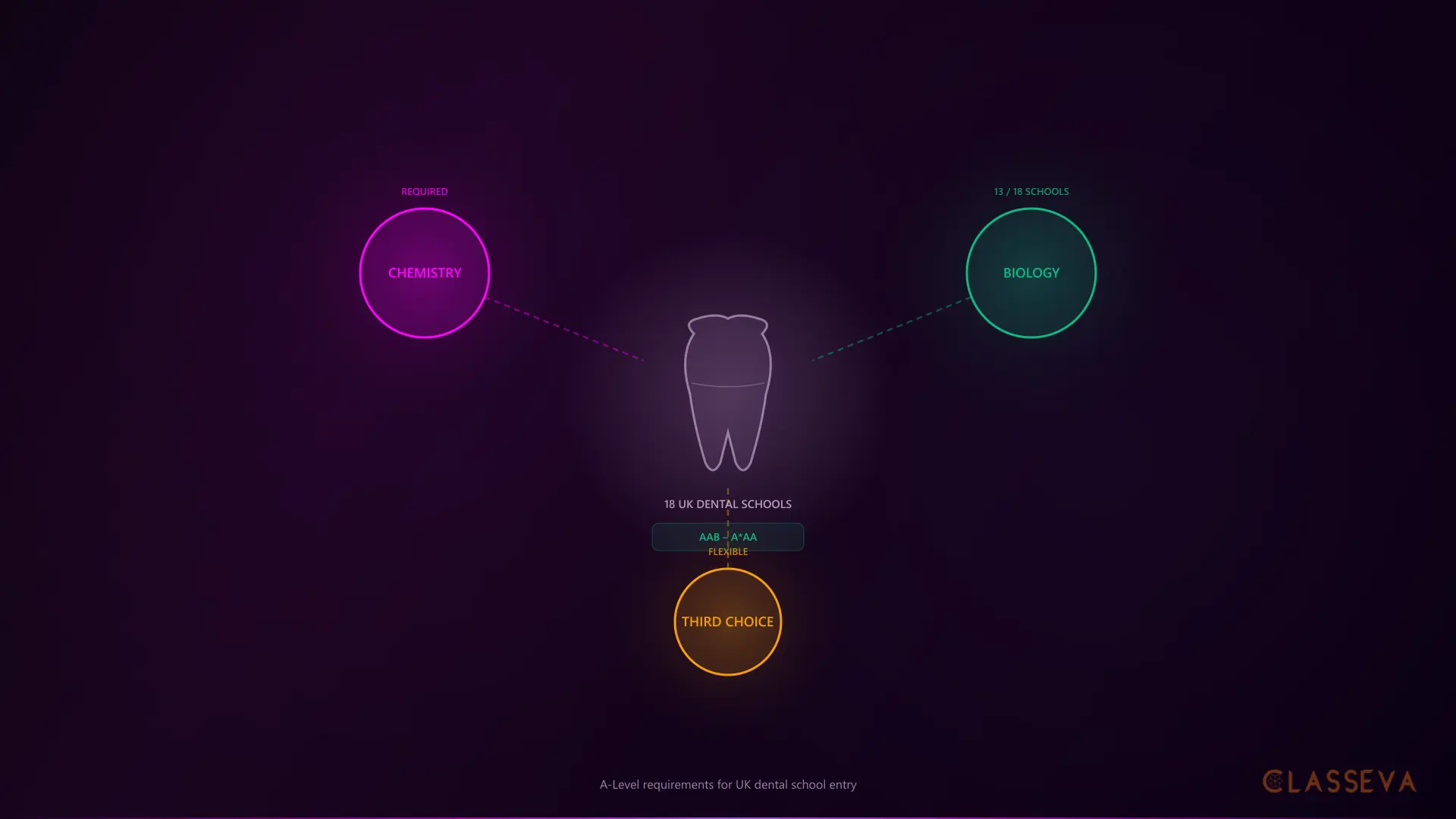
Chemistry is the single most important A-Level for dentistry. It is required by virtually every UK dental school, and those very few that do not list it as compulsory still include it on their approved science subjects list. In practical terms, applying to dentistry without Chemistry A-Level means ruling out almost every option.
The reason is the same as for medicine: the early years of a dental degree are heavily rooted in biochemistry. Understanding how materials interact with tooth enamel and oral tissues, how anaesthetics work, and how drugs are metabolised all depends on a solid Chemistry foundation. Dental schools have consistently found that students without this background struggle in the first year.
Biology: Required by the Majority
Biology is the second essential subject. Of the approximately 18 dental schools in the UK, 13 explicitly require both Chemistry and Biology. The remaining schools accept Chemistry plus one other approved science, but dropping Biology significantly narrows your child's choices in a field where there are already far fewer universities to choose from than for medicine.
There are roughly 18 dental schools in the UK compared to over 40 medical schools. With so few places available, every restriction matters more. Taking both Chemistry and Biology keeps all 18 dental schools open. Dropping Biology could reduce your child's options to as few as 5.
Your Third A-Level
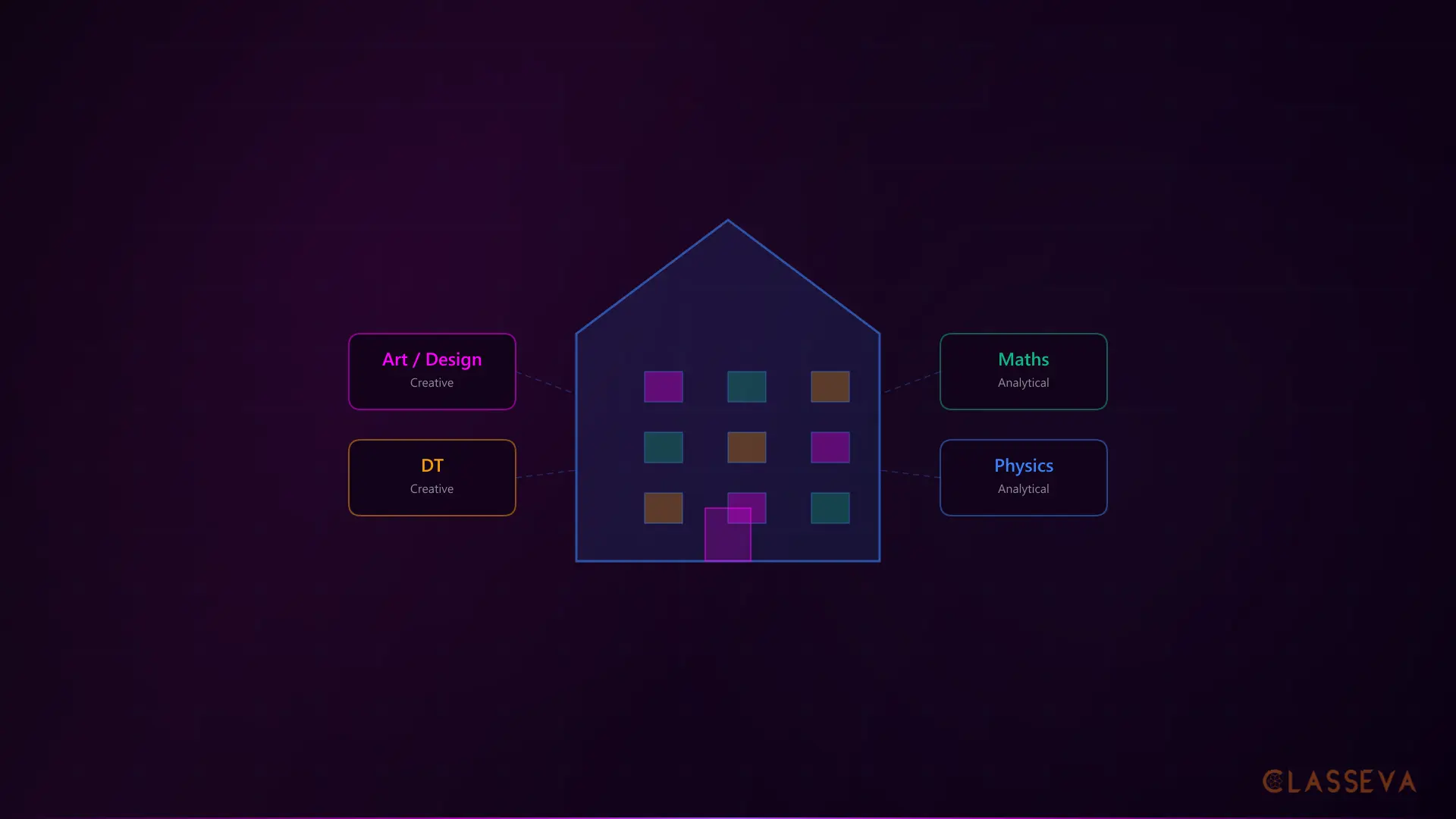
With Chemistry and Biology secured, the third A-Level is where your child has genuine flexibility. Dental schools generally accept any academic third subject, though they tend to prefer those that demonstrate analytical thinking or scientific reasoning.
Maths
- •Demonstrates quantitative reasoning
- •Strong fallback for other science degrees
- •Preferred by some dental schools
- •Useful for biomechanics modules
Physics
- •Relevant to dental materials and imaging
- •Valued for analytical problem-solving
- •Less commonly chosen but well-respected
- •Good complement to Chemistry and Biology
Psychology
- •Directly relevant to patient management
- •Covers research methods and statistics
- •Shows interest in patient communication
- •Growing in popularity among dental applicants
As the Russell Group's Informed Choices guidenotes, “Chemistry, biology and either maths or physics will keep all dentistry courses open to you.” That said, non-science subjects like English Literature, History, or a Modern Foreign Language are also accepted as the third A-Level by most dental schools. The key is that your child should choose whichever third subject they will get the highest grade in.
What Grades Do Dental Schools Ask For?
Dentistry entry requirements A-Levels for grades are high, but not quite as uniformly demanding as medicine. The most common offer is AAA, matching the typical medical school standard, but a meaningful number of dental schools offer places at AAB, which is rare in medicine.
| Offer Level | Example Universities | Notes |
|---|---|---|
| A*AA | Queen Mary University of London | Requires Biology or Chemistry plus a second science |
| AAA | Birmingham, Cardiff, Sheffield, Dundee | The most common standard offer for dentistry |
| AAB | Some dental schools via standard or contextual routes | Lower than almost any medical school offer |
Typical A-Level grade requirements across UK dental schools (2025/2026 entry)
How Dentistry Offers Differ from Medicine
The grade range for dentistry is wider than for medicine. While almost no medical school drops below AAA for standard offers, several dental schools routinely offer AAB. This makes dentistry slightly more accessible on paper, though in practice the competition for places remains fierce because there are far fewer dental schools.
Contextual offers also exist in dentistry. Many dental schools make reduced offers (typically ABB or AAB) to students from underrepresented backgrounds, those who are first in their family to attend university, or those from areas with low progression to higher education. If your child qualifies for a contextual offer, it is worth checking each dental school's specific criteria.
Predicted grades are critical. Your child's teachers will predict their A-Level grades early in Year 13, and dental schools use these predictions alongside the UCAT score to decide who receives an interview. If your child is likely to be predicted below AAA, they should focus their application on dental schools that accept AAB. For a broader view of how A-Level subject choices connect to career pathways, see our guide to the best A-Level subject combinations.
The UCAT for Dentistry
The UCAT (University Clinical Aptitude Test) is required by almost all UK dental schools. If your child is also considering medicine, the good news is that the same UCAT sitting covers both. One test, one fee, one set of results that can be sent to both medical and dental schools.
The UCAT tests five areas over approximately two hours: Verbal Reasoning, Decision Making, Quantitative Reasoning, Abstract Reasoning, and Situational Judgement. None of these sections test dental or scientific knowledge. The UCAT measures aptitude and reasoning, not what your child has learned in school.
The UCAT testing window runs from July to September each year. Most students sit it in the summer between Year 12 and Year 13. Results are available immediately after the test, so your child will know their score before finalising their UCAS choices. Free official practice materials are available at ucat.ac.uk.
How Dental Schools Use UCAT Scores
Dental schools vary in how heavily they weight the UCAT. Some use it as a primary screening tool: applicants below a certain UCAT threshold will not be considered, regardless of grades. Others use it as one factor in a holistic review alongside predicted grades, the personal statement, and work experience.
A strong UCAT score can compensate for predicted grades on the lower end of the range, while a weak UCAT can undermine an otherwise strong application. The best approach is to start UCAT practice 4 to 8 weeks before the test date. This is not something to leave until the week before.
GCSE Requirements for Dentistry
GCSE grades matter more for dentistry than parents typically expect. Unlike many university courses that barely glance at GCSEs once A-Level predictions are in place, dental schools actively use GCSE results as part of their screening process.
| Requirement | Typical Standard | Example |
|---|---|---|
| English Language | Grade 6/B or above | Required by most dental schools |
| Mathematics | Grade 6/B or above | Required by most dental schools |
| Science GCSEs | Grade 6–8 | Biology and Chemistry specifically at some schools |
| Birmingham specific | Grade 8 in Bio & Chem, 7 in Maths & English | One of the highest GCSE bars in the country |
Common GCSE requirements across UK dental schools (source: Dental Schools Council)
The University of Birmingham stands out for having particularly demanding GCSE requirements: grade 8 in both Biology and Chemistry, and grade 7 in both Maths and English. Other dental schools are less specific, but most expect a strong profile with several GCSEs at grade 7 or above. If your child is currently in Year 10 or 11, this is the time to ensure their GCSE performance supports a future dentistry application. Our guide to GCSE grades needed for A-Levels covers how GCSE results connect to sixth form choices.
Some dental schools use a GCSE scoring system where each grade earns points that contribute to a total admissions score alongside the UCAT and predicted A-Levels. Strong GCSEs can genuinely make the difference between receiving an interview invitation and being filtered out early.
Dental Work Experience and Manual Dexterity
This is where dentistry diverges most clearly from medicine. Dental schools expect applicants to have specific dental work experience, not just general healthcare experience. They also value manual dexterity in a way that medical schools do not. Both of these elements require planning well in advance.
What Counts as Dental Work Experience
Dental schools want evidence that your child has observed the day-to-day reality of being a dentist and has reflected on what they learned. The most common forms of dental work experience include:
Shadow a General Dentist
Spend time observing a practising dentist in a high-street dental surgery. This is the most valued form of work experience. Ask your family dentist or contact local practices directly.
Volunteer in a Dental Setting
Some dental practices, community dental services, or dental charities accept volunteers. Even reception or support work in a dental environment demonstrates genuine interest.
Hospital Dental Placements
Observing oral surgery or orthodontic clinics in a hospital setting is excellent if available. These are harder to arrange but demonstrate initiative.
Related Healthcare Volunteering
Volunteering in care homes, hospices, or with organisations like St John Ambulance shows caring commitment, but should supplement dental experience, not replace it.
COVID-era virtual work experience alternatives are less accepted now that in-person placements are widely available again. Dental schools want to see that your child has physically been in a dental environment and can reflect on what they observed.
Manual Dexterity Testing
Dentistry requires fine motor skills in a way that most medical specialties do not. Several dental schools test manual dexterity at interview, and this is something parents and students often hear about too late to prepare for properly.
Manual dexterity tasks at dental school interviews typically involve activities like wire bending, soap carving, or completing a small model. These tests assess hand-eye coordination, precision, and the ability to work carefully in a confined space. They are not testing whether your child can already do dental procedures; they are testing whether they have the baseline fine motor skills that dental training will develop.
Practise fine motor tasks before the interview: carving soap or cheese into shapes, bending wire with pliers, building small models, or even practising mirror writing. These activities build the hand-eye coordination that dental schools are looking for. Start several weeks before any interview.
The Parent Timeline: Year 10 to 13
The dentistry application process spans several years, just like medicine, and shares the same early UCAS deadline. Here is the timeline every parent of an aspiring dentist needs.
Year 10: Build GCSEs and Begin Exploring
Focus on strong GCSE performance, especially in Sciences, Maths, and English. Start looking for dental shadowing opportunities. Ask your family dentist if your child can observe for a day or two.
Year 11: Confirm Strong GCSEs
Achieve the strongest possible GCSE grades. Research which dental schools your child is interested in and check their specific GCSE requirements. Confirm A-Level choices: Chemistry + Biology + a third subject.
Year 12 Autumn: Start A-Levels and Work Experience
Begin A-Levels in Chemistry, Biology, and the third subject. Start or continue regular dental work experience. Attend dental school open days to understand what each school offers.
Year 12 Spring: Prepare for the UCAT
Begin UCAT preparation using official practice materials at ucat.ac.uk. This needs 4 to 8 weeks of consistent practice. Start practising manual dexterity tasks (wire bending, soap carving).
Year 12 Summer: Sit the UCAT
Sit the UCAT between July and September. Results are immediate. Begin drafting the personal statement, focusing on dental work experience and motivation for dentistry specifically.
Year 13 September: Finalise the Application
Complete the personal statement. Request the school reference. Select up to 4 dentistry choices on UCAS. The fifth choice can be a related course (Biomedical Science, Dental Hygiene) as a backup.
Year 13: 15 October Deadline
Submit the UCAS application before 15 October. This is the same early deadline as medicine. Late applications for dentistry are not accepted.
Year 13 Winter to Spring: Interviews
Attend interviews, which may include Multiple Mini Interviews (MMIs), manual dexterity tasks, and traditional panel questions. Prepare by practising fine motor tasks and common interview scenarios.
The biggest mistake I saw families make with dentistry applications was treating them identically to medicine applications. The personal statement needs to be about dentistry, not healthcare in general. The work experience needs to be in a dental setting, not just a hospital. And the interview may include manual dexterity tasks that medicine interviews do not. Prepare for dentistry specifically.
Dentistry vs Medicine: A Quick Comparison
Many families consider both dentistry and medicine, especially since the A-Level requirements overlap almost completely. Here are the key differences in the application process that parents should understand.
Dentistry
- •Approximately 18 dental schools in the UK
- •Some schools accept AAB (lower than medicine)
- •Manual dexterity may be tested at interview
- •Dental-specific work experience expected
- •UCAT required (same test as medicine)
- •UCAS deadline: 15 October (same as medicine)
Medicine
- •Over 40 medical schools in the UK
- •Almost all require AAA minimum
- •No manual dexterity testing at interview
- •General healthcare work experience expected
- •UCAT required (same test as dentistry)
- •UCAS deadline: 15 October (same as dentistry)
The smaller number of dental schools is an important practical consideration. With fewer options, each application choice matters more. Your child can apply to a maximum of 4 dentistry programmes on UCAS (the fifth can be any course), so they need to choose carefully based on their predicted grades and UCAT score.
For parents whose child is considering both dentistry and medicine, the good news is that the A-Level preparation is identical: Chemistry + Biology + a third subject, plus the UCAT. Your child does not need to decide between the two until they are selecting their UCAS choices. However, the personal statement and work experience should be tailored to whichever they ultimately choose, so that decision should ideally be made by the summer before Year 13. For a detailed look at the medicine pathway, see our A-Levels for medicine guide.
If your child is still choosing their A-Level subjects, our guide to how to choose A-Level subjects covers the broader decision-making process. For information on subject combinations that keep the widest range of competitive courses open, see best A-Level combinations. And for full details on every dental school's entry requirements, the Dental Schools Council website publishes an annual guide that is the definitive reference for parents and students.
The families I worked with who succeeded in dentistry applications had one thing in common: they started early. Not early in the sense of pressuring a 14-year-old to commit to a career, but early in the sense of understanding the requirements, building a strong GCSE foundation, and giving their child the time to explore dental settings genuinely. Dentistry is achievable for any motivated student with the right grades, but it rewards those who plan ahead.