What A-Levels Do You Need for Medicine?
A-Levels for medicine is one of the most searched education topics in the UK, and for good reason. Medicine is one of the few university courses where choosing the wrong A-Level subjects in Year 12 can lock your child out entirely, regardless of how strong their grades are.
During my time working in tutoring, the most stressful conversations I had with parents were about medicine. Not because the grades were impossible, but because families often discovered the specific subject requirements too late. I spoke to parents whose children had three A*s but had taken the wrong combination, and their top-choice medical schools would not consider them.
This guide gives you the full picture: which A-Levels are required, which combinations keep the most doors open, what grades medical schools actually ask for, and the complete timeline from Year 10 to application day.
Which A-Levels Are Required for Medicine?
Unlike most degree courses, medical schools specify which A-Level subjects applicants must have studied. This is not a preference or a recommendation. If a medical school requires Chemistry and your child does not have it, their application will not be considered, no matter how strong their other grades are.
Chemistry: The Non-Negotiable
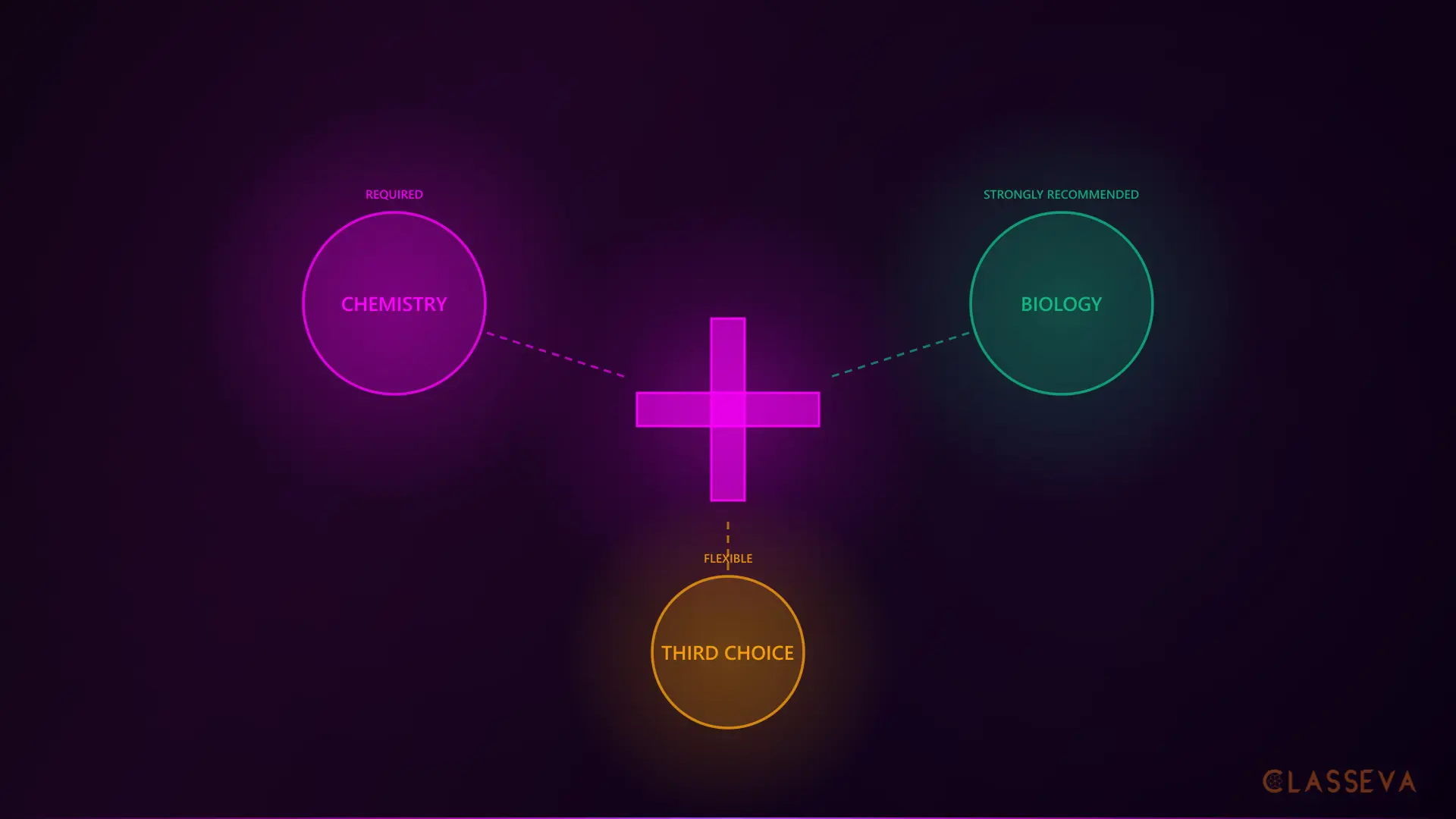
Chemistry is the closest thing to a universal requirement across UK medical schools. The overwhelming majority list it as compulsory, and those that do not still include it on their list of acceptable science subjects. In practical terms, applying to medicine without Chemistry A-Level means ruling out most of the approximately 40 UK medical schools.
The reason is straightforward: the first two years of a medical degree are heavily biochemistry-based. Pharmacology, metabolism, and molecular biology all build directly on A-Level Chemistry knowledge. Medical schools have found that students without this foundation struggle significantly in the pre-clinical years.
Biology: Strongly Recommended
Biology is the second most important subject, required by the majority of medical schools and strongly recommended by the rest. Some universities will accept Chemistry plus one other science (Maths or Physics) without Biology, but this narrows your child's options considerably.
Around a third of UK medical schools explicitly require Biology as one of your three A-Levels. The remainder accept it as one of several approved science subjects. Taking Biology keeps every medical school in the country open to your child. Dropping it immediately removes a significant portion.
Your Third Subject
With Chemistry and Biology in place, the third A-Level is where your child has genuine flexibility. Medical schools generally accept any third subject, though they tend to prefer those that demonstrate analytical or scientific thinking.
The most common choices for the third A-Level among successful medicine applicants are:
Maths
- •Demonstrates quantitative reasoning
- •Useful for pharmacology and statistics modules
- •Preferred by some medical schools
- •Good fallback if medicine plans change
Physics
- •Valued for analytical problem-solving
- •Relevant to medical physics and imaging
- •Less commonly chosen but well-respected
- •Strong complement to Chemistry and Biology
Psychology
- •Directly relevant to patient interaction
- •Covers research methods and statistics
- •Growing in popularity among applicants
- •Demonstrates interest in mental health
Other subjects like English Literature, History, or a Modern Foreign Language are also accepted. Medical schools value the critical thinking and communication skills these subjects develop. The key is that at least two of the three A-Levels should be from a science or maths discipline.
The Safest A-Level Combination for Medicine
If your child is serious about medicine and wants to keep the maximum number of medical schools open, the safest combination is:
Chemistry + Biology + one of Maths, Physics, or Psychology. This combination is accepted by virtually every UK medical school. It satisfies both the Chemistry requirement and the Biology requirement, while the third subject demonstrates breadth.
The specific third subject matters less than parents often think. I have seen families agonise for weeks over whether Maths or Psychology is “better” for medicine. The honest answer: both are accepted everywhere, so the best choice is whichever subject your child will get the highest grade in. A student with A*A*A in Chemistry, Biology, and Psychology is in a stronger position than one with A*A*B in Chemistry, Biology, and Maths.
Subjects That Can Close Doors
While most third subjects are accepted, there are specific combinations and subjects that can limit your child's options. This is where parents need to pay close attention, because these restrictions are not always obvious from a casual read of admissions pages.
Maths and Further Maths Restriction
Some medical schools will not accept Maths and Further Mathsas two of your child's three A-Levels. The reasoning is that these two subjects share substantial content overlap, and medical schools want to see breadth of academic ability, not depth in a single discipline.
This does not mean Maths is unwelcome. It means that if your child takes Maths as their third A-Level alongside Chemistry and Biology, that is perfectly fine. But if they were to take Chemistry, Maths, and Further Maths (dropping Biology), some medical schools would not accept this combination because only one of their three subjects is a laboratory science.
Students who are exceptionally strong at maths sometimes want to take Chemistry, Maths, and Further Maths. While this keeps some medical schools open, it closes others. If your child is set on medicine, they should take Biology instead of Further Maths as one of their three.
Excluded Subjects
Two subjects are universally excluded from the count of three A-Levels by medical schools:
| Subject | Status | Why |
|---|---|---|
| General Studies | Not accepted | Considered too broad; no specialist depth |
| Critical Thinking | Not accepted | Not considered a full A-Level by medical schools |
These subjects are not counted as one of your three A-Levels by any UK medical school
Your child can take these subjects as a fourth A-Level if they wish, but they will not count towards the three subjects medical schools assess. Some schools also view certain vocational qualifications differently, so it is worth checking individual admissions pages if your child is considering a BTEC alongside their A-Levels.
What Grades Do Medical Schools Need?
Medicine A-Level requirements for grades are among the highest of any university course. The minimum offer from most medical schools is AAA, but many of the most competitive programmes ask for more.
| Offer Level | Example Universities | Notes |
|---|---|---|
| A*A*A | Oxford, some London medical schools | The highest standard offers in the country |
| A*AA | Cambridge, Imperial, UCL, Edinburgh | A* typically required in Chemistry or Biology |
| AAA | Most Russell Group medical schools | The most common standard offer |
| AAB | Some widening participation programmes | Contextual offers for eligible students |
Typical A-Level grade requirements across UK medical schools (2025/2026 entry)
Contextual offers are worth knowing about. Many medical schools make lower offers (sometimes AAB or even ABB) to students from underrepresented backgrounds, those who are first in their family to attend university, or those from areas with low progression to higher education. These are genuine, published pathways, not exceptions to the rule.
One thing that catches families off guard: predicted grades matter just as much as final grades for the application itself. Your child's teachers will predict their A-Level grades at the start of Year 13, and medical schools use these predictions to decide who receives an interview. A student predicted ABB is unlikely to receive interview invitations from medical schools offering AAA, even if they ultimately achieve higher grades.
Beyond A-Levels: The Full Picture
A-Level grades alone do not get your child into medical school. Medicine is unusual in that the application process has multiple components, each of which can make or break a candidacy. Parents need to understand all of these, not just the grades.
The UCAT
The UCAT (University Clinical Aptitude Test) is required by the majority of UK medical schools. It replaced the BMAT at most universities and is now the dominant admissions test for medicine. Your child will typically sit the UCAT in the summer between Year 12 and Year 13, with results available immediately.
The UCAT tests five areas: verbal reasoning, decision making, quantitative reasoning, abstract reasoning, and situational judgement. It is a two-hour computer-based test, and the score is used alongside A-Level predictions and the personal statement to decide who is invited to interview.
The UCAT testing window typically opens in July and closes in September. Most students sit it in July or August of the summer before Year 13. Preparation usually takes 4 to 8 weeks, and there are free official practice materials available through the UCAT website.
A strong UCAT score can compensate for slightly lower predicted grades, and a weak UCAT score can undermine an otherwise excellent application. This is something parents rarely hear about until Year 12, which is often too late for adequate preparation.
Work Experience
Medical schools expect applicants to demonstrate sustained engagement with healthcare, not just a single week of shadowing. The emphasis is on reflection: what did your child observe, what did they learn about the realities of being a doctor, and how did the experience confirm their motivation?
Useful forms of work experience include volunteering in care homes, hospices, or community health settings; hospital shadowing placements (where available); regular volunteering with organisations like St John Ambulance; and any role involving caring for others. The key word medical schools use is “sustained”: they want to see ongoing commitment, not a one-off visit.
GCSE Grades Still Matter
Many medical schools require a minimum number of GCSEs at grade 7, 8, or 9, with some specifying English and Maths at grade 6 or above. Our complete guide to GCSEs for medicine covers this in detail, but the key point for parents is that GCSE performance is not forgotten once A-Levels begin.
Some medical schools use a GCSE scoring system where each grade earns points, and these contribute to a total admissions score alongside the UCAT. Oxford, for example, uses GCSE profiles when shortlisting applicants who have similar UCAT scores and predicted A-Level grades.
The Parent Timeline: Year 10 to 13
The medicine application process spans several years, and it is easy to miss critical deadlines if you are not aware of them in advance. Here is the timeline every parent of an aspiring medical student needs to know.
Medicine has an earlier UCAS deadline than most courses: 15 October in Year 13. This is roughly two months earlier than the standard January deadline. Missing it means waiting an entire year to reapply. Parents should have this date in their calendar from the start of Year 12.
Year 10: Build the Foundation
Focus on strong GCSE performance, particularly in sciences, maths, and English. Start looking into local volunteering opportunities in healthcare settings.
Year 11: GCSEs and Early Research
Achieve the strongest possible GCSE grades. Research which A-Level subjects your child's target medical schools require. Confirm A-Level choices before sixth form enrolment.
Year 12 Autumn: Commit to the Path
Begin A-Levels in Chemistry, Biology, and a third subject. Start or continue regular work experience in a healthcare setting.
Year 12 Spring: Prepare for the UCAT
Begin UCAT preparation using official practice materials. Attend medical school open days to narrow down your child's preferred universities.
Year 12 Summer: UCAT and Personal Statement
Sit the UCAT between July and September. Begin drafting the personal statement, drawing on work experience and academic motivation.
Year 13 September: Finalise Application
Complete the personal statement. Request the school reference. Select up to 4 medicine choices on UCAS (the fifth can be a non-medicine backup).
Year 13 October 15: Submit
Submit the UCAS application before the October deadline. This is not flexible, and late applications for medicine are not accepted.
Year 13 Winter: Interviews
Attend interviews at universities that invite your child. These may be Multiple Mini Interviews (MMIs) or traditional panel interviews.
What If Your Child Changes Their Mind?
This is something parents rarely think about until it happens, but it is more common than you might expect. Not every student who starts Year 12 wanting to study medicine still feels the same way by Year 13. The good news is that the recommended A-Level combination for medicine is one of the most versatile in the entire curriculum.
Chemistry, Biology, and Maths opens doors to Veterinary Science, Dentistry, Biomedical Sciences, Pharmacy, Biochemistry, and dozens of other degree courses. Even if your child decides medicine is not for them, they will not have wasted their A-Level choices. This is one of the strongest arguments for the Chemistry + Biology + Maths combination: it keeps the widest range of competitive degrees accessible.
If Medicine Stays the Goal
- •Continue with Chemistry + Biology + third subject
- •Sit the UCAT in summer of Year 12
- •Apply via UCAS by 15 October
- •Prepare for interviews
If Plans Change
- •Chemistry + Biology opens Veterinary, Dentistry, Pharmacy
- •Chemistry + Maths opens Engineering, Natural Sciences
- •Biology + Psychology opens Neuroscience, Biomedical Science
- •No A-Level choices are wasted
Having worked with many families in tutoring, I noticed that the students who coped best with changing their mind were those whose parents had not built the entire family identity around “my child is going to be a doctor.” Keeping the conversation open about alternatives, while still supporting the medicine goal, gives your child permission to be honest if their interests shift.
For more on how A-Level subject choices connect to career pathways, see our guide to GCSE grades needed for A-Levels. If your child is still at the GCSE stage, our GCSEs for medicine guide covers the earlier steps in detail. And for broader guidance on subject combinations, the Russell Group's Informed Choices guide is an excellent independent resource.
The UCAS medicine entry requirements pageprovides an up-to-date list of every medical school's specific subject and grade requirements. It is worth bookmarking this page and checking it directly, as requirements can change year to year.
The best thing you can do as a parent is help your child understand the full picture early. The families I saw succeed were not those with the cleverest children. They were the ones who knew the requirements, planned ahead, and gave their child the time and support to build a genuinely strong application. Start early, stay informed, and the process becomes manageable rather than overwhelming.