Russell Group Universities: What Parents Should Know
If your child is starting to think about university, you have probably come across the term “Russell Group” on open day websites, school prospectuses, or in conversations with other parents. Some families treat Russell Group membership as shorthand for “the good universities.” Others have no idea what it means. Neither reaction is quite right.
During my time working in tutoring, I noticed that parents fell into two camps when it came to the Russell Group. One group insisted their child mustattend a Russell Group university, even if a non-member institution was ranked higher for their child's chosen subject. The other group had never encountered the term and were making decisions without understanding how some employers and industries view these institutions. Both groups were making partially informed choices.
This Russell Group universities guideexplains what the Russell Group actually is, lists all 24 member universities, and gives you the honest picture of when it matters for your child's future and when it genuinely does not.
What Is the Russell Group?
The Russell Group is an association of 24 UK universities that describe themselves as “research-intensive.” Together, these 24 institutions receive a disproportionate share of UK research funding, produce a large volume of academic research, and tend to rank highly in global league tables.
Here is the key point that many parents miss: the Russell Group is not a government designation or an official quality mark. It is, in practical terms, a lobbying and collaboration group. Universities apply to join and are accepted based on their research output and income. A university can be excellent without being a member, and membership says nothing directly about teaching quality.
The Russell Group is not a ranking, not a government quality label, and not a guarantee of better teaching. It is a self-selected membership group based on research activity. Think of it as an indicator of research strength, not overall university quality.
How Did It Start?
The Russell Group was founded in 1994. The name comes from the Hotel Russell in London's Russell Square, where the vice-chancellors of these universities first met. Originally there were 17 members. The group expanded to 20 in 2006 and then to the current 24 in 2012, when Durham, Exeter, Queen Mary, and York were invited to join.
What Membership Actually Means
Member universities typically share certain characteristics: large endowments, high volumes of published research, significant income from research grants (public and private), and strong postgraduate communities. They collectively account for around two-thirds of research grant and contract income in UK universities.
What membership does not guarantee is better undergraduate teaching, higher student satisfaction, or stronger graduate employment outcomes in every field. Some of the highest-rated universities for student experience and teaching quality, such as St Andrews, Loughborough, and Lancaster, are not Russell Group members.
The Full List of 24 Russell Group Universities
There are exactly 24 universities in the Russell Group universities list. The group has not expanded since 2012, though there is occasional speculation about which institutions might join next. Here they are, along with their locations.
| University | Location | Notable Strengths |
|---|---|---|
| University of Oxford | Oxford, England | Humanities, Sciences, PPE, Medicine |
| University of Cambridge | Cambridge, England | Sciences, Engineering, Mathematics, Law |
| Imperial College London | London | Engineering, Medicine, Science, Computing |
| UCL | London | Architecture, Medicine, Psychology, Law |
| LSE | London | Economics, Politics, Social Sciences, Law |
| King's College London | London | Law, Dentistry, Nursing, Humanities |
| Queen Mary University of London | London | Medicine, Law, Linguistics, Drama |
| University of Edinburgh | Edinburgh, Scotland | Medicine, AI, Veterinary Science, Law |
| University of Glasgow | Glasgow, Scotland | Medicine, Dentistry, Engineering, Arts |
| Cardiff University | Cardiff, Wales | Journalism, Architecture, Optometry |
| Queen's University Belfast | Belfast, N. Ireland | Pharmacy, Food Science, Law |
| University of Manchester | Manchester | Physics, Engineering, Business, Medicine |
| University of Birmingham | Birmingham | Dentistry, Sport, Chemical Engineering |
| University of Bristol | Bristol | Veterinary Science, Engineering, Law |
| University of Warwick | Coventry | Mathematics, Economics, Business, Theatre |
| Durham University | Durham | Theology, English, Archaeology, Law |
| University of Exeter | Exeter | Biosciences, Business, Sport Science |
| University of York | York | History, English, Chemistry, Electronics |
| University of Leeds | Leeds | Engineering, Media, Business, Dentistry |
| University of Sheffield | Sheffield | Engineering, Architecture, Journalism |
| University of Nottingham | Nottingham | Pharmacy, Veterinary Medicine, Engineering |
| University of Liverpool | Liverpool | Veterinary Science, Architecture, Medicine |
| University of Southampton | Southampton | Electronics, Marine Science, Engineering |
| Newcastle University | Newcastle | Medicine, Architecture, Marine Technology |
Source: Russell Group. Strengths based on subject league table performance.
Russell Group Universities by Region
Five Russell Group universities are in London (Imperial, UCL, LSE, King's, Queen Mary). The rest are distributed across England, Scotland, Wales, and Northern Ireland. This geographical spread means your child can attend a Russell Group university without necessarily moving to London or the South East.
Edinburgh and Glasgow (Scotland) and Queen's Belfast (Northern Ireland) are Russell Group members. Scottish universities typically offer four-year undergraduate degrees rather than three, and tuition fee structures differ. Check the specifics before assuming the same costs apply.
When the Russell Group Matters
It would be dishonest to say the Russell Group label never matters. In certain career paths, it carries real weight. Understanding when helps your child make a genuinely informed choice rather than applying based on prestige alone.
Competitive Graduate Schemes
Investment banking, management consulting, and the top-tier “magic circle” law firms recruit disproportionately from Russell Group universities. This is not a formal policy at most firms, but it is an observable pattern. Graduate recruiters at these organisations often attend careers fairs only at Russell Group institutions, and their application screening sometimes uses university prestige as an early filter.
If your child is interested in careers at firms like Goldman Sachs, McKinsey, Deloitte, or Clifford Chance, attending a Russell Group university (and particularly a top-ten member) does provide a measurable advantage in getting interviews.
Research Careers and Postgraduate Study
Because Russell Group universities receive the majority of UK research funding, they offer more funded PhD positions, more laboratory resources, and more opportunities to work alongside leading academics. If your child is considering an academic or research career, the research environment at these institutions is genuinely stronger.
International Recognition
Russell Group universities appear more frequently in global rankings (THE World University Rankings, QS World Rankings). If your child is considering working abroad, particularly in countries where university brand recognition matters (parts of Asia, the Middle East, the United States), a Russell Group degree is more likely to be immediately recognised.
Russell Group Advantage
- •Investment banking and consulting recruitment
- •Magic circle law firm access
- •Funded PhD and research positions
- •International name recognition
- •Medicine, Dentistry, and Vet Science programmes
Russell Group Irrelevant
- •Teaching, Nursing, Social Work, Physiotherapy
- •Creative industries (portfolio matters more)
- •Most SME and public sector employment
- •Vocational degrees with strong employer demand
- •Subjects where non-members rank #1
When the Russell Group Does Not Matter
This is the section many parents need most. For the majority of careers and degree subjects, the Russell Group label makes little practical difference. Knowing this can save your child from choosing a less suitable course simply because the university has a recognisable name.
Teaching Quality and Student Satisfaction
Russell Group membership is based on research, not teaching. The National Student Survey (NSS) and the Teaching Excellence Framework (TEF) both measure teaching quality directly. In both, many non-Russell Group universities consistently outperform members.
The University of St Andrews, for example, regularly tops student satisfaction rankings in the UK but is not a Russell Group member. Loughborough University has won the Complete University Guide Student Experience award repeatedly. Lancaster, Bath, and Harper Adams all score highly for teaching without Russell Group membership.
When comparing universities, check the TEF rating (Gold, Silver, Bronze) and the NSS scores for your child's specific subject. These measure the quality of teaching your child will actually experience, not the university's research reputation.
Subject-Specific Excellence
Some of the best programmes in the country are at non-Russell Group universities. Loughborough is consistently ranked number one for Sport Science. Arts University Bournemouth leads for Animation. Northumbria has a strong reputation for Architecture practice-based courses. The Royal Veterinary College is world-class for veterinary science but is not a Russell Group member.
One pattern I noticed working with families was that students sometimes chose a lower-ranked programme at a Russell Group university over a top-ranked programme at a non-member, purely because of the name. When they researched graduate outcomes for their specific subject, the picture often looked very different.
Vocational and Creative Degrees
For Nursing, Physiotherapy, Teaching, Social Work, Midwifery, and similar vocational degrees, employer demand is so high that the university name matters far less than the qualification itself. The NHS, local authorities, and schools need qualified professionals. They do not filter by Russell Group status.
In creative industries such as art, design, film, animation, and music production, your child's portfolio and practical experience carry far more weight than university prestige. An industry recruiter reviewing a showreel or portfolio does not check whether the university was in the Russell Group.
Russell Group vs Other Universities: How to Compare
The question of Russell Group vs other universities comes up in almost every conversation I have had with parents about higher education. The honest answer is: it depends entirely on what your child wants to study and what career they are aiming for.
Rather than treating Russell Group membership as a binary quality filter, use it as one of several data points alongside subject-specific league tables, graduate employment statistics, and the Teaching Excellence Framework rating.
Choosing a Russell Group university purely for the name, when a non-member ranks higher for your child's subject, is one of the most common mistakes families make. A mediocre programme at a famous university is still a mediocre programme.
League Tables Worth Checking
No single league table tells the full story, but together they give a rounded picture. Here are the ones worth checking for your child's shortlisted subjects.
| League Table | Focus | Best For |
|---|---|---|
| Complete University Guide | Overall and subject-specific rankings | Comparing specific subjects across universities |
| Guardian University Guide | Teaching quality and student satisfaction | Finding universities where students are happiest |
| THE World University Rankings | Global research rankings | International career plans or postgraduate research |
| The Uni Guide (Student Room) | Student reviews and real experiences | Understanding day-to-day student life |
| Discover Uni (GOV.UK) | Graduate outcomes and salary data | Understanding what graduates actually earn |
Use subject-specific rankings, not the overall table, when comparing courses.
The most useful approach is to look at the subject-level rankings on The Complete University Guide and then cross-reference with the Discover Uni data for graduate employment rates. This tells you both how the course is rated and what graduates from that course actually go on to do.
The Informed Choices Guide and Facilitating Subjects
The Russell Group published a guide called Informed Choices, which has significantly influenced A-Level subject selection advice in schools for over a decade. The guide identified a set of “facilitating subjects” that keep the most Russell Group doors open.
| Facilitating Subject | Why It Is Valued |
|---|---|
| Mathematics | Required or preferred for most STEM and social science degrees |
| Further Mathematics | Essential for competitive Maths, Physics, and Engineering programmes |
| English Literature | Valued across humanities, social sciences, and law |
| Physics | Required for engineering and physical sciences |
| Biology | Required for medicine, dentistry, and life sciences |
| Chemistry | Required for medicine, dentistry, and chemical sciences |
| Geography | Valued for its combination of analytical and essay skills |
| History | Valued for critical analysis and extended writing |
| Modern Languages | Valued across all disciplines as a skills subject |
Source: Russell Group Informed Choices guide. The strict 'facilitating' category has been relaxed, but these subjects remain broadly valued.
It is worth noting that the Russell Group has softened the “facilitating subjects” concept in recent years. The current guidance emphasises choosing subjects your child enjoys and will achieve well in, rather than rigidly sticking to the original list. However, the practical reality is that these subjects do keep the widest range of Russell Group courses accessible.
For a deeper look at how facilitating subjects affect university choices, see our guide to facilitating subjects for A-Level students.
What Parents Should Do Now
The most useful thing you can take from this Russell Group universities guideis a framework for thinking about university choices, rather than a simple “Russell Group good, everything else bad” rule. Here are practical steps.
Start with the subject, not the university
Ask your child what they want to study, then look at which universities rank highest for that subject specifically. The Complete University Guide subject tables are the best starting point.
Check graduate outcomes
Use Discover Uni (the government data portal) to compare graduate employment rates and salaries for the same course at different universities. This data is more useful than overall prestige.
Understand when the Russell Group label matters
If your child is aiming for investment banking, management consulting, or academic research, the Russell Group does carry weight. For most other career paths, it is one factor among many.
Visit universities in person
Open days reveal things league tables cannot: whether your child feels comfortable on campus, the quality of facilities for their course, and whether the teaching staff are engaging.
Keep A-Level choices flexible
If your child is unsure about their degree path, choosing facilitating subjects keeps the widest range of Russell Group courses open. See our guide to the best A-Level combinations for more detail.
Do not dismiss alternatives
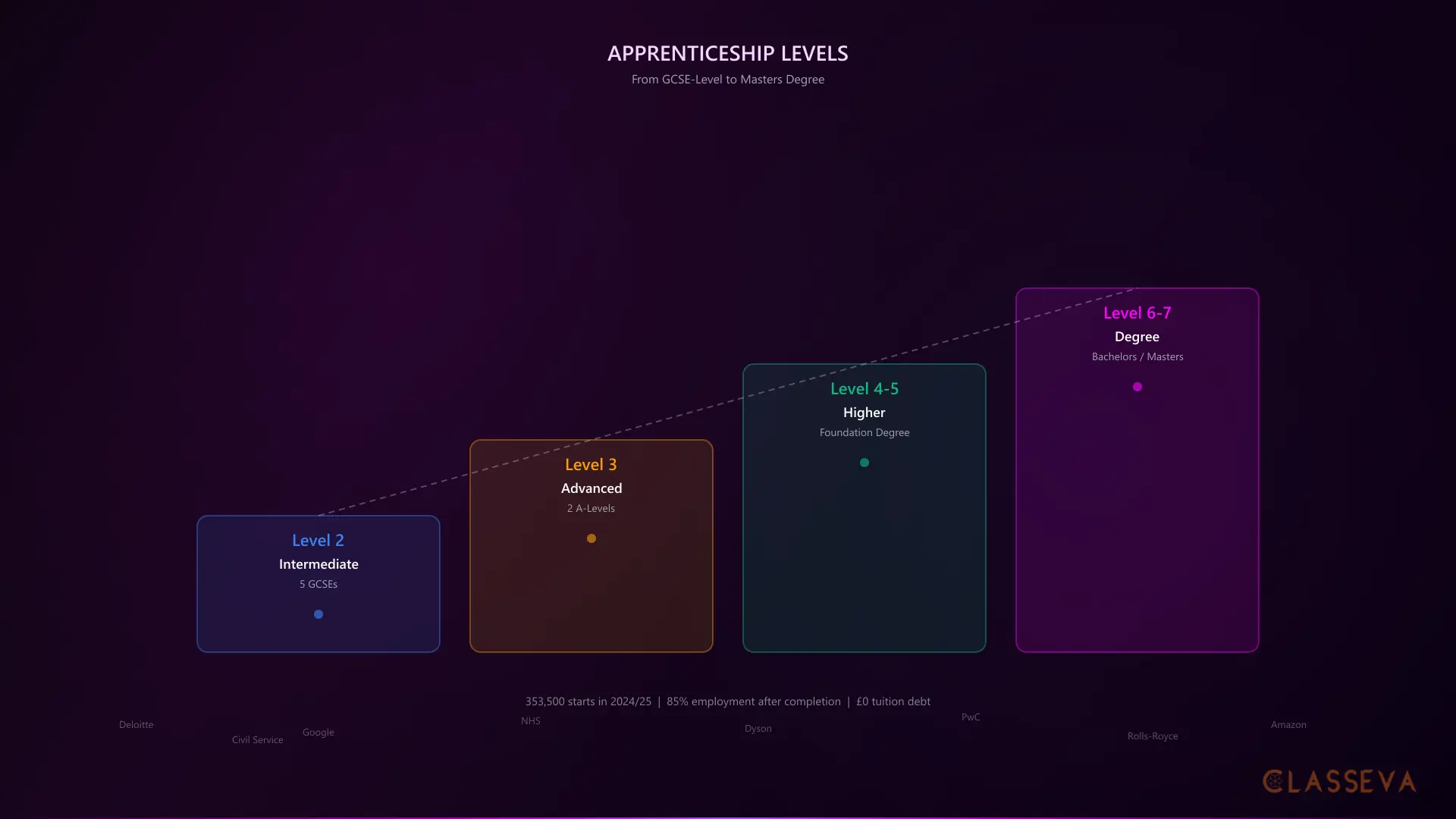
Degree apprenticeships, foundation years, and non-Russell Group universities with top-ranked programmes all deserve serious consideration. The best university is the one where your child will thrive.
If your child is still at the A-Level subject selection stage, getting that choice right is more impactful than which university they eventually apply to. The best A-Level subject combinations guide covers how to keep doors open while playing to your child's strengths.
For families exploring alternatives to the traditional university route, our guide to degree apprenticeships explains how your child can earn a full degree while being paid a salary from day one. And if your child is still building their A-Level knowledge, the A-Levels for medicine guide is a good example of how entry requirements work in practice for competitive Russell Group courses.
The Russell Group is a useful reference point, not a definitive ranking. Use it as one input alongside subject rankings, graduate outcomes, and your child's personal fit. The best university for your child is the one where they will learn, grow, and graduate ready for the career they want.