KS1 SATs: What Parents Need to Know
If your child is in Year 2, you may have heard other parents mention “SATs” and wondered whether your six-year-old really has formal exams. The short answer: probably not, or at least not in the way you might think. KS1 SATs have changed significantly in recent years, and the situation in 2026 is quite different from what Year 6 parents experience.
The most important thing to know is this: since the 2023/24 academic year, KS1 SATs tests are no longer compulsory. Your child will still be assessed at the end of Year 2 through teacher assessment, but the formal test papers are now optional. Some schools still use them; others have stopped entirely.
When I worked in the tutoring industry, I noticed that parents of younger children often had the most questions and the least information. Schools were sometimes unclear about what was happening, and parents were left wondering whether they should be doing something at home. This guide sets out exactly what KS1 assessments involve in 2026, how they differ from the KS2 SATs your child will face in Year 6, and what you can do to support your child without creating unnecessary pressure.
What Are KS1 SATs?
KS1 SATs are national curriculum assessments taken at the end of Key Stage 1, when your child is in Year 2 (aged 6 to 7). They were introduced to measure whether children had reached the expected standard in core subjects before moving into Key Stage 2. For many years, schools were required to administer formal test papers alongside teacher assessment. That changed in 2024.
The 2024 Change: Tests Are Now Optional
From the 2023/24 academic year, the government made KS1 SATs tests optional. This means schools are no longer required to administer the formal reading, maths, and GPS papers to Year 2 children. Instead, teacher assessment is the primary and mandatory method for reporting at the end of Key Stage 1.
The decision came after growing recognition that formal testing at age six or seven can create unnecessary stress for young children. The GOV.UK assessment arrangements now state that schools may use the test papers to inform their teacher assessments if they wish, but they are not obliged to.
Your child will be assessed at the end of Year 2, regardless of whether your school uses the formal tests. The teacher assessment is mandatory. What has changed is the method: schools now have more flexibility in how they gather evidence to make their judgements.
Does My Child's School Still Use Them?
Many schools still choose to administer the KS1 test papers even though they are optional. There are a few reasons for this. The papers provide a standardised benchmark that helps teachers calibrate their assessments. They also give schools a structured way to identify children who may need additional support in Year 3.
If you are unsure whether your child's school uses the formal tests, ask the class teacher or check the school's assessment policy. There is no right or wrong answer here: some excellent schools use them, and some equally excellent schools do not.
What the KS1 Tests Cover
If your school does use the formal KS1 SATs papers, here is what your child will sit. The tests are designed to be low-pressure: they are administered by the class teacher (not an external examiner), they are not strictly timed, and they are typically spread across several days in May.
Reading Papers
There are two reading papers. Paper 1 is a combined booklet where your child reads a short passage and answers questions on the same pages. The questions are straightforward retrieval: finding information, matching, and simple inference. Paper 2 uses a separate reading booklet and answer booklet, with longer texts and more demanding questions including vocabulary and explanation.
Maths Papers
Paper 1 is arithmetic: basic addition, subtraction, simple multiplication and division, and place value. No aids or resources are allowed. Paper 2 is reasoning: word problems, shape and measurement questions, and problems that require children to apply their mathematical understanding rather than just calculate.
Grammar, Punctuation and Spelling
Paper 1 tests grammar and punctuation through short-answer questions: identifying nouns, verbs, adjectives, using correct punctuation, and forming sentences. Paper 2 is a spelling test where the teacher reads out 20 words and children write them in a booklet.
| Paper | Format | Focus |
|---|---|---|
| Reading Paper 1 | Combined reading and answer booklet | Retrieval, simple inference |
| Reading Paper 2 | Separate reading and answer booklet | Vocabulary, explanation, inference |
| Maths Paper 1 | Arithmetic (no aids) | Addition, subtraction, multiplication, division |
| Maths Paper 2 | Reasoning | Word problems, shape, measurement |
| GPS Paper 1 | Short-answer questions | Grammar, punctuation |
| GPS Paper 2 | Spelling (teacher-read) | 20 words dictated aloud |
If your school uses the formal KS1 tests, these are the six papers your child may sit.
KS1 tests are deliberately designed to feel like normal classroom activities. Your child may not even realise they are doing a “test.” Teachers often introduce them as special activities rather than exams, and there is no strict time pressure. If your child does not finish, that is fine.
How Teacher Assessment Works
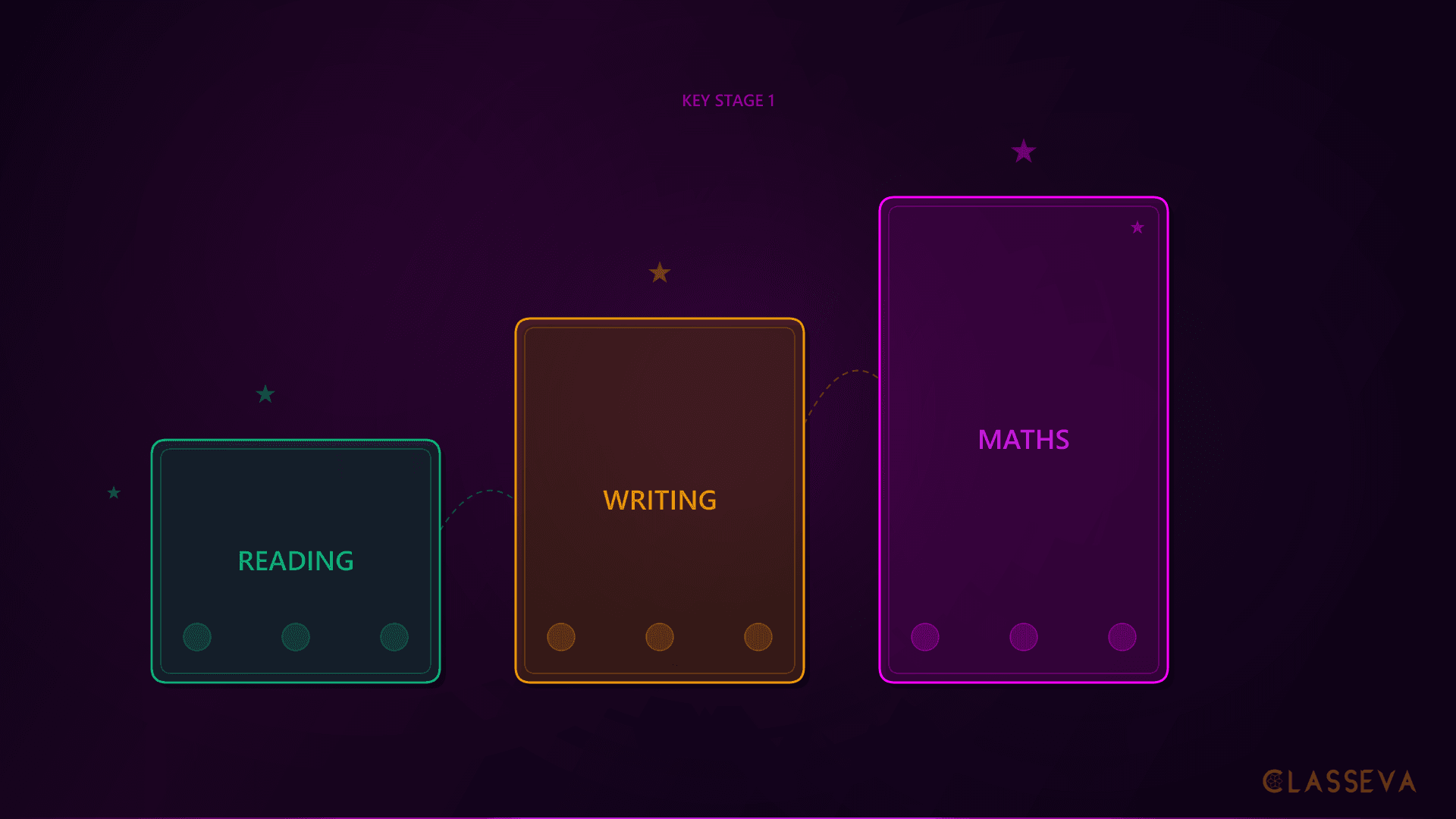
Whether or not your school uses the formal tests, teacher assessment is the mandatory and final method for reporting KS1 outcomes. Teachers use their professional judgement, built up across the entire school year, to assess your child in reading, writing, mathematics, and science.
The Three Assessment Standards
For each subject, your child's teacher will report one of three standards:
Working Towards Expected
- •Your child has not yet reached the standard expected for the end of Year 2
- •This is not a failure. It signals areas where targeted support will help
- •Many children assessed here at KS1 reach expected standard by KS2
Working at Expected
- •Your child has met the standard expected for their age
- •This is where the majority of children are assessed
- •It means they have a solid foundation for Key Stage 2
Greater Depth
- •Your child is working above the standard expected
- •They show deeper understanding and can apply skills in new contexts
- •This does not predict future grades. It is a snapshot at age 6-7
What Teachers Use to Make Judgements
Teachers draw on multiple sources of evidence: classwork throughout the year, guided reading sessions, written work in exercise books, observations during lessons, and (if used) the formal test results. The assessment is not based on a single test score. It is a holistic judgement about whether your child consistently demonstrates the skills and knowledge expected at the end of Key Stage 1.
How KS1 Differs from KS2 SATs
If you have an older child who has been through Year 6, you know what KS2 SATs feel like: a defined test week, timed papers, external marking, and results that feed into school league tables. KS1 is a completely different experience.
| Feature | KS1 (Year 2) | KS2 (Year 6) |
|---|---|---|
| Tests compulsory? | No (optional since 2024) | Yes (mandatory) |
| Timed papers? | No (flexible, untimed) | Yes (strict time limits) |
| Marked by | Class teacher | External markers |
| Results in league tables? | No | Yes |
| Final outcome | Teacher assessment only | Test scores + teacher assessment (writing) |
| Scaled scores? | No | Yes (80-120 scale) |
| Pressure level | Low (feels like classwork) | Higher (formal test conditions) |
Source: GOV.UK KS1 and KS2 assessment arrangements
Why KS1 Is Lower Pressure
The key difference is purpose. KS2 SATs exist partly to hold schools accountable through published data. KS1 assessments are designed to inform teaching: they help the Year 3 teacher understand where each child is and what support they need. There is no league table pressure at KS1, no national publication of results, and no external scrutiny of individual scores.
Having spoken with many parents during my time in the tutoring industry, I found that those with children in both Key Stages sometimes applied Year 6 levels of concern to their Year 2 child. The reality is that these are two very different situations. Your Year 2 child does not need practice papers every weekend. They need to enjoy school and build a strong foundation.
The government's Curriculum and Assessment Review recognised that formal testing at age 6-7 placed unnecessary pressure on young children without adding significant value beyond what teacher assessment already provided. Teachers who work with children daily are well placed to assess their progress without requiring formal test conditions.
What Happens with the Results
Your child's KS1 teacher assessment results are shared with you as a parent and reported to the local authority. They are also passed to your child's Year 3 teacher to support transition planning. That is it. They do not appear on any public record, they are not used for secondary school admissions, and they do not follow your child through their education in any formal sense.
For context, the UK education system uses Key Stage assessments as checkpoints, not gatekeepers. KS1 is the earliest of these checkpoints, and the lightest touch.
How Parents Can Help at Home
The single most important thing to know about supporting a Year 2 child is this: at age 6-7, attitude towards learning matters far more than test scores. The skills assessed at KS1 (reading, writing, basic maths) are built through daily habits, not through intense preparation. Here is what actually makes a difference.
Building Reading Confidence
Reading with your child regularly is the highest-impact thing you can do. It supports not just the reading assessment but writing and vocabulary development too. Aim for at least 10 to 15 minutes of reading together every day. Ask questions about what you read: “Why do you think that character did that?” or “What do you think might happen next?” These are the same types of inference questions the assessments cover.
Let your child choose books they genuinely enjoy. Forcing a reluctant reader through books they dislike is counterproductive. If they want to read the same book for the fifth time, that is fine. Re-reading builds fluency and confidence.
Maths in Everyday Life
The maths assessed at KS1 covers number bonds, basic operations (addition, subtraction, simple multiplication and division), telling the time, measuring, and handling money. All of these can be practised naturally without worksheets.
Practise number bonds
Play quick-fire games: "What goes with 7 to make 10?" Work up from bonds to 10, then bonds to 20. These are fundamental building blocks.
Count everything
Steps to the car, grapes in the bowl, coins in a jar. Counting forwards and backwards in 2s, 5s, and 10s builds the foundation for multiplication.
Use real money
Let your child handle coins when shopping. "Can you find the coins to make 35p?" This builds place value and addition skills simultaneously.
Tell the time
Ask your child what time it is throughout the day. Start with o’clock and half past, then move to quarter past and quarter to.
Measure and compare
Baking is brilliant for maths: weighing ingredients, comparing amounts, and following a sequence of steps. "Which is heavier, 200g or half a kilogram?"
Encouraging Writing
Writing is teacher-assessed only (there is no formal writing test), but it is still one of the four assessed subjects. Encourage your child to write for real purposes: shopping lists, birthday cards, letters to grandparents, labels for their drawings, or short stories about their day. The key is that writing feels purposeful, not like a chore.
Past KS1 test papers are available free from GOV.UK. Use them for gentle familiarisation, not intensive drilling. Let your child try a paper in a relaxed setting so the format feels familiar. If they find it stressful, stop. The formal test is just one small part of the overall assessment.
The Bigger Picture
KS1 is the foundation. The skills assessed here, reading fluently, writing clearly, understanding numbers, are the building blocks for everything that follows through Key Stage 2 and beyond. The move away from mandatory testing at this age reflects a growing understanding that young children learn best when they feel confident and engaged, not when they are anxious about exams.
From what I saw working with families, the children who thrived at primary school were not the ones who started test preparation earliest. They were the ones whose parents read with them, played number games, and treated learning as something enjoyable rather than a performance to be measured. At age 6-7, building a love of learning is genuinely more valuable than any assessment outcome.
Do not compare your child's KS1 outcomes with other children's. Development at this age varies enormously. A child assessed as “working towards” in Year 2 is not behind in any permanent sense. They are developing at their own pace, and early intervention at this stage is highly effective. What matters is that the school identifies any gaps and provides appropriate support.
What to Do If You Have Concerns
If you are worried about your child's progress, the first step is always to speak to the class teacher. They spend more time with your child than any other adult outside your home and can give you specific, actionable advice. Ask what your child is doing well, where they might need extra support, and what you can do at home to help.
If your child is assessed as “working towards the expected standard” in any subject, this is an opportunity for targeted support rather than a cause for alarm. Early intervention at Key Stage 1 is one of the most effective times to address gaps. Many children who receive focused support in Years 2 and 3 go on to reach the expected standard comfortably by the end of Key Stage 2. Our KS2 SATs guide covers what to expect when your child reaches Year 6.
For a broader view of how the assessment system works across all Key Stages, including KS1 resources on BBC Bitesize and the progression from KS1 through to GCSEs, see our guide to the UK education system and Key Stages.