Is GCSE Computer Science Hard? What Parents Need to Know
Is GCSE Computer Science hard? It is one of the most common questions parents ask when their child is choosing GCSE options, and the honest answer is: yes, for most students, it is one of the more demanding optional GCSEs. Not because the concepts are impossibly advanced, but because the subject is fundamentally different from what many students and parents expect.
Having spent years working in UK tutoring, I noticed a recurring pattern with Computer Science. Students would choose it thinking it was about “computers” in the everyday sense: using software, designing websites, perhaps some light coding. By the time they encountered binary arithmetic, truth tables, and the fetch-decode-execute cycle, the gap between expectation and reality had already caused real damage to their confidence.
This guide breaks down exactly what makes GCSE Computer Science difficult, what makes it more accessible than its reputation suggests, and how you can tell whether it is the right choice for your child before they commit.
The Honest Answer: Yes, It Is Hard
GCSE Computer Science consistently ranks among the more challenging optional GCSEs. The AQA GCSE Computer Science specification covers a breadth of content that surprises many families: hardware architecture, software systems, networking protocols, data representation in binary and hexadecimal, cyber security, programming, algorithms, and ethical considerations. That is a lot of ground for two exam papers.
The difficulty is not about memorising facts. Unlike GCSEs where learning content and reproducing it gets you through, Computer Science requires you to apply understanding to unfamiliar problems. You might learn how a bubble sort works, but the exam will ask you to trace a modified version you have never seen before.
CS Is Not ICT
This is the single biggest source of confusion. Many parents remember ICT from their own school days: learning to use Word, building spreadsheets in Excel, creating presentations. ICT was about using technology. GCSE Computer Science is about understanding and building technology at a fundamental level.
ICT (Discontinued)
- •Using software (Word, Excel, Access)
- •Creating documents and databases
- •Practical application of tools
- •Largely discontinued as a standalone GCSE
Computer Science
- •How CPUs process instructions
- •Writing and tracing algorithms
- •Binary arithmetic and Boolean logic
- •Network protocols and cyber security
If your child says they want to take Computer Science because they “like computers,” that is worth unpacking. Do they mean they enjoy gaming and social media? Or do they mean they are curious about how software is built and how computers actually process data? Only the latter aligns with what GCSE CS actually teaches.
What Makes GCSE Computer Science Difficult
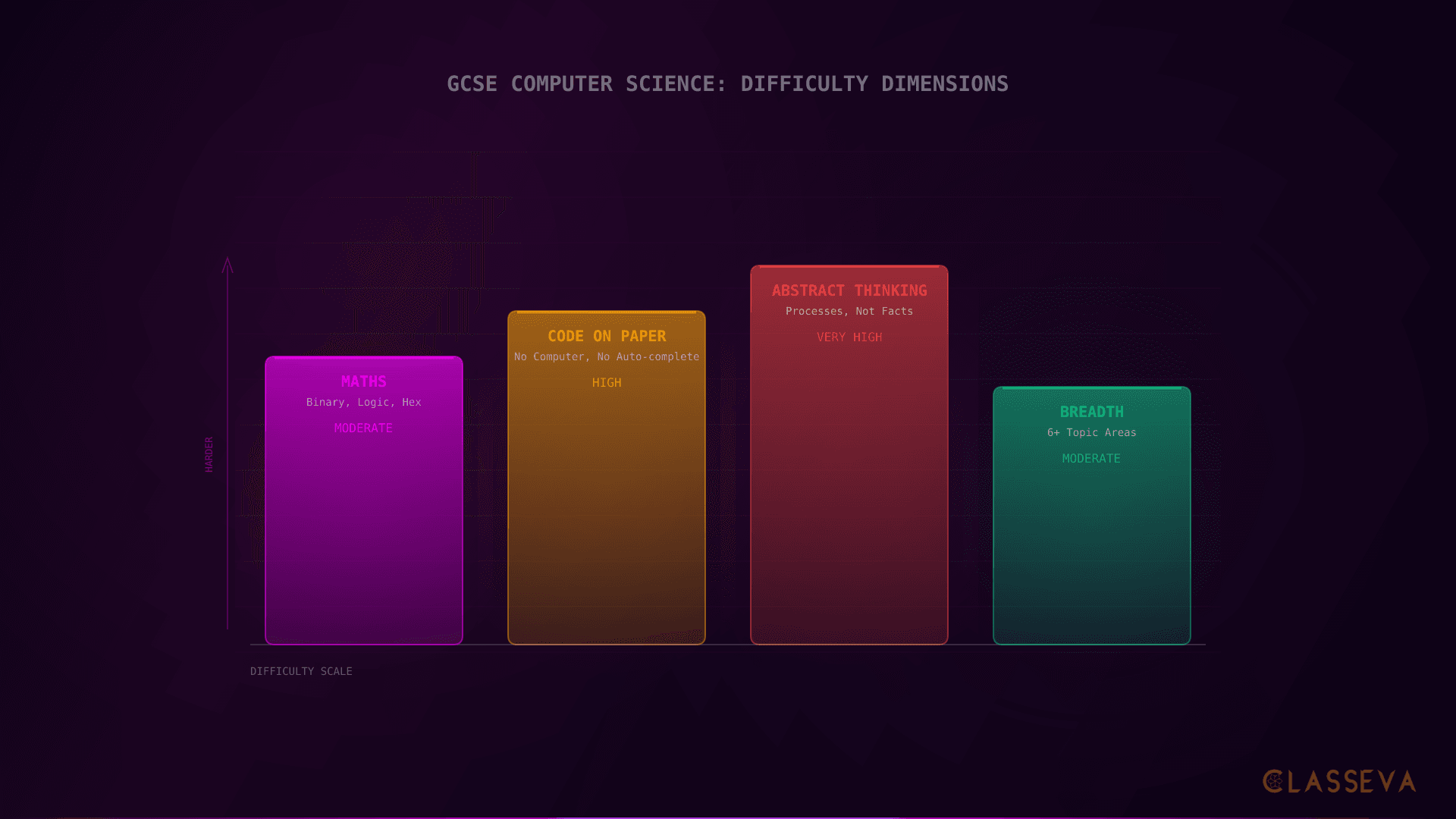
The GCSE computer science difficulty comes from five specific areas that together create a subject quite unlike anything else on the options list. Understanding each one helps parents set realistic expectations.
The Maths Content
GCSE Computer Science is more mathematical than most students expect. Binary conversion (between binary, denary, and hexadecimal), binary addition, binary shifts, Boolean logic using AND, OR, NOT, and XOR operators, logic gate diagrams, and truth tables all require numerical confidence.
Beyond pure number work, students must calculate file sizes using specific formulas. For images: resolution multiplied by colour depth. For sound: sample rate multiplied by bit depth multiplied by duration. These are not optional extras; they are core exam content.
Students who are working at grade 5 or above in GCSE Maths typically have the numerical foundations to handle the CS maths content. Students struggling with Maths at KS3 will find CS compounds the difficulty because the mathematical concepts are applied in an unfamiliar context (binary rather than decimal).
Programming on Paper
This is the challenge that catches the most students off guard. In the exam, your child must read, trace, and write code entirely by hand on paper. There is no computer, no syntax highlighting, no auto-complete, and no “run” button to test whether their code works.
Trace tables are a particularly demanding skill. Students must follow a piece of code line by line, tracking how each variable changes at every step. One small misread (confusing < with <=, for example) cascades through the entire table.
When I worked in tutoring, the students who struggled most with CS were often those who could write working code on a computer but fell apart when asked to do the same thing by hand. The auto-complete and error messages they relied on were gone, and suddenly they realised they did not truly understand the syntax they had been using.
Encourage your child to practise coding on paper regularly, even outside of school. Writing code by hand and manually tracing through it builds a deeper understanding than typing and running. Have them write a short program, then trace it step by step before checking on a computer.
Abstract Thinking
Many CS concepts are invisible. You cannot point to the fetch-decode-execute cycle, hold a network packet, or see binary being stored in RAM. Students must understand processes, not just memorise definitions.
“Explain how the fetch-decode-execute cycle works” is a fundamentally different kind of question from “Name three causes of World War One.” In History, the content can be memorised. In CS, you need to understand the sequence of events, why each step happens, and what would go wrong if a step were missing.
This abstract thinking requirement is what separates Computer Science from most other GCSEs. It is closer to Physics in its demand for conceptual understanding, and students who do well in Physics often have the right mindset for CS.
Breadth of Content
The GCSE Computer Science specification covers an unusually wide range of material. Students must learn about hardware (CPU components, memory types, storage devices), software (operating systems, translators, utility software), networking (protocols, topologies, the internet, security threats), data representation, programming, algorithms, and ethical, legal, and environmental issues.
| Area | Key Topics | Challenge Type |
|---|---|---|
| Hardware | CPU architecture, memory, storage | Understanding processes |
| Software | Operating systems, translators | Abstract concepts |
| Networks | Protocols, topologies, security | Breadth of terminology |
| Data representation | Binary, hex, images, sound | Mathematical calculations |
| Programming | Variables, loops, arrays, functions | Writing code on paper |
| Algorithms | Sorting, searching, trace tables | Logical problem-solving |
The six major content areas of GCSE Computer Science, each with its own vocabulary and skills
Each area feels like its own mini-subject. A student who is confident with programming might struggle with networking terminology. Another who grasps hardware theory might find the programming questions challenging. The breadth means there are few “easy wins” for any single type of learner.
No Coursework Safety Net
On both AQA and OCR, the programming project (Non-Exam Assessment or NEA) does not count toward the final grade. Your child's entire GCSE CS grade depends on the written exam papers.
This removes the safety net that subjects like Design and Technology, Food Technology, or Art provide through coursework. There is no buffer. However, the programming skills developed during the NEA are directly tested in the exam, so completing it thoroughly is still essential preparation.
What Makes CS More Accessible Than You Think
Despite the challenges, GCSE Computer Science has genuine advantages that suit certain types of learners. Understanding these helps parents see the full picture, not just the difficulty.
Logical, Not Subjective
Unlike English Literature or History, where marks depend partly on the quality of argument and interpretation, CS answers tend to be right or wrong. A binary conversion is either correct or it is not. A trace table either gives the right output or it does not.
For students who find the subjectivity of essay-based subjects frustrating, this clarity can be genuinely reassuring. There are no essays to structure, no “how convincing is the student's analysis” judgement calls. If your child is the type who asks “but what is the actual answer?” in English lessons, they may find CS refreshingly clear-cut.
Pattern-Based Questions
Many CS question types are highly predictable. Trace tables follow the same format every year. Binary conversion questions use the same method. “Write a program that...” questions follow similar patterns. Once you have seen and practised the pattern ten times, there are fewer surprises than in humanities subjects.
Students who enjoy coding often find the programming aspects genuinely engaging. Building something, even on paper, can feel more motivating than reading textbooks. And knowing that CS opens strong career pathways gives many students the motivation to push through the harder theoretical content.
Is Computer Science the Right Choice for Your Child?
This is the most important question in this entire guide. GCSE computer science difficulty is real, but difficulty alone should not determine the choice. What matters is whether the typeof difficulty matches your child's strengths.
Signs CS Is a Good Fit
From my experience working with students preparing for GCSE options, the children who thrived in Computer Science shared certain characteristics. Not all of them, but typically at least three or four from this list:
They enjoy problem-solving and puzzles
Students who like Sudoku, logic puzzles, escape rooms, or strategy games tend to take naturally to computational thinking.
They are comfortable with maths
Grade 5+ in GCSE Maths provides the numerical foundation needed. They do not need to love maths, but they should not actively dread it.
They are curious about how things work
The student who asks "but how does Wi-Fi actually send data?" rather than just using it is showing the right instinct for CS.
They can think in steps and sequences
Following and creating step-by-step instructions (algorithms) is the foundation of programming. Students who think methodically suit CS.
They have patience for debugging
Code rarely works first time. Students who get frustrated by trial-and-error may struggle with the iterative nature of programming.
Signs Your Child Might Struggle
Equally important are the warning signs that CS may not be the right fit. None of these are absolute disqualifiers, but if several apply, it is worth having an honest conversation before committing.
The most common reason students struggle in GCSE CS is choosing it because they “like computers.” If “liking computers” means gaming, social media, and watching YouTube, that has almost nothing to do with what GCSE Computer Science actually teaches. It is the single biggest expectation mismatch in the GCSE options process.
Your child might find CS harder than expected if they find maths difficult (the binary and logic content requires numerical comfort), prefer memorising facts over understanding processes, dislike the idea of writing code by hand without a computer, or expected CS to be like ICT with presentations and spreadsheets.
Before choosing CS, ask your child a simple question: “Do you want to learn how computers work and how to program, or do you just want to use computers?” Only the former should take Computer Science.
How CS Compares to Other GCSEs
Parents often ask how hard is GCSE computer sciencecompared to other subjects their child might choose instead. The answer depends on what “hard” means, because different GCSEs are hard in different ways.
| Subject | Type of Difficulty | CS Similarity |
|---|---|---|
| Maths | Cumulative problem-solving, abstract reasoning | High: similar mathematical thinking |
| Physics | Abstract concepts, calculations, applying formulas | High: both require understanding processes |
| History | Essay writing, memorisation, source analysis | Low: CS has no essays or arguments |
| English Literature | Interpretation, sustained analytical writing | Low: CS answers are right or wrong |
| Design & Technology | Practical skills, coursework, theory | Medium: both have practical and theory elements |
| French/Spanish | Memorisation, speaking, listening, writing | Low: very different skill sets required |
Subjects most similar to CS in difficulty type are highlighted
The hardest GCSEs ranking varies depending on whether you measure by pass rates, student perception, or content demand. CS ranks high on content demand and abstract thinking, but its predictable question patterns make it more approachable than subjects like Further Maths or English Literature for students who suit the logical style.
What Parents Can Do to Help
Whether your child has already started GCSE CS or is still deciding, there are practical steps you can take to support them. These come directly from patterns I saw working with families navigating the same decision.
Practical Steps
Have the "ICT vs CS" conversation
Before they choose CS, make sure your child understands the difference. Ask them: "Do you want to learn how computers work and how to program, or do you mainly enjoy using apps and games?" Only genuine curiosity about the former aligns with GCSE CS.
Check their maths confidence
If your child is struggling with maths at KS3, CS will compound the difficulty. The binary arithmetic, logic, and calculation content requires comfort with numbers. A student working at grade 5+ in maths will typically cope.
Talk to the CS teacher
Ask specifically whether your child's KS3 computing performance suggests they will cope at GCSE. Teachers see the transition every year and can give honest, calibrated advice that generic guidance cannot.
Encourage paper-based practice
The single biggest exam-day shock is writing code on paper. Buy a pack of lined paper and have your child practise writing short programs by hand, then tracing through them without a computer. This builds the muscle memory the exam requires.
Explore the specification together
Download the AQA or OCR specification (both are freely available on their websites) and browse the topic list with your child. If the content excites them, that is a strong signal. If it feels alien and intimidating, consider whether that discomfort is productive challenge or genuine mismatch.
Consider subject combinations
CS pairs naturally with Maths and Science for a strong STEM profile. It also works alongside creative subjects for a balanced combination. Think about what your child wants to do post-16 and whether CS supports that direction.
If your child is already studying CS and finding it difficult, the complete GCSE Computer Science topic list can help identify exactly which areas need the most attention. Focus revision time on weak areas rather than revisiting topics they already understand.
Prior coding experience from clubs, Scratch, or self-teaching is helpful but not essential. Many students start GCSE CS with no programming background and do well. What matters more than prior experience is the right mindset: logical thinking, curiosity about systems, and patience with problem-solving.
The Career Argument: Is It Worth the Difficulty?
One strong reason to consider GCSE Computer Science despite its difficulty is what it leads to. CS is one of the most in-demand subjects at A-Level, and the technology sector continues to be the fastest-growing area of the UK economy for graduate employment.
Students who do well at GCSE CS have clear pathways into A-Level Computer Science, computing apprenticeships, and eventually careers in software engineering, data science, cyber security, game development, and dozens of related fields. The government's £29,000 teaching bursary for CS reflects how seriously the UK takes the subject: there are not enough qualified CS teachers because the skills are so valued in the private sector.
That said, GCSE CS is not the only route into technology careers. Students who find CS too demanding can still develop digital skills through other qualifications and self-directed learning. The GCSE is not a prerequisite for A-Level CS at every sixth form, though it is strongly recommended.
For students who are suited to it, though, GCSE Computer Science provides a genuine advantage. It builds the computational thinking skills that underpin everything from A-Level coursework to university applications to early careers. If your child has the right mindset, the difficulty is an investment that pays off.
If your child is weighing up which subjects are hardest overall, our hardest GCSEs ranked guide puts CS in context alongside every other popular option. And for students also considering whether GCSE Maths is hard, understanding the overlap in mathematical thinking between the two subjects can help inform the decision.