Is GCSE Maths Hard? What Parents Need to Know
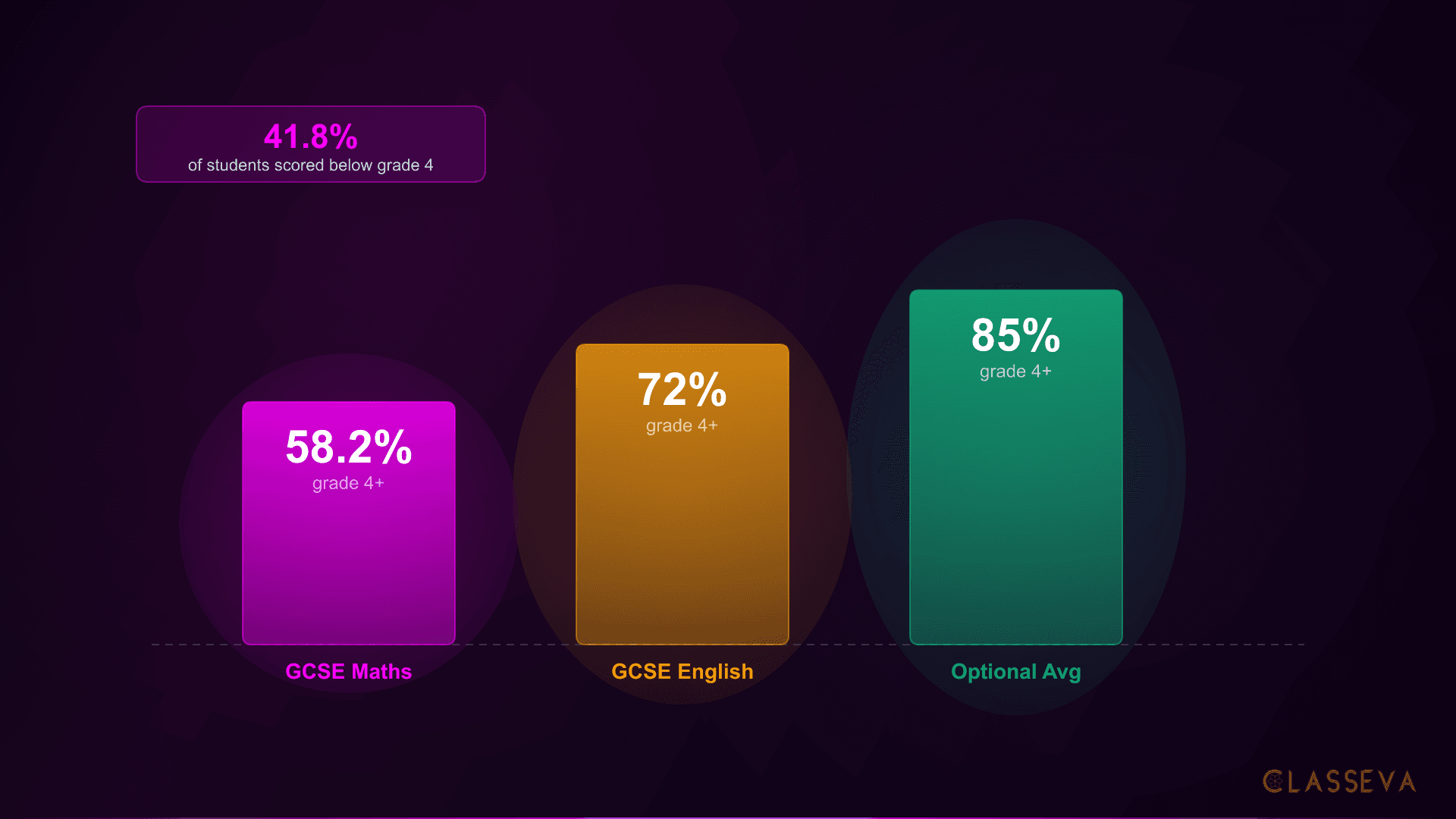
Is GCSE Maths hard? It is one of the most searched education questions in the UK, and the honest answer is: for a significant number of students, yes. In 2025, only 58.2% of entries achieved grade 4 or above, the government's “standard pass.” That means over 40% of students sitting GCSE Maths did not reach the baseline that most employers and colleges expect.
Those numbers make Maths one of the hardest GCSEs to pass when measured by results. But raw pass rates do not tell the full story. This guide breaks down the data, explains why so many students find GCSE Maths difficult, identifies the specific topics that cause the most problems, and gives you practical steps to support your child.
What the Data Actually Says
GCSE Maths had 831,556 entries in 2025, making it the second most popular GCSE behind English Language. But unlike optional subjects where students who dislike the topic simply do not choose it, every student in England must sit Maths. That single fact shapes everything about its results.
| Metric | 2025 Figure | What It Means |
|---|---|---|
| Total entries | 831,556 | Second largest GCSE cohort in England |
| Grade 7+ rate | 16.5% | Lower than most optional subjects due to compulsory entry |
| Grade 4+ rate | 58.2% | Over 40% did not reach the standard pass |
| Resit entries | ~25% | Nearly 1 in 4 entries are students retaking the exam |
Source: Tes 2025 GCSE results, FFT Datalab
Why the Pass Rate Is Misleading
Compare that 58.2% pass rate to a subject like GCSE Drama, where over 70% of students typically achieve grade 4+. Does that mean Drama is “easier”? Not necessarily. Students who take Drama chose it because they enjoy it and expect to do well. Students who take Maths include everyone, including those who have struggled with numbers since primary school.
When I worked in tutoring, I saw this dynamic constantly. Parents would look at the pass rates and panic, but the question is not really “is GCSE Maths hard?” in abstract terms. The question that matters is: is it hard for your child, given their current ability and the tier they are on? That is a much more useful question to answer.
The Resit Factor
Nearly 25% of all GCSE Maths entries are resits. Students who do not achieve grade 4 by the end of Year 11 are required to continue studying Maths in post-16 education. Many resit in November of Year 12 and again the following summer. These repeat entries pull the overall pass rate down because they represent students who already found the exam difficult once.
A 58.2% pass rate looks alarming until you consider that every single student in England takes this exam. In optional subjects, the cohort is self-selected. Comparing GCSE Maths pass rates to optional subjects is like comparing a marathon finish time for all runners versus only those who qualified.
Why GCSE Maths Is Hard
The GCSE Maths difficulty comes from a combination of factors that do not affect most other subjects. Understanding these helps you see where your child might be getting stuck and, more importantly, what you can do about it.
Cumulative Knowledge Gaps
Maths is uniquely cumulative. A student who does not properly understand fractions in Year 7 will struggle with ratio in Year 9 and find algebraic fractions in Year 11 essentially impossible. Unlike History, where a weak understanding of the Tudors does not stop you learning about the Cold War, every Maths topic builds directly on what came before.
This is the single biggest reason why students struggle with GCSE Maths. The problem often started years before the GCSE course began. A student sitting in a Year 11 class working on quadratic equations who never fully grasped negative numbers in Year 7 is trying to build on foundations that are not there.
If your child is in Year 9 or 10 and struggling with GCSE content, the issue is rarely the current topic. Ask their teacher: “What foundational skills are they missing?” Addressing the root cause (often basic algebra or fractions) is far more effective than drilling the topic they are currently failing.
Abstract Thinking and No Formula Sheet
Maths requires manipulating abstract symbols and concepts in a way that most other GCSEs do not. In English, a student who partly understands a concept can still write something and earn marks. In Maths, if you cannot do the calculation, you get zero on that question (though method marks for showing working help).
Unlike A-Level Maths, where students receive a formula booklet, GCSE Maths students must memorise all required formulae. The area of a trapezoid, the quadratic formula, trigonometric ratios, the sine and cosine rules (Higher only): all must be recalled from memory under exam conditions. For the full list of what your child needs to know, see our complete GCSE Maths topics guide.
What Makes Maths Different
- •Every topic builds on previous ones
- •No formula sheet provided in the exam
- •Abstract reasoning required, not just recall
- •All content from Year 10 and 11 tested at once
- •No partial credit for "sort of knowing"
What Stays the Same
- •Method marks reward showing working
- •Past paper patterns repeat year on year
- •Calculator allowed in 2 of 3 papers
- •Foundation tier makes content accessible
- •Regular practice builds fluency reliably
Foundation vs Higher: What Parents Should Know
GCSE Maths is split into two tiers, and this decision has a major impact on how hard GCSE Maths actually feels for your child. The content overlap is significant, but the ceiling and floor are very different.
| Foundation Tier | Higher Tier | |
|---|---|---|
| Grade range | Grades 1 to 5 | Grades 4 to 9 |
| Content coverage | 50 to 60% of specification | Entire specification |
| Question style | Scaffolded, step-by-step | Less guidance, choose your own method |
| Advanced topics | Not included | Surds, vectors, circle theorems, proof |
| Risk if struggling | Lower ceiling but safer floor | Below grade 4 = Ungraded |
Foundation offers grades 1 to 5; Higher covers grades 4 to 9 but risks a U grade.
When Higher Is the Wrong Choice
Having seen hundreds of students prepare for GCSE Maths across both tiers, the most damaging mistake I saw was students sitting Higher tier papers when they should have been on Foundation. A student consistently scoring 15 to 25% on Higher papers is spending most of their exam time staring at questions they cannot attempt. The result is not just a low grade; it is a destruction of confidence.
Some parents insist on Higher because they believe it looks better or because they want to keep grade 6+ open. But a student who achieves a solid grade 5 on Foundation is better off than one who scrapes a 4 (or gets a U) on Higher. If your child is consistently below 30% on Higher practice papers, have a frank conversation with their teacher about switching.
Foundation tier is not “easy Maths.” It covers a substantial portion of the specification and the questions still require genuine mathematical understanding. The grade 5 ceiling means your child can achieve the government's “strong pass,” which is accepted by the vast majority of sixth forms and colleges. For more detail on how boundaries work, see our GCSE Maths grade boundaries guide.
The Topics Students Struggle With Most
Not all GCSE Maths content is equally difficult. Certain topics consistently cause problems across schools and exam boards, and knowing which ones lets you target your child's revision effectively.
Foundation Tier Problem Areas
Fractions in worded problems
Students often understand fraction arithmetic in isolation but cannot apply it when a question is written as a word problem. The translation from English to Maths is the barrier.
Ratio and proportion
Sharing in a given ratio sounds simple but trips students up when combined with real-world contexts. Problems involving recipe scaling, exchange rates, or best-buy comparisons require confident ratio work.
Forming and solving equations
Students can often solve an equation when given one, but struggle to form the equation from a worded scenario. This skill connects algebra to every other topic.
Probability from experiments
Relative frequency, expected outcomes, and interpreting probability from data tables require careful reading. Many students lose marks not because the maths is hard, but because they misread the question.
Higher Tier Problem Areas
On Higher tier, the jump in difficulty is significant. The AQA GCSE Maths specification includes these topics exclusively at Higher, and they are where most marks are lost.
Trigonometry (sine, cosine, tangent rules)
Requires combining spatial reasoning with algebraic manipulation. Students must identify which rule to use, set up the equation, and solve it, often in multi-step problems.
Circle theorems
There are seven or eight theorems to learn, and exam questions require identifying which theorem applies to a specific diagram. This is pattern recognition under pressure.
Algebraic fractions and surds
Simplifying expressions with surds or algebraic fractions demands confident manipulation of symbols. One small error in a sign or bracket cascades through the entire solution.
Vectors, proof, and iteration
These topics are abstract even by Maths standards. Geometric proof and vector problems require logical reasoning that goes beyond computation into formal argument.
Why Your Child Might Be Struggling
If your child finds GCSE Maths hard, it does not mean they are “not a Maths person.” That phrase is one of the most damaging myths in education. There are specific, identifiable reasons why students struggle, and almost all of them are fixable.
| Reason | What It Looks Like | What Helps |
|---|---|---|
| Knowledge gaps from KS3 | Cannot do basic algebra or fractions confidently | Go back to the gap and rebuild, even if it feels like going backwards |
| Maths anxiety | Freezes in tests, avoids Maths homework, says "I can't do it" | Low-stakes daily practice, positive reinforcement, professional support if severe |
| Teaching speed mismatch | Understands eventually but class moves on before it clicks | AI tutoring for instant explanations at their pace |
| Passive revision habits | Spends hours "revising" but scores do not improve | Switch to active methods: past papers, practice questions, self-testing |
| Wrong tier | Below 30% on Higher papers consistently | Discuss switching to Foundation with the school |
Common reasons students struggle with GCSE Maths, and targeted solutions for each.
Maths Anxiety Is Real
Maths anxiety is not laziness or a lack of ability. It is a genuine psychological response where stress about Maths impairs working memory, making it harder to think clearly during problems and exams. Research from the University of Cambridge has found that maths anxiety affects students across all ability levels, not just those who struggle academically.
The signs are often subtle: your child might avoid starting Maths homework, become unusually upset before Maths tests, or say things like “I'm just not a Maths person.” If you recognise these patterns, the solution is not more pressure. It is building confidence through small, achievable wins. Ten minutes of practice at a comfortable level, done daily, does more for anxiety than a three-hour revision session done under stress. Our guide on exam anxiety in teenagers covers strategies that work across all subjects.
Avoid saying “I was never good at Maths”in front of your child. Research consistently shows this normalises failure and creates a self-fulfilling prophecy. Instead, try: “Maths was hard for me too, but I wish I'd stuck with it.” The message shifts from “inability is inherited” to “persistence pays off.”
What Parents Can Do
You do not need to be able to solve quadratic equations to help your child succeed at GCSE Maths. The most effective GCSE Maths help parents can provide is structural, not mathematical. It is about creating the right conditions for learning, not teaching the content yourself.
Daily Practice Over Weekend Cramming
Maths is like a sport: short, regular sessions build fluency far more effectively than long, irregular ones. A student who practises for 10 to 15 minutes every day will outperform one who does a three-hour session on Sunday, even if the total hours are identical. This is because spaced practice (distributing work over time) is one of the most robust findings in learning science.
Use past papers as the primary revision tool
Past papers are the single most effective way to revise for GCSE Maths. They reveal exactly what examiners ask, how questions are structured, and where marks are awarded. Do a paper, mark it honestly, then spend time understanding every mistake.
Focus on understanding, not memorising
A student who understands why you cross-multiply can apply it to any new problem. A student who memorised the steps cannot adapt when the question looks slightly different. Always ask your child: "Can you explain why that works?"
Check the tier decision with the school
If your child is consistently scoring below 30% on Higher papers, Foundation might be a better path to a secure grade 4 or 5. A solid Foundation result is far more useful than a Higher U grade.
Use AI tutoring for the "stuck" moments
The moment a student hits a wall in Maths is the moment that matters most. If they have to wait until the next lesson to get help, the frustration builds and the gap widens. AI tutoring tools like Classeva provide instant explanations at any time.
The One Thing That Matters Most
From my experience working with parents and students, the single most important thing you can do is help your child identify and close their specific gaps. Generic revision (opening a textbook to a random page) is almost useless. Targeted revision (knowing that your child struggles with ratio problems and doing 20 ratio questions in a week) transforms results.
Ask your child's teacher for their most recent mock exam breakdown. Most schools provide a topic-by-topic analysis showing which questions were answered well and which were not. That document is your revision roadmap. If the school does not provide one, a free Classevasession can help identify weak areas by working through diagnostic questions tailored to your child's exam board.
For a complete breakdown of what will be on the exam, see our guides on GCSE Maths exam dates for 2026 and the GCSE Maths resit process if your child needs to retake.
Mock results are not just a prediction. They are a diagnostic tool. The specific questions your child got wrong tell you exactly which topics to target. Work backwards from the mock, not forwards from page one of the textbook.
GCSE Maths is hard for many students, but it is not a fixed trait. The students who improve most are not always the most naturally gifted; they are the ones who identify their gaps, practise actively, and get help quickly when they are stuck. Whether that help comes from a teacher, a parent, or an AI tutor, the important thing is that it comes before the gap becomes a chasm.