GCSE Maths Resit: Rules, Dates, and How to Pass
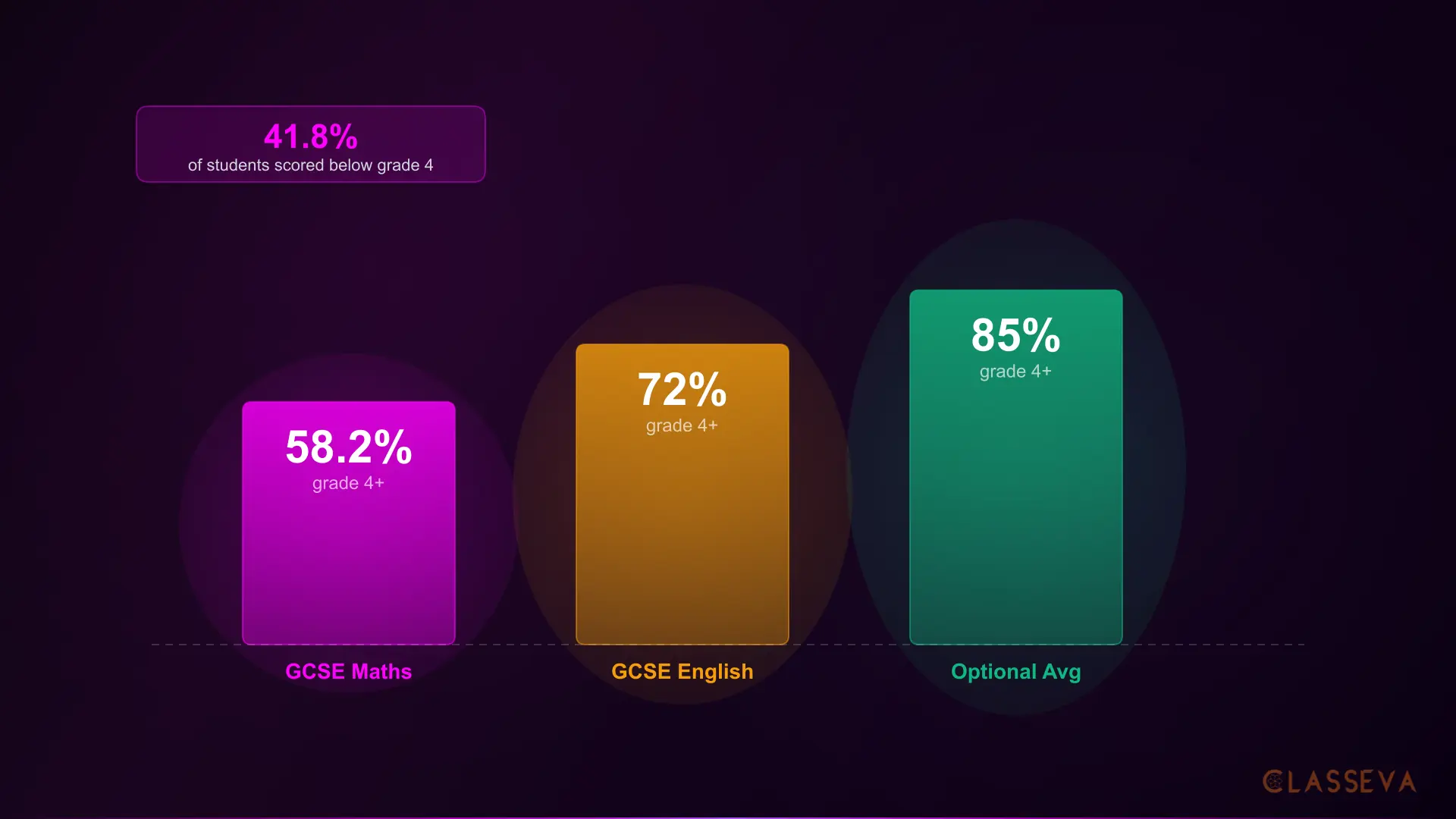
Nearly 25% of all GCSE Maths entries in 2025 were resits. If your child missed grade 4, they are not alone, and this is not the end of the road. The GCSE maths resit is a structured process with clear rules, two exam windows per year, and a realistic path to passing.
During my time working in the tutoring industry, resit students were the group I found most rewarding to work with. They already had a year or two of the course behind them. The knowledge was there; it just needed unlocking. The students who approached the resit with a targeted plan, rather than trying to re-learn everything from scratch, were the ones who passed.
Does Your Child Have to Resit GCSE Maths?
Yes, in most cases. Since 2014, the Condition of Funding rules require students aged 16 to 19 on government-funded study programmes to continue studying GCSE Maths if they have not achieved grade 4 or above. This applies whether your child is taking A-levels, BTECs, T-Levels, or any other post-16 programme at a sixth form or college.
The Condition of Funding Rule
The rule is straightforward: if your child did not achieve grade 4 in GCSE Maths (or English Language), their post-16 provider must ensure they continue studying toward that qualification. The provider's funding depends on it. This is not optional for the school or the student.
Any student aged 16 to 19 on a government-funded study programme (sixth form, FE college, training provider) who does not hold a grade 4 or above in GCSE Maths. This includes students on A-level, BTEC, T-Level, and apprenticeship programmes. Full details are on the GOV.UK Condition of Funding guidance.
Grade 3 vs Grade 2: What Changes
The rules differ depending on what grade your child achieved:
Grade 3
- •Must resit the GCSE itself
- •Functional Skills is not accepted as an alternative
- •College will enter them for November or summer GCSE
- •Closest to the grade 4 boundary, so targeted revision can close the gap
Grade 2 or Below
- •Can study Functional Skills Level 2 as an alternative
- •Many colleges still enter students for GCSE anyway
- •Functional Skills is on-demand with quicker results
- •Accepted by most employers as equivalent to grade 4
One thing worth knowing: there is no limit on resit attempts. Your child can sit both the November and summer series in the same academic year. Each attempt produces a separate certificate, and the original grade is never replaced. Employers and universities look at the highest grade achieved.
GCSE Maths Resit Dates: November and Summer
Unlike most GCSEs, which can only be sat in the summer, GCSE Maths has two exam windows per year. This is a significant advantage for resit students, giving them two chances within a single academic year.
The November Advantage
The November series is unique to GCSE Maths and English Language. No other GCSE subject offers it. For a student who received their results in August, this means their first resit opportunity is just three months away, while the material is still relatively fresh.
Even if your child does not feel fully prepared, the November resit is worth attempting. It provides genuine exam experience under real conditions, and some students surprise themselves. If they do not pass, they have another attempt in the summer with the benefit of having seen a live paper. There is no penalty for a lower result; the higher grade always stands.
Full Resit Timeline
Here is what the resit journey looks like for a student who receives results below grade 4 in summer 2026:
For specific exam dates in 2026, see our GCSE Maths exam dates 2026 guide, which covers all three exam boards. Entry deadlines for the November series are typically in early October, so if your child received results in August, you have about six weeks to register. Check the AQA dates and timetables page for exact deadlines.
Foundation vs Higher Tier for Resits
This is one of the most important decisions for a GCSE maths resit, and one that many parents do not realise they can make. Your child is not locked into the same tier they sat originally. They can switch between Foundation and Higher for the resit.
| Factor | Foundation Tier | Higher Tier |
|---|---|---|
| Grade range | Grades 1 to 5 | Grades 4 to 9 |
| Target for resit | Grade 4 (standard pass) | Grade 4 minimum, up to 9 |
| Question difficulty | More accessible, structured | More demanding, multi-step |
| Risk of U grade | Low (wide grade range) | Higher (if below grade 4 boundary) |
| Best for | Students aiming for grade 4 | Students who narrowly missed grade 5+ |
Foundation tier is generally the safer option for students whose primary goal is achieving grade 4.
If your child scored grade 3 on Higher tier, switching to Foundation is often the right call. The questions are more structured and accessible, and the grade 4 boundary sits in the middle of the Foundation range rather than at the very bottom of Higher. For students who scored grade 3 on Foundation, the answer is simpler: stay on Foundation and focus on the specific questions they left blank or answered incorrectly.
Which Exam Board?
Students can also resit with a different exam board. If your child originally sat AQA, they can switch to Edexcel or OCR for the resit. In practice, most colleges enter students for the same board because that is what their teachers know best. However, if your child found the question style of one board particularly difficult, it is worth discussing a switch with their college.
All three major boards (AQA, Edexcel, OCR) cover the same national curriculum content. The differences are in paper structure, question style, and how marks are allocated. For a full comparison, see our GCSE Maths topics guide.
How to Pass the GCSE Maths Resit
Resitting GCSE Maths does not mean re-learning the entire course from scratch. Your child already sat through two years of lessons and attempted the exam. The strategy for the resit is fundamentally different from first-time preparation: it is about closing specific gaps, not covering everything again.
Step 1: Diagnose the Real Problem
Before your child opens a single textbook, you need to understand why they did not achieve grade 4. The cause determines the solution:
The quickest way to diagnose the problem is to request your child's exam paper back (called a “review of results” or “access to scripts”). This costs around £10 to £15 per paper and shows you exactly which questions they attempted, where they gained marks, and where they lost them. If you cannot access the original scripts, sitting a past paper under timed conditions achieves a similar diagnostic result.
Step 2: Focus on High-Value Topics
Not all GCSE Maths topics carry equal weight. On Foundation tier, certain topics appear more frequently and carry more marks than others. Focusing on these gives the biggest return for the time invested:
| Topic Area | What It Covers | Why It Matters |
|---|---|---|
| Number | Fractions, decimals, percentages, ratio | Largest single topic area on Foundation |
| Basic algebra | Solving equations, substitution, expanding | Appears across multiple papers |
| Ratio and proportion | Sharing quantities, scaling, recipes | High-mark questions, often structured |
| Statistics | Averages, charts, probability | Accessible marks with clear methods |
| Geometry basics | Area, perimeter, angles, symmetry | Straightforward once methods are learned |
These five topic areas collectively represent the majority of Foundation paper marks.
For the full topic breakdown across all exam boards, see our complete GCSE Maths topics list. Understanding which topics are assessed, and how, allows your child to prioritise effectively.
Step 3: Past Papers Under Timed Conditions
Past papers are the single most effective tool for resit preparation. But there is a right way and a wrong way to use them.
Do the paper under timed conditions
No notes, no phone, no calculator on Paper 1. Treat it as a real exam. This reveals the actual gap between what your child knows and what they can produce under pressure.
Mark it using the official mark scheme
Mark schemes are free on every exam board website. They show exactly how marks are awarded, including method marks for partial answers. Many students do not realise they can earn marks even for incomplete solutions.
Sort questions into three categories
Category A: correct and confident. Category B: attempted but lost marks (exam technique issue). Category C: left blank or completely wrong (knowledge gap). Focus revision time on B and C topics only.
Repeat with a new paper every one to two weeks
Track progress by counting total marks per paper. The goal is to see the mark total rising over time. If it stalls, switch focus to a different weak topic area.
The most common pattern I saw with resit students was spending time on topics they already understood because it felt productive. They would practise percentage questions for an hour, get them all right, and feel good about it. Meanwhile, the algebra questions that cost them grade 4 remained untouched. Effective resit revision is uncomfortable because it targets the weak spots, not the comfortable ones.
The Non-Calculator Trap
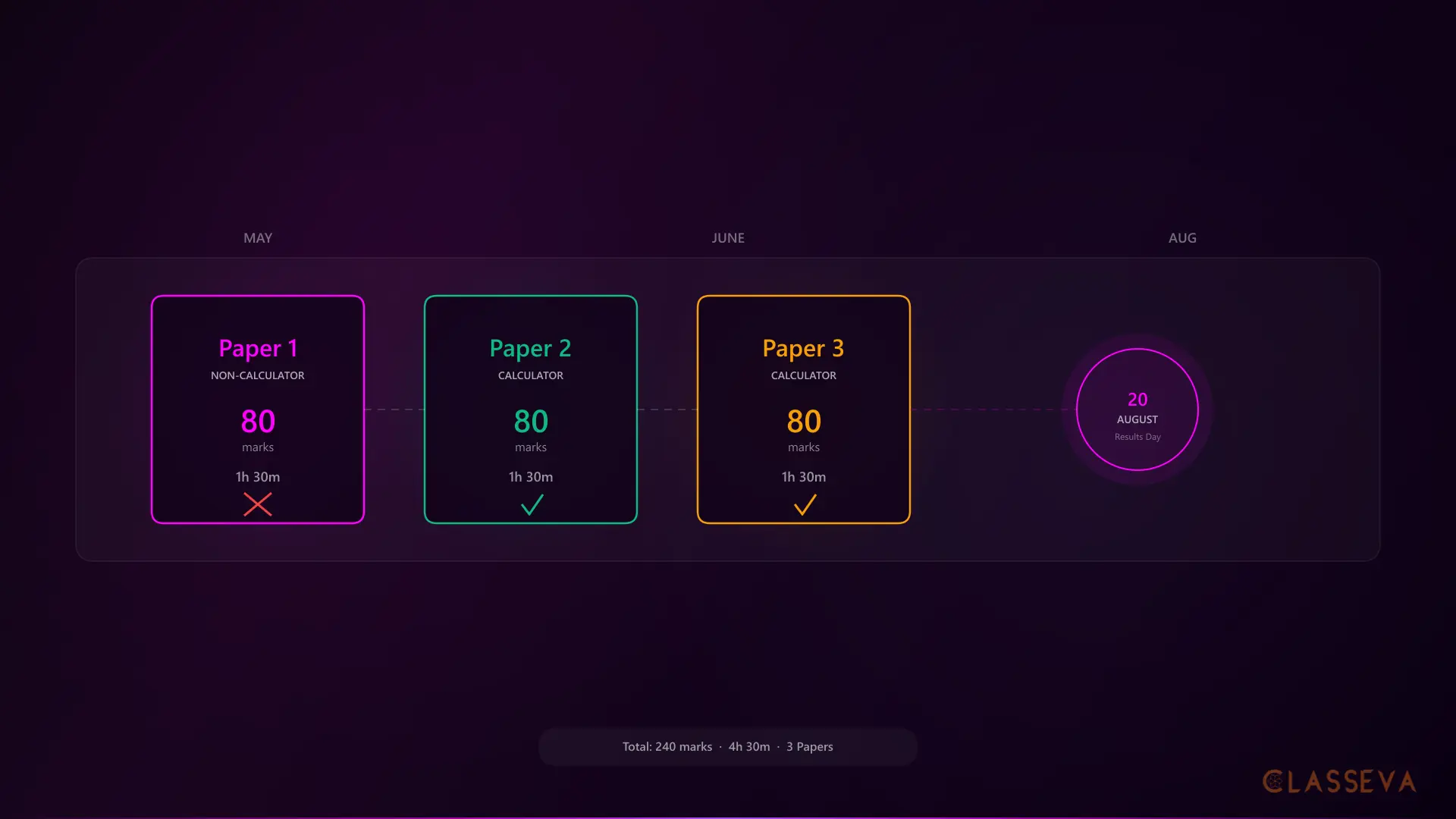
GCSE Maths Paper 1 is a non-calculator paper. For resit students, this is often where the most marks are lost. Many have become reliant on calculators for basic arithmetic, and when the calculator is removed, their performance drops significantly.
The fix is not complicated, but it requires consistent practice. Spend 10 to 15 minutes daily on mental arithmetic: times tables, fraction arithmetic (adding, multiplying, converting), percentage calculations, and long division. These skills atrophy quickly without a calculator, but they also rebuild quickly with daily practice.
For a deeper look at how the three papers differ and how to prepare for each, see our GCSE Maths grade boundaries guide, which breaks down the mark thresholds paper by paper.
Keeping Your Child Motivated
Resitting a GCSE can feel demoralising. Your child is studying a subject they have already “finished” while their peers move on to new qualifications. The single most important thing you can do as a parent is to normalise it.
From my experience working with families of resit students, the students who passed were not necessarily the most naturally able. They were the ones whose parents treated the resit as a normal, manageable challenge rather than a source of shame. Small shifts in language make a difference: “Let's get this sorted” is more motivating than “You need to work harder this time.”
If your child scored grade 2 or below, Functional Skills Level 2 Maths is a genuine alternative. It is accepted by most employers and many universities. It is assessed on-demand (not tied to summer or November windows), results come back quickly, and the content is more practically focused. It is not a lesser qualification; it is a different one. Discuss this option with your child's college if you think it might suit them better.
AI tutoring tools can also help resit students who feel self-conscious about asking for help in class. Classeva lets students practise specific question types at their own pace, get instant feedback, and revisit weak topics without anyone watching. For some resit students, that privacy removes the biggest barrier to actually engaging with the material.
Practical Checklist for Parents
Here is a concrete list of actions you can take in the weeks after your child receives their results:
Confirm which exam board and tier your child sat
Check their results slip or ask the school. This determines which past papers and mark schemes to use for revision.
Request their exam scripts back
Contact the school or exam board within the review window (usually 2-3 weeks after results day). This costs around £10-£15 per paper but gives you a precise diagnosis of where marks were lost.
Discuss tier choice with their college
If they scored grade 3 on Higher tier, ask about switching to Foundation. If they scored grade 2 or below, discuss whether Functional Skills Level 2 might be more appropriate.
Register for the November resit early
Entry deadlines are typically early October. Do not wait until the last week. Some centres fill up, and late entries may incur additional fees.
Set up a simple weekly revision routine
Two to three focused sessions of 30-45 minutes per week is more effective than one long weekend session. Each session should include at least one timed past paper question set.
Celebrate grade 4 when it comes
Moving from grade 3 to grade 4 is a genuine achievement. It opens doors to further education, apprenticeships, and employment. Make sure your child knows this matters.
For broader context on what GCSEs are and why they matter, our parent's guide covers the full picture, including how grades translate into post-16 opportunities.