GCSE Maths Grade Boundaries: What Marks Do You Need?
“How many marks does my child need for a grade 7?” It is one of the most common questions parents ask during GCSE revision season, and the honest answer is frustrating: nobody knows until results day. GCSE maths grade boundaries are set after all papers have been marked, and they shift every single year.
That said, historical data tells us a great deal. Having spent years helping students prepare for their GCSE maths exams, I can tell you that understanding how boundaries work, and how to use past data wisely, gives parents a genuine advantage. Not because you can predict the exact numbers, but because you can set realistic expectations and focus revision where it actually matters.
How GCSE Maths Grade Boundaries Work
A GCSE maths grade boundaryis the minimum number of raw marks a student needs across all three papers to achieve a particular grade. Every student sitting the same exam board and tier receives the same papers, and the boundaries are applied uniformly to everyone's total marks.
What the Numbers Actually Mean
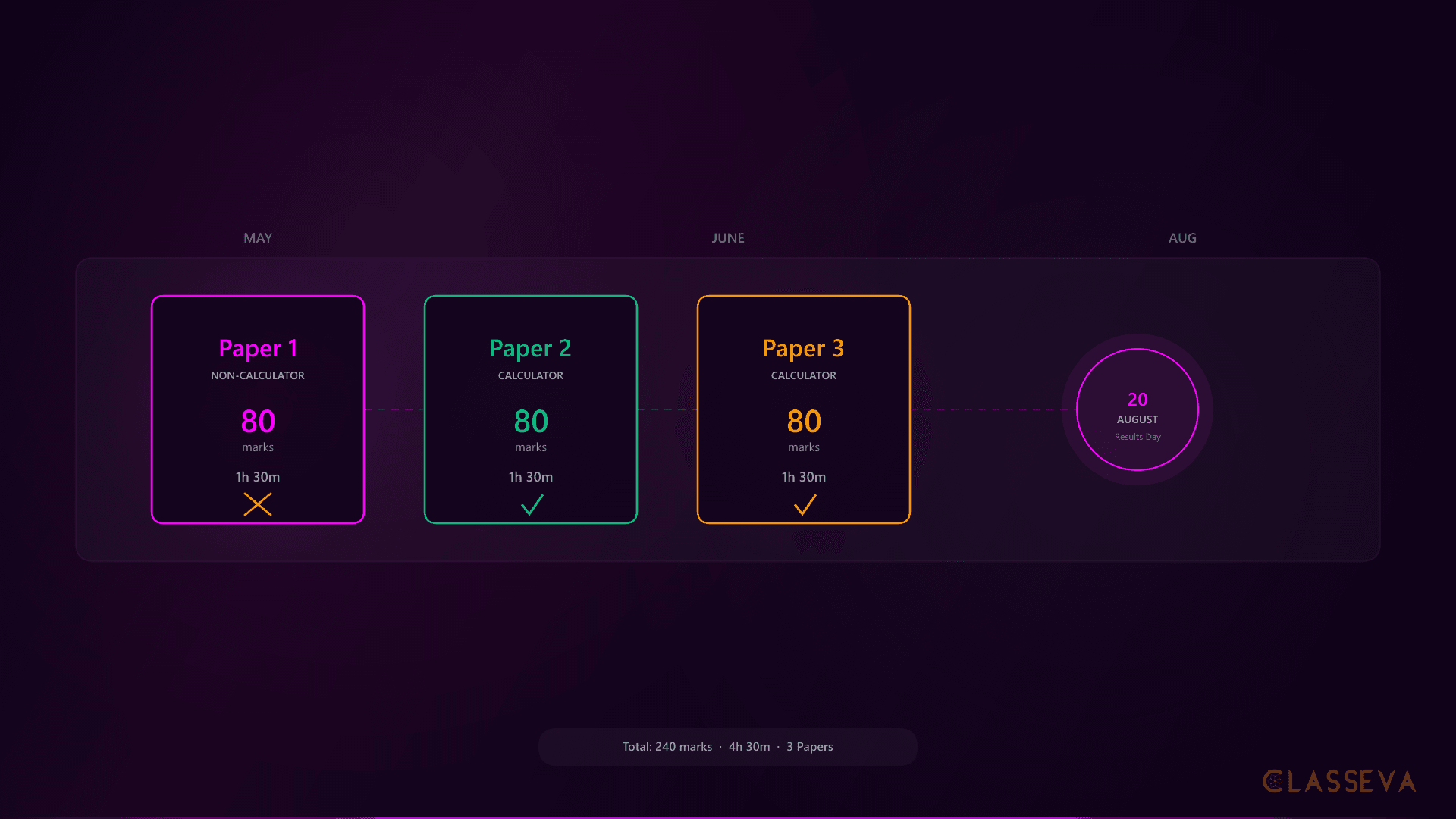
GCSE maths is assessed through three written papers, each worth 80 marks, giving a total of 240 marks. Paper 1 is non-calculator; Papers 2 and 3 allow a calculator. After all scripts are marked nationally, each exam board sets the grade boundaries for that year's papers.
The grade your child receives depends entirely on where their total mark falls relative to these boundaries. If the grade 7 boundary is set at 144 marks and your child scores 145, they get a grade 7. If they score 143, they get a grade 6. There is no rounding, no discretion, and no teacher input at this stage.
GCSE maths is worth 240 total marks across three papers (80 marks each). Paper 1 is non-calculator. Papers 2 and 3 allow calculators. All three papers carry equal weight.
Why Boundaries Change Every Year
Boundaries are not fixed percentages. They are calculated after marking is complete, using a process called “awarding.” A panel of senior examiners reviews student scripts at key grade points and decides where the boundaries should fall, taking into account the difficulty of that year's papers and the overall performance of the cohort.
This means a harder paper produces lower boundaries. If the exam was particularly challenging, students might need fewer marks for a grade 7 than in a year with easier papers. The system is designed to ensure that a grade 7 represents the same standard of ability every year, even though the raw marks needed change.
The 2023 to 2025 exams returned to pre-pandemic grading standards after the more generous boundaries used during the transition back from teacher-assessed grades. The 2026 boundaries should be comparable to this settled pattern.
Foundation vs Higher Tier Boundaries
GCSE maths is split into two tiers, and this is where many parents get confused. Your child does not sit the same papers as every other student. They sit either Foundation or Higher, and each tier has completely different grade boundaries because the papers contain different questions.
Foundation Tier (Grades 1 to 5)
Foundation tier papers are designed to be accessible, covering the core curriculum without the most demanding topics. The maximum grade achievable is grade 5. Typical boundary percentages based on historical data:
| Grade | Typical % of 240 marks | Approximate marks |
|---|---|---|
| Grade 5 (max on Foundation) | 55% to 65% | 132 to 156 |
| Grade 4 (standard pass) | 40% to 50% | 96 to 120 |
| Grade 3 | 25% to 35% | 60 to 84 |
| Grade 2 | 15% to 20% | 36 to 48 |
| Grade 1 | 8% to 12% | 19 to 29 |
Approximate Foundation tier boundaries based on historical patterns. Actual boundaries vary by year and exam board.
The important thing to understand about Foundation is the ceiling. If your child is regularly scoring above 65% on Foundation mock papers, they may be capable of achieving a grade 6 or higher, but they will be capped at grade 5 if they stay on Foundation tier.
Higher Tier (Grades 4 to 9)
Higher tier papers include more demanding questions covering the full specification. The grade range is 4 to 9, but there is a critical risk: if your child scores below the grade 4 boundary on Higher, they receive a U (ungraded). They do not drop to grade 3, 2, or 1.
| Grade | Typical % of 240 marks | Approximate marks |
|---|---|---|
| Grade 9 | 75% to 85% | 180 to 204 |
| Grade 8 | 65% to 75% | 156 to 180 |
| Grade 7 | 55% to 65% | 132 to 156 |
| Grade 6 | 40% to 50% | 96 to 120 |
| Grade 5 | 30% to 38% | 72 to 91 |
| Grade 4 (minimum on Higher) | 15% to 25% | 36 to 60 |
Approximate Higher tier boundaries. Grade 7 is highlighted as the most commonly asked-about boundary.
One pattern I noticed repeatedly when working with GCSE students: parents often focus on what mark is needed for a grade 7 or 9, but the students who made the biggest jumps in their final grade were those who focused on not losing marks on the questions they should be getting right. Careless errors on the first 40 marks of each paper cost more grades than struggling with the harder questions at the end.
The Tier Decision
The choice between Foundation and Higher is one of the most consequential decisions in GCSE maths, and it is usually made by the school in Year 11. If your child is predicted a grade 5 or 6, this decision deserves a conversation with their maths teacher.
Foundation Tier
- •Maximum grade: 5
- •Papers are more accessible
- •No risk of U grade (ungraded)
- •Best for students predicted grades 1 to 5
- •Secures a “standard pass” (grade 4) more reliably
Higher Tier
- •Grade range: 4 to 9
- •Papers include harder content
- •Risk of U if below grade 4 boundary
- •Required for students targeting grade 6+
- •Needed for A-Level Maths entry
If your child is on the boundary between tiers (predicted grade 5 or 6), ask their teacher: “What would they score on a Higher paper right now?” If they are consistently hitting grade 4 or above on Higher mocks, they are probably safe on Higher tier. If they are regularly below 20% on Higher mocks, Foundation may give them a more secure outcome. Read more about the differences between Foundation and Higher tier.
AQA, Edexcel, and OCR Boundaries Compared
Your child's exam board matters more than most parents realise. AQA, Edexcel (Pearson), and OCR all deliver the same national curriculum for GCSE maths, but their papers are structured differently, ask different styles of questions, and produce different grade boundaries. If you want to understand more about the differences, we have a detailed comparison of AQA, Edexcel, and OCR for GCSE maths.
Edexcel is the most popular exam board for GCSE maths in England, used by roughly 40% of schools. AQA follows closely, with OCR used by a smaller proportion. Each board publishes its historical GCSE maths grade boundaries freely on its website.
Why Each Board Sets Different Boundaries
Different exam boards write papers of different difficulty. A harder set of Edexcel papers in one year might produce boundaries where grade 7 requires 130 out of 240 marks, while AQA's slightly more accessible papers that same year might set grade 7 at 150 marks. The resulting grades are designed to represent the same standard: Ofqual monitors national outcomes to ensure comparability across boards.
This is why comparing raw boundaries between boards is misleading. A “lower” boundary on one board does not mean it is easier to get that grade. It means the paper was harder, so students needed fewer marks to demonstrate the same level of understanding.
The most practical step: check which exam board your child's school uses. You can usually find this on the school website or by asking the maths department directly. Once you know the board, use only that board's past papers and historical boundaries for comparison. Mixing papers from different boards during revision leads to confusion about expectations. For the full list of GCSE maths topics across boards, see our dedicated guide.
How to Use Historical Boundaries After Mock Exams
Historical grade boundaries become genuinely useful after your child sits mock exams. This is the one time during the year when you have a concrete number to work with, and comparing it against past boundaries gives you a realistic picture of where your child stands.
Interpreting Your Child's Mock Scores
When your child brings home their mock results, the first question is: did they sit an actual past paper from their exam board? If so, you can look up the historical boundary for that specific paper series and compare directly. If the school used an internally written mock, the comparison is less precise but still useful as a rough guide.
Find your child’s total raw mark
Add up their marks across all three mock papers. The total should be out of 240.
Identify the exam board and paper series
Ask the school which past paper they used (e.g., AQA June 2024, Edexcel November 2023). This tells you which historical boundaries to look up.
Look up the historical boundaries
Visit the exam board’s website and find the grade boundaries for that paper series. Compare your child’s total mark against each grade boundary.
Assess the margin
If your child is 10 or more marks above a grade boundary, they are likely secure for that grade. Within 5 marks either side of a boundary, the outcome could go either way in the real exam.
Setting Realistic Targets
Based on where your child's mock score falls relative to historical boundaries, you can set a focused revision target. The goal is not to memorise boundary numbers but to understand the gap between where your child is and where they need to be.
Do not treat historical boundaries as guarantees. A student who scored 150 marks on a 2024 past paper and sees that the 2024 grade 7 boundary was 145 might assume they are safe for a grade 7 in 2026. But the 2026 papers will be different, and the boundaries will be different. Use past data as a guide to set revision priorities, not as a fixed target to hit.
Something I observed consistently when helping students after their mocks: the ones who improved most between mocks and the real exam were those who analysed their errors by topic, not by grade. Instead of saying “I need 12 more marks for a grade 7,” they said “I lost 8 marks on ratio questions and 6 marks on trigonometry.” That specificity turned revision into targeted practice rather than general studying. If your child wants to strengthen their exam technique, practising with GCSE maths past papers is one of the most effective methods.
What to Do If Your Child Is Near a Boundary
If your child's mock scores place them within a few marks of a grade boundary, those marginal marks become the most important marks in their entire exam. Here is how to approach this practically.
The Marginal Marks Strategy
The easiest marks to gain in GCSE maths are not found by mastering difficult grade 9 content. They come from eliminating errors on questions your child can already do, and from picking up method marks on questions they find challenging. Even partial working on a difficult question can earn 1 to 2 marks.
Eliminate blank answers
Every blank question is a guaranteed zero. Even writing down a relevant formula or the first step of working can earn method marks. Teach your child to attempt every question.
Show all working
In GCSE maths, examiners award marks for correct method even if the final answer is wrong. “Show your working” is not just teacher advice; it is the difference between 0 marks and 2 to 3 marks on a 4-mark question.
Reduce careless errors
Have your child review their mock papers and count how many marks they lost to mistakes on questions they understood. Misreading a negative sign, forgetting units, or making arithmetic slips can easily cost 10 to 15 marks across three papers.
Target the highest-value weak topics
Identify which topics lost the most marks in mocks and focus revision there. Closing a 6-mark gap in one topic is more efficient than trying to gain 1 mark across six topics.
Mark schemes are more valuable than grade boundaries for day-to-day revision. Understanding exactly what earns marks on a specific question type is more productive than worrying about where the grade boundary might fall. If your child is aiming for the top grades, our guide on how to get a grade 9 in GCSE maths covers advanced strategies.
After Results Day
GCSE results day for the 2026 cohort is 20 August 2026. On this date, each exam board publishes the final grade boundaries for that year's papers on its website.
After your child receives their grade, check the published boundaries to understand how they performed. Were they comfortably above the boundary for their grade, or were they marginal? This context matters, particularly if you are considering a remark.
If your child is 1 to 2 marks below a grade boundary, the school can request a review of marking through the exam board. There is a fee (typically around £40 to £50 per paper) which is refunded if the grade changes. In maths, remarks occasionally result in grade changes, though it is less common than in subjects with extended writing. Your school will advise on whether a remark is worth pursuing. For more on results day, see our GCSE results day 2026 parent's guide.
If the result is lower than expected and your child needs to resit, GCSE maths is one of two subjects (alongside English) that students must continue until they achieve at least a grade 4. Our guide to GCSE resits in 2026 explains the process and timelines.
Where to Find GCSE Maths Grade Boundaries
Every exam board publishes its historical grade boundaries freely. You do not need to pay for this information, and any website charging for boundary data is selling something that is available at no cost.
| Exam Board | Where to Find Boundaries | Published |
|---|---|---|
| AQA | aqa.org.uk → Results Day → Grade Boundaries | August each year |
| Edexcel (Pearson) | qualifications.pearson.com → Results → Grade Boundaries | August each year |
| OCR | ocr.org.uk → Administration → Results | August each year |
All exam boards publish historical GCSE maths grade boundaries free of charge.
The AQA grade boundaries archive contains boundaries going back several years, making it straightforward to see how boundaries have shifted over time. Edexcel and OCR offer similar archives on their own websites.
For a broader picture of how the grading system works across all subjects, including what GCSEs are and how the 9 to 1 system works, see our parent's guide. You can also check our GCSE maths exam dates for 2026 so you know exactly when each paper is scheduled.
Do not obsess over grade boundaries during revision. They are useful as a reference point after mocks and after results day, but they should not drive day-to-day revision. The most productive revision focuses on understanding topics and practising past paper questions, not on hitting a specific mark target that will change anyway.