Lord of the Flies GCSE Guide: Themes, Characters, Quotes
Lord of the Flies by William Golding is one of the most studied prose texts at GCSE English Literature. Published in 1954, it tells the story of a group of British schoolboys stranded on an uninhabited island who descend from order into violence. It is dark, disturbing, and deliberately so. Golding wrote it as an allegory: every character, every object, and every event represents something larger about human nature.
From my years working with GCSE students, the consistent challenge with this novel is not understanding the plot. The plot is gripping and students tend to remember it well. The challenge is making the leap from what happens to what it means. The students who reach the top grades are the ones who can explain what each character representsand connect every scene back to Golding's argument about humanity.
What Lord of the Flies Is Really About
On the surface, Lord of the Flies is a survival story. Boys crash-land on a tropical island, attempt to govern themselves, and fail catastrophically. But Golding was not writing an adventure story. He was writing a philosophical argument disguised as a novel. His thesis: civilisation is a thin veneer, and without its structures and rules, humans will revert to brutality.
The Coral Island Inversion
Your child's teacher will almost certainly mention The Coral Island by R.M. Ballantyne, published in 1857. It is a Victorian adventure novel where three British boys are shipwrecked on a Pacific island and thrive. They build shelters, defeat pirates, and convert indigenous people to Christianity. The message is clear: British boys are civilised, resourceful, and morally superior.
Golding despised this idea. He deliberately used the same setup (British schoolboys, a tropical island, no adults) and produced the opposite outcome. His boys do not thrive. They murder each other. He even named two characters Ralph and Jack, echoing Ballantyne's heroes. This is not coincidence; it is a direct literary challenge. Understanding this inversion is valuable exam material because it demonstrates Golding's purpose clearly.
Examiners reward students who connect the novel to Golding's purpose. Mentioning the Coral Island inversion shows the examiner that your child understands why Golding wrote the novel, not just what happens in it. This is the difference between describing the plot and analysing it.
Golding's War Experience
William Golding served in the Royal Navy during the Second World War and was involved in the D-Day landings at Normandy. He witnessed first-hand the scale of human cruelty that modern warfare made possible. The Holocaust, the bombing of Hiroshima, and the sheer mechanised violence of WWII convinced him that evil is not something created by social conditions. It is, he believed, built into human nature itself.
The novel also carries Cold War undertones. The boys are being evacuated because of a nuclear war. A dead parachutist from an aerial battle drifts onto the island. Even the adult world is destroying itself. Golding's point is that the boys' descent into savagery is not an anomaly; it mirrors what the adults are already doing on a global scale.
The Seven Key Themes Your Child Needs to Know
Every possible exam question on Lord of the Flies will connect to one or more of these themes. Your child does not need to memorise a list, but they do need to understand how the themes intersect and how Golding develops them through characters, symbols, and events.
| Theme | What It Means | Key Symbol or Scene |
|---|---|---|
| Civilisation vs savagery | The central conflict of the entire novel | The conch vs the hunt |
| Innate evil | Evil exists inside humans, not in external monsters | The beast; the Lord of the Flies |
| Power and leadership | Democracy vs authoritarianism | Ralph’s elections vs Jack’s fear tactics |
| Fear and the unknown | Fear makes people irrational and controllable | The beast on the mountain |
| Loss of innocence | Children arrive civilised and leave as killers | The naval officer’s final observation |
| Democracy and the conch | Rules only work if people choose to follow them | The conch being destroyed with Piggy |
| Violence and ritual | Hunting becomes ritual savagery, not survival | The killing of the sow |
The seven themes of Lord of the Flies and how Golding presents them
Civilisation vs Savagery
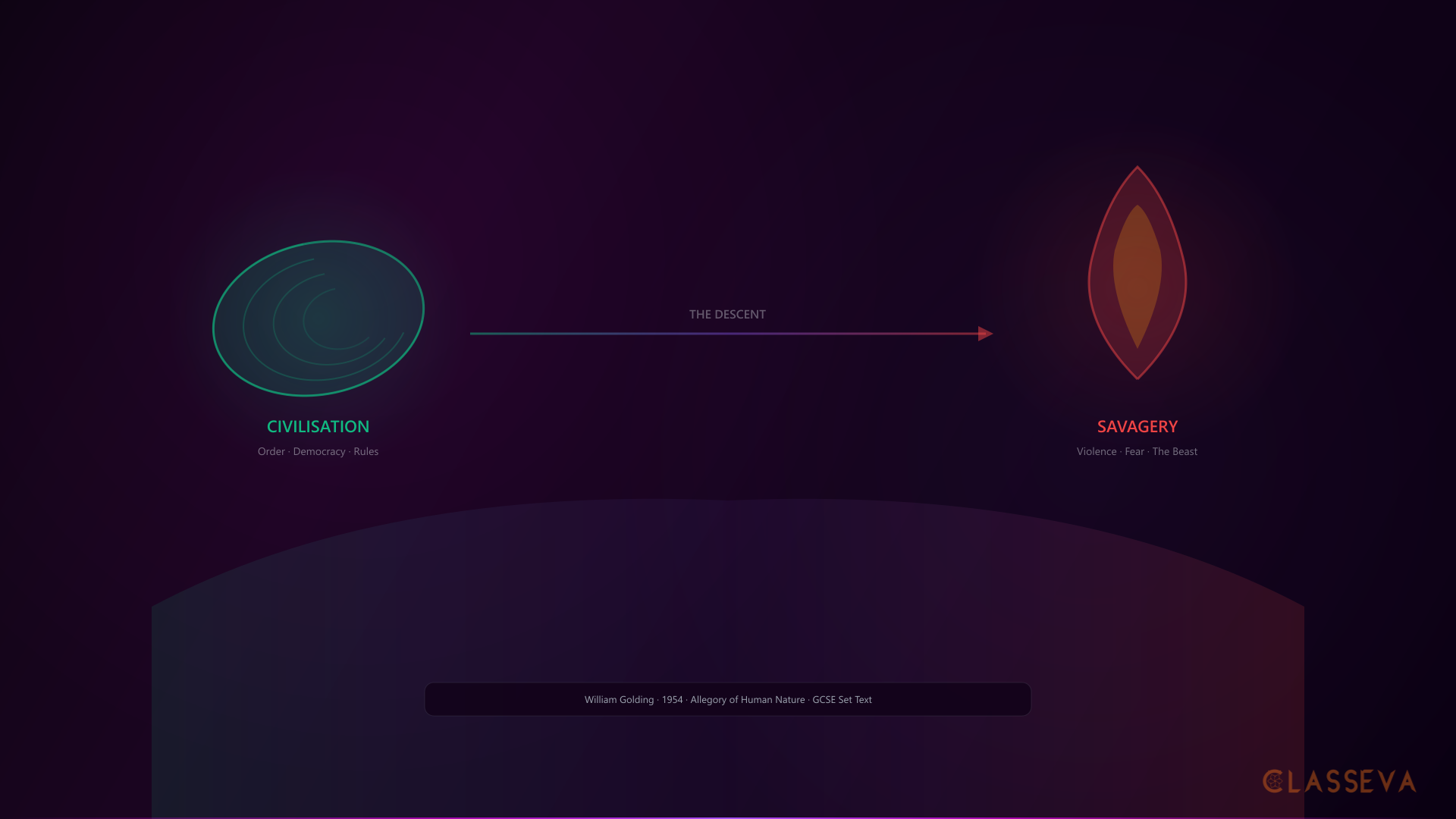
This is the central tension that drives every chapter. Ralph represents civilisation: he insists on rules, builds shelters, and maintains the signal fire for rescue. Jack represents savagery: he paints his face, hunts obsessively, and prioritises violence over cooperation. The novel tracks a gradual, irreversible shift from one to the other.
What makes this theme analytically rich is that the shift is not sudden. It happens in small steps. First Jack lets the fire go out. Then the boys start chanting during hunts. Then they kill Simon. Then they kill Piggy. Each step normalises the next. This is Golding's argument about how civilisations collapse: not in a single dramatic moment, but through a slow erosion of the rules that held things together.
Innate Evil and the Beast
The “beast” is the most important symbol in the novel. The younger boys (the littluns) are terrified of a monster on the island. The older boys search for it, argue about it, and eventually leave offerings for it. But the beast is not real. It is a dead parachutist tangled in the rocks on the mountaintop.
Only Simon understands the truth. In his hallucination with the Lord of the Flies (the pig's head on a stick), the head tells him: “Fancy thinking the Beast was something you could hunt and kill! . . . You knew, didn't you? I'm part of you.” The beast is not external. It is the capacity for evil that exists inside every boy. This is Golding's central philosophical point, and it is the idea your child should be able to explain clearly in any exam answer.
Almost any Lord of the Flies exam question can be strengthened by discussing the beast. Whether the question is about leadership, fear, violence, or a specific character, the beast connects to all of them. Encourage your child to see it as a theme that runs through everything, not a standalone topic.
Power, Leadership and Fear
Ralph leads through democracy. He holds elections, uses the conch to manage discussion, and makes decisions collectively. Jack leads through fear and spectacle: the thrill of the hunt, face paint that strips away individual identity, and physical intimidation. The novel demonstrates how easily democratic leadership is overthrown when people are frightened.
Ralph’s Leadership
- •Elected democratically by the group
- •Uses the conch to give everyone a voice
- •Focuses on rescue (the signal fire)
- •Builds shelters for collective survival
- •Gradually loses followers to Jack
Jack’s Leadership
- •Seizes power through fear and charisma
- •Uses face paint to strip civilised identity
- •Focuses on hunting and feasting
- •Offers excitement and meat instead of rules
- •Controls through violence and punishment
Jack exploits the boys' fear of the beast to consolidate power. He positions himself as the protector who can kill the beast, while Ralph offers only boring rules and the hope of rescue. Fear makes people choose the strong leader over the fair one. Golding wrote this nine years after the defeat of fascism in Europe, and the parallel is deliberate.
Character Analysis: The Boys on the Island
Lord of the Flies is an allegory, which means every character represents an idea. Your child needs to understand both who the character is as a person and what they symbolise. Examiners reward students who can move fluently between these two levels of reading. For a broader look at how set texts are assessed, see our GCSE English Literature set texts overview.
Ralph and Piggy: Order and Reason
Ralph is the elected leader who represents civilisation, democratic values, and the rule of law. He builds shelters, insists on maintaining the signal fire, and tries to keep the group focused on rescue. His tragedy is that he does everything right and still loses. By the end of the novel, he is hunted across the island like an animal.
Piggyis Ralph's intellectual adviser. He represents reason, scientific thinking, and logic. His glasses are used to start the fire, making them a symbol of technology and knowledge. Piggy is mocked for his weight, his asthma, and his lower-class accent, yet he is the most insightful character on the island. His death, crushed by a boulder pushed by Roger while the conch shatters in his hands, marks the death of reason itself.
Piggy's glasses are used to light the fire, which represents both hope (the signal for rescue) and destruction (when it burns out of control). When Jack steals the glasses, he steals the power of knowledge and technology. This moment, more than any other, signals the final collapse of rational order on the island.
Jack and Roger: Tyranny and Sadism
Jack Merridewarrives as the head of the choir boys, already accustomed to authority. He represents authoritarianism, the seductive appeal of power, and the human desire for violence. His transformation is tracked through face paint: once he covers his face, he is liberated from the shame and self-awareness that civilisation requires. The mask “compelled them,” Golding writes, freeing Jack to act on his darkest impulses.
Rogeris Jack's enforcer and represents pure sadism. Early in the novel, Roger throws stones at a younger boy but aims to miss. He still feels the “taboo of the old life,” the invisible hand of civilisation restraining him. By the end, he kills Piggy with a boulder without hesitation. Roger's progression from near-miss to murder is one of the most chilling illustrations of Golding's thesis about what happens when societal restraints are removed.
Simon: The Moral Truth-Teller
Simon is the character students find hardest to write about, but he is arguably the most important. He is gentle, solitary, and perceptive. He retreats alone into the forest. He helps the littluns pick fruit. He is the only boy who climbs the mountain to discover that the “beast” is just a dead parachutist.
Simon's conversation with the Lord of the Flies (the severed pig's head) is the philosophical heart of the novel. The head tells him the beast is “part of you” and that there is no escape from it. When Simon tries to bring this truth back to the group, they kill him in a frenzied dance, mistaking him for the beast itself. The irony is devastating: the one person who understood the truth about evil was destroyed by the very evil he tried to reveal.
Simon is frequently interpreted as a Christ figure. He speaks truth, is rejected, and is killed by those he tried to save. His body drifts out to sea in a passage of extraordinary beauty, surrounded by bioluminescent creatures. This is strong analysis material for your child's exam responses. For more on how to revise effectively for GCSE English, see our dedicated revision guide.
Key Quotes for Exam Success
Whether your child's exam is extract-based or essay-based, embedded quotations are essential for demonstrating knowledge and close textual analysis. The strongest approach is to memorise short, flexible phrases that can be woven into sentences rather than long passages.
Quotes by Theme
| Theme | Quote | Who / Context |
|---|---|---|
| Civilisation vs savagery | "We’ve got to have rules and obey them. After all, we’re not savages." | Jack (Ch.2). Deeply ironic given his later transformation. |
| Innate evil | "Fancy thinking the Beast was something you could hunt and kill!" | The Lord of the Flies to Simon. The beast is internal. |
| Innate evil | "Maybe there is a beast . . . maybe it’s only us." | Simon (Ch.5). The only boy to understand the truth. |
| Power and fear | "Bollocks to the rules! We’re strong – we hunt!" | Jack (Ch.5). The rejection of democracy for power. |
| Loss of innocence | "Ralph wept for the end of innocence, the darkness of man’s heart." | Final chapter. Golding’s thesis stated explicitly. |
| Violence and ritual | "Kill the beast! Cut his throat! Spill his blood!" | The chant during Simon’s murder. Ritual replaces reason. |
| Democracy | "And the conch doesn’t count at this end of the island." | Jack (Ch.6). Democracy only has power if people accept it. |
| Loss of restraint | "Roger gathered a handful of stones and began to throw them. Yet there was a space round Henry." | Ch.4. Civilisation still restrains Roger, but barely. |
Eight essential Lord of the Flies quotes organised by theme
Building a Quote Bank
Fifteen to twenty quotes is the sweet spot for Lord of the Flies GCSE revision. Your child should aim for two to three quotes per major theme, with each quote linked to at least one character. Short phrases of five to ten words are easier to memorise and more flexible than entire sentences.
Select quotes by theme, not by chapter
Organise quotes under theme headings (civilisation vs savagery, innate evil, power, etc.) rather than chronologically. Exam questions are theme-based, not plot-based.
Link every quote to a character and a technique
For each quote, note who says it, what literary technique Golding uses (irony, symbolism, metaphor), and what it reveals about his argument.
Use flashcards with the quote on one side and analysis on the other
Active recall with flashcards is far more effective than re-reading a list. Test from both directions: given the quote, explain the analysis; given the theme, recall the quote.
Practise embedding quotes in full sentences
The exam rewards embedded quotations woven into sentences, not standalone block quotes. Practise writing sentences like: Golding reveals the fragility of democracy when Jack declares the conch "doesn’t count at this end of the island."
The biggest mark-killer on Lord of the Flies essays is narrative retelling. Students describe what happens in the novel without analysing why Golding made those choices. Every sentence your child writes should connect back to a theme, a technique, or Golding's purpose. “Simon is killed” is plot. “Golding presents Simon's death as the destruction of moral truth by collective hysteria” is analysis.
Exam Technique: What Examiners Want
The way Lord of the Flies is examined varies by exam board. Some boards use extract-based questions where students are given a passage and asked to analyse it before widening their discussion to the whole text. Others use essay-based questions on themes or characters. Your child should check their specific specification. Our guide to GCSE English grade boundaries explains how marks translate to final grades across different boards.
Extract-Based Questions
If your child sits an extract-based paper, the examiner provides a passage from the novel and asks them to analyse it in relation to a theme or idea. The key structure is: analyse the extract closely first (language, techniques, word choices), then broaden out to discuss how the same theme appears elsewhere in the novel.
What Separates a Good Answer from a Great One
A grade 5 answer will identify themes, use some quotations, and show understanding of the plot. A grade 8 or 9 answer does something different: it explores how Golding creates meaning through language, structure, and form, and connects every point to his broader purpose. Here is what that looks like in practice:
Grade 5 Response
- •Identifies the theme correctly
- •Uses relevant quotations
- •Explains what happens in the novel
- •May mention context briefly
- •Tends to retell the story with some comment
Grade 8/9 Response
- •Analyses specific word choices and techniques
- •Embeds quotations fluently in sentences
- •Connects every point to Golding’s purpose
- •Discusses how the reader is positioned to respond
- •References context as integral to meaning, not as an add-on
The consistent pattern among students who score highly is that they treat context (Golding's WWII experience, the Cold War, the Coral Island inversion) not as a separate paragraph to bolt on at the end, but as something woven through every point they make. If your child can link a quote to a technique and to Golding's purpose in the same sentence, they are writing at the top of the mark scheme. Our guide on common GCSE English exam mistakes covers more pitfalls to avoid.
How Parents Can Help at Home
You do not need to have read Lord of the Flies yourself to support your child effectively (though it is a short novel and genuinely worth reading). The most useful thing you can do is help them move from knowing the story to understanding the argument. The SparkNotes page for Lord of the Fliesis a useful companion resource for parents who want a quick summary alongside their child's revision.
Ask the big question: are humans naturally good or evil?
This is the question at the heart of every possible exam response. Discussing it as a genuine conversation helps your child form their own interpretation, which makes their essays more personal and convincing.
Help them identify symbols, not just plot
Go through the key symbols together: the conch (democracy), Piggy’s glasses (reason and technology), the fire (hope and destruction), the beast (innate evil), and the Lord of the Flies itself (the devil within). If your child can explain what each symbol means, they can answer almost any question.
Watch the 1963 film adaptation together
The black-and-white 1963 film directed by Peter Brook is faithful to the novel and powerfully atmospheric. It brings the characters to life and can help visual learners connect with the text.
Test their quotes using active recall
Read out a theme and ask them to give you a relevant quote. Then reverse it: read a quote and ask what theme it connects to. This two-way testing is far more effective than reading a list of quotes silently.
Remind them it is an allegory, not just a story
Every character, object, and event in the novel represents something larger. The boys are not just boys; they represent different aspects of human nature and society. Helping your child see this symbolic layer is the single most important thing you can do for their grade.
For a broader perspective on how Lord of the Flies fits alongside the other texts your child may be studying, our Macbeth GCSE guide and An Inspector Calls GCSE guide follow the same structure and approach. For the full view of what is available, see the Edexcel GCSE English Literature specification.