Animal Farm GCSE Guide: Themes, Characters, and Key Quotes
Animal Farm by George Orwell is one of the most commonly studied modern prose texts at GCSE. It is short (under 100 pages), the language is accessible, and the story on the surface is simple: animals overthrow a farmer, run the farm themselves, and things go wrong. What makes it a brilliant GCSE text is the layer underneath. Every character, every event, and every altered commandment maps directly to the Russian Revolution and the rise of Stalin.
During my time working in the tutoring industry, the students who struggled most with Animal Farm were almost never struggling with the text itself. They were struggling with the history. Once a student understood that Napoleon is Stalin and Snowball is Trotsky, the entire novel clicked into place. This Animal Farm GCSE guide gives you everything you need to help your child make those connections.
Why Animal Farm Works as a GCSE Text
Animal Farm was published in August 1945, immediately after the Second World War. Orwell was a committed democratic socialist who had fought in the Spanish Civil War and seen totalitarianism first-hand. He was not opposed to the ideals of the Russian Revolution. He was horrified by how Stalin had twisted those ideals into a brutal dictatorship. Understanding that distinction is the single most important piece of context for the exam.
The Allegory Explained
An allegoryis a story where characters and events represent something else entirely. In Animal Farm, the “something else” is the Russian Revolution of 1917, the power struggle between Stalin and Trotsky, and the decades of authoritarian rule that followed. Every detail in the novel has a parallel: the Battle of the Cowshed is the Russian Civil War, the windmill represents Soviet industrialisation, and the executions of animals who “confess” to working with Snowball mirror Stalin's show trials and purges of the 1930s.
Examiners consistently reward students who explain both layers of the allegory. Writing “Napoleon takes control of the farm” is descriptive. Writing “Napoleon seizes power through his dogs, mirroring Stalin's use of the secret police to eliminate opposition” is analytical. The second version reaches the higher grade bands.
How the Exam Works
Animal Farm is typically examined as a modern prose text (post-1914 fiction). On AQA, it appears on Paper 2 Section A, where students answer one essay question from a choice of two. Unlike Shakespeare, there is no printed extract for the modern text question on AQA. Your child must write entirely from memory, selecting their own references and quotes. Check your child's specific exam board specification for the exact format, as Edexcel and OCR structure their papers differently.
The Seven Key Themes in Animal Farm
Every exam question on Animal Farm connects to one or more of these seven themes. Your child does not need to predict the question. They need to understand the themes deeply enough to apply their knowledge to whatever question appears.
Power and Corruption
This is the central theme of the novel. The pigs seize power promising equality, but within months they are sleeping in beds, drinking whisky, and walking on two legs. Orwell's argument is not that revolution is wrong, but that power corrupts those who hold it. Napoleon does not start as a villain. He becomes one, gradually, through a series of small decisions that each seem justifiable in isolation. That gradual process is what examiners want students to trace.
Propaganda and the Control of Language
Squealer is Orwell's representation of state propaganda (specifically the Soviet newspaper Pravda). He manipulates language to justify every injustice: the pigs taking the milk and apples is for the animals' own benefit; Snowball was always a traitor; the commandments were never actually changed. The phrase “he could turn black into white” captures Squealer's function perfectly. This theme connects directly to other GCSE set texts where language is used as a tool of power.
Squealer's manipulation of language is one of the richest areas for GCSE analysis. If your child learns how the commandments are rewritten step by step, they have ready-made evidence for questions about power, propaganda, and the corruption of ideals.
Education, Ignorance, and Class
The pigs maintain power partly because the other animals cannot read. The sheep mindlessly bleat slogans. Benjamin the donkey can read but chooses not to speak up until it is too late. Orwell shows how ignorance enables tyranny, how the ruling class exploits the working class (Boxer works himself to death for rulers who discard him), and how intellectuals who see the truth but stay silent are complicit. The remaining themes (revolution and betrayal, violence and intimidation, the corruption of ideals) weave through the entire novel and overlap with the three above.
Revolution and Betrayal
- •Old Major’s dream of equality inspires the revolution
- •Napoleon twists the revolution into personal dictatorship
- •Parallels the betrayal of the 1917 Revolution by Stalin
Violence and Intimidation
- •Napoleon’s dogs (secret police) silence all opposition
- •Public executions of animals who “confess” to disloyalty
- •Fear maintains power when propaganda alone is not enough
Character Analysis: Who Your Child Needs to Know
Every character in Animal Farm represents a real historical figure or social group. Understanding these parallels is what separates a descriptive answer from an analytical one.
Napoleon and Snowball
Napoleonrepresents Joseph Stalin. He is not the cleverest pig (that is Snowball), but he is the most ruthless. He seizes power not through debate or ideas but through force: he raises nine puppies in secret and uses them to drive Snowball off the farm. Once in control, he gradually adopts every human behaviour the revolution was meant to abolish. He sleeps in a bed, drinks whisky, trades with humans, and eventually walks on two legs. The genius of Orwell's characterisation is that each step feels small and justifiable in isolation.
Snowball represents Leon Trotsky. He is intelligent, idealistic, and genuinely committed to the revolution. He designs the windmill, organises the defence of the farm, and creates committees to educate the other animals. After Napoleon drives him out, Snowball becomes a scapegoat: everything that goes wrong on the farm is blamed on him. This parallels how Stalin rewrote history to paint Trotsky as a traitor after exiling him.
Squealer and Old Major
Squealerrepresents Soviet propaganda. His role is to justify the unjustifiable. When the pigs take all the apples and milk, Squealer explains it is for the animals' own good. When the commandments change overnight, Squealer insists they were always written that way. “He could turn black into white” is the key description. For GCSE analysis, Squealer is the mechanism through which Orwell shows how language controls thought.
Old Majorrepresents a combination of Karl Marx (the philosopher behind communist theory) and Vladimir Lenin (the leader of the 1917 Revolution). His speech in Chapter 1 lays out the vision of equality that inspires the rebellion. Crucially, Old Major dies before the revolution happens. His ideals are then corrupted by those who claim to follow them, which mirrors how Marx's philosophy was distorted by Stalin.
Boxer, Benjamin, and the Masses
Boxeris the emotional heart of the novel. He represents the loyal, hardworking proletariat. His two mottos are “I will work harder” and “Napoleon is always right.” He gives everything to the farm and is rewarded by being sent to the knacker's yard when he is no longer useful. His fate is the novel's most devastating moment and Orwell's clearest statement about how totalitarian regimes exploit the people who sustain them.
Benjamin the donkey represents cynical intellectuals who see the truth but do not act. He can read the commandments but does not warn the others until it is too late. The sheep represent the unthinking masses who repeat slogans without understanding. Their bleating of “Four legs good, two legs bad!” (later changed to “Four legs good, two legs better!”) shows how easily propaganda replaces genuine thought.
| Character | Represents | Key Role in the Story |
|---|---|---|
| Mr Jones | Tsar Nicholas II | The incompetent ruler overthrown by the revolution |
| Mr Frederick | Hitler | Appears to negotiate with Napoleon but attacks the farm |
| The Dogs | Stalin’s secret police (NKVD) | Raised from puppies to be Napoleon’s loyal enforcers |
| The Sheep | Unthinking masses | Bleat slogans that drown out dissent |
| Moses the Raven | The Russian Orthodox Church | Promises a paradise (Sugarcandy Mountain) to keep animals passive |
Supporting characters and their historical parallels
Essential Quotes Your Child Should Know
For Animal Farm GCSE revision, memorising the right quotes is more effective than memorising many quotes. Each quote below connects to at least two themes, giving your child flexibility whatever question appears.
Quotes for Power and Propaganda
| Quote | Speaker/Context | Themes |
|---|---|---|
| "All animals are equal, but some animals are more equal than others" | Final commandment | Power, corruption of ideals, propaganda |
| "He could turn black into white" | Narrator on Squealer | Propaganda, control of language |
| "The creatures outside looked from pig to man, and from man to pig... impossible to say which was which" | Final scene | Power, corruption, revolution and betrayal |
| "Four legs good, two legs bad!" | The sheep | Propaganda, education and ignorance |
| "Napoleon is always right" | Boxer’s motto | Power, education and ignorance, exploitation |
Key quotes for power and propaganda themes
Quotes for Betrayal and Exploitation
| Quote | Speaker/Context | Themes |
|---|---|---|
| "I will work harder" | Boxer’s motto | Class, exploitation, betrayal |
| "Surely, comrades, you do not want Jones back?" | Squealer’s recurring argument | Propaganda, fear, intimidation |
| "No animal shall sleep in a bed with sheets" | Altered commandment | Corruption of ideals, propaganda |
| "All men are enemies. All animals are comrades" | Old Major’s speech | Revolution, idealism (later betrayed) |
Key quotes for betrayal and exploitation themes
Students often quote Animal Farm without explaining the allegorical layer. Writing that “the pigs changed the commandments” is narrative retelling. Writing that “the gradual alteration of the commandments mirrors how Stalin rewrote Soviet law to legitimise his own power” is analysis. Examiners mark analysis, not retelling.
The Commandments: Tracking Corruption Step by Step
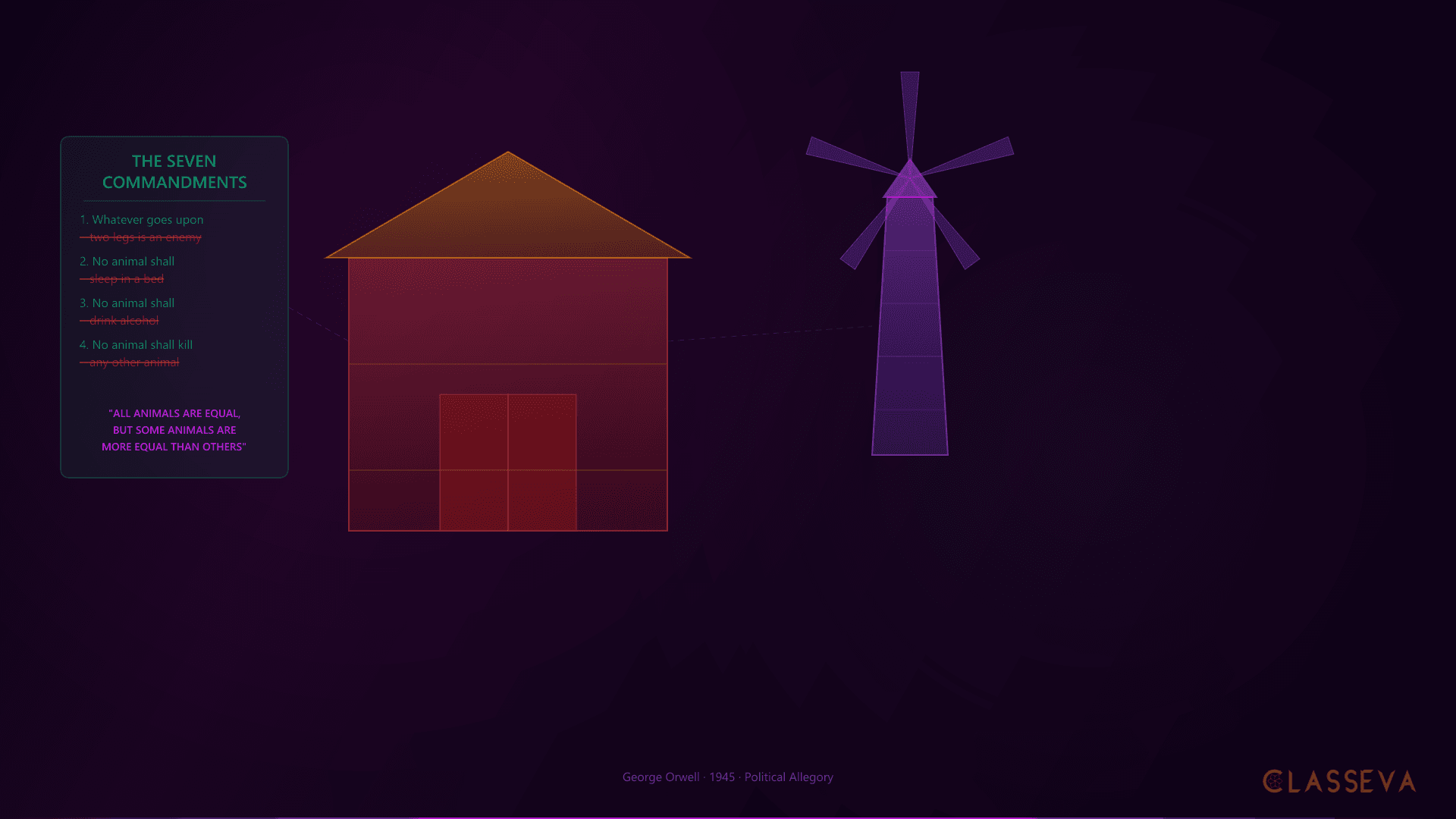
The Seven Commandments of Animalism are the backbone of the novel's structure. They begin as a genuine code of equality and are gradually rewritten to justify pig supremacy. Tracking how each commandment changes is one of the most effective ways to demonstrate understanding of Orwell's central argument about the Animal Farm themes of corruption and propaganda.
Orwell's genius is in the method. No commandment is openly abolished. Each is subtly modified with an additional clause that renders the original meaningless. “No animal shall sleep in a bed” becomes “No animal shall sleep in a bed with sheets.” The structure is preserved while the meaning is gutted. For the exam, this is powerful evidence for any question about propaganda, corruption, or the abuse of language.
How Parents Can Help with Animal Farm Revision
You do not need to have read Animal Farm recently to help your child. What matters most is helping them see the connections between the farm narrative and the real-world history it represents. A ten-minute conversation about Stalin and Trotsky can do more for their understanding than hours of passive re-reading.
Practical Revision Strategies
Watch an adaptation together
The 1954 animated film is a faithful adaptation and takes under 90 minutes. It helps your child visualise the allegory and sparks natural conversation about what each event represents.
Learn the basic Russian Revolution timeline
Even a short YouTube overview of Stalin versus Trotsky gives your child the context they need. Understanding that Napoleon equals Stalin transforms surface-level description into top-grade analysis.
Practise the commandment changes
Help your child memorise how each commandment is altered. Ask them to explain what the change represents and which theme it connects to. This is some of the most reliable exam material in the novel.
Quiz their quotes by theme
Pick a theme (power, propaganda, class) and ask your child to give two quotes that connect to it. This builds the flexible recall they need under exam conditions.
Discuss modern parallels
Propaganda, fake news, political manipulation, the gap between promises and reality. These conversations help your child understand why Orwell’s message still matters, which is exactly the kind of broader engagement examiners reward.
Time their essay practice
Under exam conditions, your child has roughly 45 minutes for the modern text essay. Running a timer while they write builds the pacing instinct they need on the day.
Exam Technique Tips
Beyond content knowledge, the way your child structures their answer matters significantly. These technique points apply specifically to Animal Farm characters analysis GCSE questions and theme-based essays.
Every analytical point should address both layers of the allegory. Surface narrative (what happens on the farm) plus political parallel (what real-world event this represents). Students who consistently do this move into the higher grade bands because it demonstrates the “conceptualised response” that mark schemes reward.
What examiners want
- •Both layers of the allegory in every paragraph
- •Short embedded quotes (3 to 5 words) woven into sentences
- •Context integrated into analysis, not in a separate paragraph
- •Tracking change across the novel, not just describing one moment
Common mistakes to avoid
- •Retelling the story without analysis
- •Quoting long passages instead of short embedded phrases
- •Writing a context paragraph that is disconnected from the argument
- •Discussing Orwell’s life without connecting it to the text’s meaning
For more guidance on the exam structure and how Animal Farm fits alongside other texts, see the complete guide to GCSE English Literature set texts. If your child is also studying a Shakespeare text, the Macbeth GCSE guide and An Inspector Calls GCSE guide follow the same format as this post. For broader English revision strategies, the how to revise for GCSE English guide covers both Language and Literature papers.
If your child is also studying Lord of the Flies, the Lord of the Flies GCSE guide covers that text in the same depth. For external resources, the BBC Bitesize Animal Farm revision guide provides a solid overview of the plot and characters. SparkNotes Animal Farm offers chapter-by-chapter summaries that can help your child fill in gaps if they have missed lessons.