Jekyll and Hyde GCSE Guide: Themes, Characters, Key Quotes
The Strange Case of Dr Jekyll and Mr Hydeis one of the most popular 19th-century prose choices at GCSE, often studied alongside or instead of A Christmas Carol. Robert Louis Stevenson's novella is only about 70 pages long, but it packs in enough thematic complexity to sustain a full exam essay. The central idea, that every person contains both good and evil, resonated with Victorian readers and still strikes a nerve today.
Most parents know the basic concept from films: a respectable doctor transforms into a violent alter ego. But the GCSE exam requires far more than plot knowledge. Your child needs to analyse Stevenson's language, explore Victorian context, and trace how the novella's unusual structure builds suspense. This Jekyll and Hyde GCSE guide covers everything you need to support that preparation, even if you have never read the novella yourself.
How Jekyll and Hyde Appears in the GCSE Exam
On AQA GCSE English Literature (8702), Jekyll and Hyde appears in Paper 1, Section B as one of the 19th-century novel options. Students receive a printed extract and must write one essay responding to a question about both the extract and the novella as a whole. The same closed book conditions apply as for the Shakespeare section.
| Exam Board | Paper | Format | Time (approx.) | Book Allowed? |
|---|---|---|---|---|
| AQA | Paper 1, Section B | Extract + whole novella essay | 50 minutes | No (closed book) |
| Edexcel | Paper 1 | Extract-based question | 55 minutes | No (closed book) |
| OCR | 19th-century prose | Extract-based essay | 50 minutes | No (closed book) |
How Jekyll and Hyde is assessed across the main GCSE exam boards
The Closed Book Challenge
The closed book format changes everything about how your child should prepare. During my years working with students, the pattern I saw again and again was this: students who understood the novella brilliantly in class would freeze in the exam because they could not recall specific quotations under pressure. Understanding is necessary but not sufficient. Your child also needs a bank of memorised quotes they can deploy flexibly.
The good news is that Jekyll and Hyde is much shorter than most GCSE texts, which means fewer characters and a tighter plot. There are no subplots to track. The entire novella builds toward a single revelation. This makes it more manageable for memorisation than something like Macbeth with its extensive cast.
Your child cannot take the text into the exam. Short, memorised quotations of 3 to 5 words are far more effective than long passages. Each quote should link to at least two themes for maximum flexibility across different exam questions.
What Examiners Actually Want
The AQA mark scheme assesses four things: a thoughtful response to the extract, analysis of language, form, and structure, relevant use of context, and a convincing personal response that addresses the whole novella. The extract is a starting point, not a boundary. Students who write only about the given extract and neglect the wider text lose marks.
A grade 7+ response analyses how Stevenson uses language to build atmosphere and convey meaning, why he structures the novella through multiple narrators, and what a Victorian reader would have understood about the themes of duality and repression. That contextual layer, connecting the text to Victorian anxieties about science, morality, and the hidden self, is where many students leave marks on the table.
The Seven Key Themes in Jekyll and Hyde
Every Jekyll and Hyde GCSE exam question centres on one or more themes. The themes in this novella are tightly interwoven: duality connects to repression, repression connects to reputation, and reputation connects to the Gothic setting of a London that hides its darkness behind respectable facades. Your child needs to understand all seven themes and, crucially, how they link together.
Duality of Human Nature
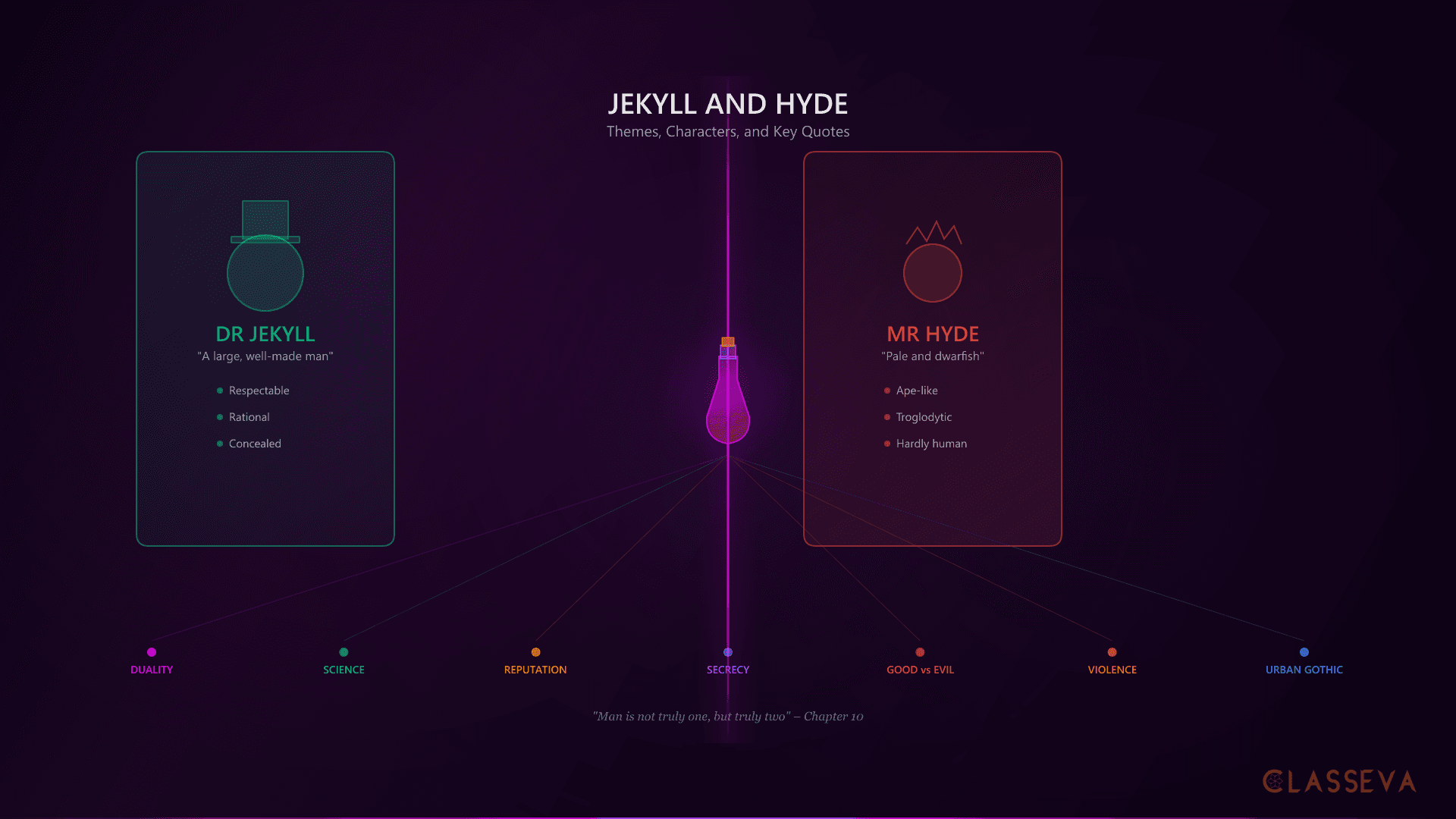
This is the central theme of the entire novella. Jekyll believes that “man is not truly one, but truly two”: every person contains both a good and an evil self. His experiment is an attempt to separate these halves. The tragedy is that the separation does not work. Hyde grows stronger with each transformation, while Jekyll grows weaker. Stevenson's argument is profound: repressing evil does not destroy it. It makes it more dangerous.
For the exam, your child should be able to discuss duality not just as a plot device but as Stevenson's comment on Victorian society. The entire culture was built on presenting a respectable exterior while hiding anything shameful. Jekyll is the ultimate expression of this: a man who creates a separate identity so he can indulge his desires without damaging his reputation. When students connect duality to context like this, they move from description into the kind of analysis that earns top marks.
Help your child create a theme grid: a table with the seven themes across the top and the main characters down the side. In each cell, they write one short quote. This single sheet forces connections between themes and characters, which is exactly what examiners reward.
Reputation, Respectability, and Repression
Victorian gentlemen were obsessed with how they appeared to others. The novella is full of characters who prioritise discretion above all else. Utterson and Enfield walk past Hyde's door and agree not to discuss what they have seen. Utterson investigates Jekyll's connection to Hyde but refuses to pry too directly. Even when characters suspect something is deeply wrong, they choose silence over scandal.
Jekyll creates Hyde partly because Victorian respectability demands it. He describes having “concealed my pleasures” and living with “an almost morbid sense of shame.” The desires he suppresses are never fully specified, which is itself significant. Stevenson leaves them vague so that every reader fills in the blank with their own understanding of what “undignified” means. The locked doors, sealed letters, and private laboratories throughout the novella are physical symbols of the secrets Victorian society forced people to keep.
Science, Violence, and the Urban Gothic
Three more themes deserve attention. Science and experimentation drives the plot: Jekyll's potion represents the danger of science without moral boundaries. Victorian audiences feared science's power to disrupt the natural order, especially after Darwin's On the Origin of Species (1859). Jekyll “plays God” by trying to separate good from evil, and it destroys him. Violence and savagery escalates throughout the novella. Hyde tramples a child, then bludgeons Sir Danvers Carew to death with a walking stick. His violence is described in animalistic, dehumanising terms, reflecting Victorian fears about evolutionary regression. And the urban Gothic setting of London itself matters: dark, foggy, labyrinthine streets mirror the hidden nature of the characters who walk them.
Past papers show that duality, repression, and science are the most commonly examined themes in Jekyll and Hyde. Your child should have at least three quotes ready for each of these, but should also be prepared for questions on violence, secrecy, or the Gothic.
Character Analysis: Who Your Child Needs to Know
Jekyll and Hyde characters analysisis central to most exam responses. The novella has a small cast, which is an advantage: your child can know all six characters in depth rather than spreading their knowledge thin. Jekyll and Hyde themselves require the deepest understanding, but Utterson's role as narrator is also analytically important.
Dr Jekyll and Mr Hyde
Jekyll is a wealthy, respected doctor who creates a potion to separate his good and evil natures. The crucial point for the exam is that Jekyll does not simply become Hyde. He already containsHyde. The potion releases what was always there. Jekyll describes his “undignified” pleasures and the “morbid sense of shame” that drove him to conceal them. He does not specify what these pleasures are. This ambiguity is deliberate: Stevenson invites every reader to project their own understanding of hidden desire.
Hyde is described in consistently dehumanising terms. He is “pale and dwarfish,” “ape-like,” and gives an “impression of deformity” that no one can quite pinpoint. Characters react to him with instinctive revulsion. This reflects the Victorian belief in physiognomy: the idea that inner corruption shows in physical appearance. Hyde is smaller than Jekyll because, as Jekyll explains, his evil side has been “less exercised and much less exhausted” over the years. It is a younger, more energetic force precisely because it has been repressed.
Dr Jekyll
- •Respected, wealthy doctor and scientist
- •"Large, well-made" with "every mark of capacity and kindness"
- •Drives the experiment to separate good from evil
- •Gradually loses control as Hyde grows dominant
- •Represents the impossibility of dividing the self
Mr Hyde
- •Jekyll's alter ego; pure, uninhibited evil
- •"Pale and dwarfish" with "ape-like fury"
- •Violence escalates from trampling to murder
- •Instinctively repulsive to every character
- •Represents the repressed desires Victorian society hid
Utterson and the Narrators
Mr Utterson is Jekyll's lawyer and the narrative viewpoint for most of the novella. He is rational, loyal, and discreet: the model Victorian gentleman. His investigation drives the plot, but his character also embodies the very problem the novella explores. Utterson suspects something terrible about Jekyll's relationship with Hyde, yet he avoids asking directly, prioritising discretion over truth. Stevenson uses Utterson to show how Victorian respectability itself becomes a form of complicity.
The novella's structure is analytically significant. Stevenson uses multiple narrators and documents: Utterson's third-person perspective, Enfield's eyewitness account, Dr Lanyon's letter, and Jekyll's final confession. This delays the revelation that Jekyll and Hyde are the same person. For the exam, your child should be able to explain why Stevenson structures the novella this way: it mirrors the theme of secrecy. Truth is literally locked away in sealed letters, to be opened only after death.
Many students forget to analyse narrative structure. The fact that Stevenson delays the truth through letters and multiple perspectives is not accidental. It reflects Victorian society's obsession with keeping secrets. Your child can earn marks by explaining how the structure reinforces the themes.
The Supporting Characters
Three other characters serve specific functions. Dr Lanyon witnesses Hyde transforming back into Jekyll and is so horrified that he dies. His death represents the destruction Jekyll's experiment causes to others, not just to himself. Mr Enfield is Utterson's cousin who first witnesses Hyde trampling a child. Like Utterson, he values discretion and avoids probing too deeply. Poole, Jekyll's loyal butler, is the one whose concern finally forces the climactic scene where Utterson breaks down the laboratory door.
| Character | Role in the Novella | Key Theme Connection |
|---|---|---|
| Dr Jekyll | Protagonist; creates the potion to separate good and evil | Duality, science, repression |
| Mr Hyde | Jekyll's alter ego; embodies pure evil and hidden desires | Duality, violence, good vs evil |
| Mr Utterson | Jekyll's lawyer; narrator for most of the novella | Reputation, secrecy, rationality vs the unknown |
| Dr Lanyon | Witnesses the transformation; dies from shock | Science, the limits of rational understanding |
| Mr Enfield | First witness to Hyde's violence; values discretion | Reputation, secrecy, Victorian propriety |
| Poole | Jekyll's butler; raises the alarm | Loyalty, the breakdown of the domestic facade |
The six key characters in Jekyll and Hyde and their thematic connections
Essential Quotes Your Child Should Know
For a closed book exam, quotes are the raw material your child builds their essay from. The most useful Jekyll and Hyde GCSEquotes are short, rich in language for analysis, and applicable to more than one theme. From my experience working with students preparing for this text, the ones who performed best were not those who had memorised the longest passages. They were the ones who could weave a three-word phrase into their own analytical sentence and explain precisely what Stevenson's word choice reveals.
Quotes for Duality and Repression
| Quote | Speaker/Source | Chapter | Themes | Why It Matters |
|---|---|---|---|---|
| "Man is not truly one, but truly two" | Jekyll (confession) | Ch. 10 | Duality | The thesis of the entire novella; Jekyll argues that duality is universal, not unique to him |
| "I learned to recognise the thorough and primitive duality of man" | Jekyll (confession) | Ch. 10 | Duality, science | "Primitive" links to evolutionary fears; duality is presented as a scientific discovery |
| "I concealed my pleasures" | Jekyll (confession) | Ch. 10 | Repression, reputation | Victorian society forced concealment; the shame is social, not merely personal |
| "An almost morbid sense of shame" | Jekyll (confession) | Ch. 10 | Repression | "Morbid" suggests the shame itself is a kind of disease; repression is pathological |
| "I was slowly losing hold of my original and better self" | Jekyll (confession) | Ch. 10 | Duality, science | Hyde grows dominant; the experiment that was meant to liberate Jekyll traps him instead |
Key quotes for the themes of duality, repression, and identity
Quotes for Violence and the Gothic
| Quote | Speaker/Source | Chapter | Themes | Why It Matters |
|---|---|---|---|---|
| "Ape-like fury" | Narrator (Carew murder) | Ch. 4 | Violence, duality | Dehumanising language links Hyde to animalistic regression and Darwinian fears |
| "Pale and dwarfish... impression of deformity" | Enfield | Ch. 1 | Good vs evil, duality | Victorian physiognomy: inner evil shows in physical form; "dwarfish" suggests stunted morality |
| "Trampled calmly over the child's body" | Enfield | Ch. 1 | Violence | "Calmly" is key: Hyde feels no guilt or hesitation, which horrifies witnesses |
| "The fog rolled over the city" | Narrator | Ch. 4 | Urban Gothic, secrecy | Fog literally and symbolically obscures; London itself mirrors the characters' hidden natures |
| "Hardly human... something troglodytic" | Utterson | Ch. 2 | Duality, violence | "Troglodytic" means cave-dwelling; Hyde is a regression to a pre-civilised state |
Key quotes for the themes of violence, the Gothic, and Hyde's animalistic nature
Students often copy out long passages without analysing them. This wastes time and does not impress examiners. Short, embedded quotations score higher. Instead of quoting a full sentence, your child should weave 3 to 5 words into their own analysis: “Stevenson describes Hyde with ‘ape-like fury,’ connecting his violence to Victorian anxieties about evolutionary regression.”
Victorian Context That Earns Extra Marks
Context is one of the four assessment objectives on AQA, and it is where Jekyll and Hyde GCSE revision often falls short. Many students know the context but present it as a separate paragraph that reads like a history essay. Examiners want to see context woven into analysis. A student who writes “Darwin published On the Origin of Species in 1859” on its own gets no credit. A student who writes “Stevenson's description of Hyde as ‘ape-like’ reflects post-Darwinian anxieties that humanity might regress to its primitive origins” gets full marks for that point.
Darwin and Victorian Fears of Degeneration
Charles Darwin's On the Origin of Species (1859) fundamentally shook Victorian society. If humans had evolved from animals, could they also devolve back? This fear, known as degeneration theory, haunted late Victorian culture. Hyde is Stevenson's embodiment of it. He is consistently described in animalistic terms: “ape-like fury,” “troglodytic,” “hardly human.” He is smaller and younger than Jekyll because the evil side has been “less exercised” and is therefore closer to a primitive state.
Just two years after the novella's publication, the Jack the Ripper murders(1888) made the idea of a respectable gentleman with a hidden, violent side terrifyingly real. Stevenson's fiction seemed prophetic. Your child does not need to mention Jack the Ripper in the exam, but understanding this cultural moment helps them see why Victorian readers found the novella so unsettling. It was not just a horror story. It was a mirror held up to their own society.
Victorian Respectability and the Double Life
Victorian society imposed strict codes of public behaviour, especially on gentlemen. Any deviation from the expected standard of morality, sobriety, and restraint was hidden or denied. Jekyll's experiment is driven by this suffocating demand for respectability. He does not create Hyde because he is uniquely evil. He creates Hyde because his society gives him no legitimate outlet for the desires every person has.
The Gothic literary tradition is also important context. Jekyll and Hyde belongs to the same genre as Frankenstein and Dracula: stories where the boundaries between civilisation and monstrosity blur. The Gothic setting of fog-bound London, with its back alleys, locked doors, and windowless buildings, creates an atmosphere where secrets can thrive. Students who can identify Stevenson's Gothic techniques, and explain what they reveal about Victorian fears, demonstrate the kind of sophisticated reading that strong GCSE English responses require.
How Parents Can Help with Jekyll and Hyde Revision
You do not need to be a literature specialist to support your child with Jekyll and Hyde GCSE revision. The most helpful parents I encountered during my time in the tutoring industry were not those who could explain every literary device. They were the ones who asked good questions at the dinner table and made revision feel like a conversation rather than a chore. The novella's themes, the tension between public image and private reality, resonate with everyday life in a way that makes discussion accessible.
Practical Revision Strategies
Read the novella together
At only 70 pages, Jekyll and Hyde is genuinely short enough for a parent to read alongside their child. Even skimming the key chapters (1, 4, 9, 10) gives you enough knowledge to have meaningful conversations about the themes.
Create quote flashcards
One short quote per card. On the front: the quote. On the back: who says it, which chapter, which themes it links to, and one sentence of analysis. Aim for 15 to 20 cards. Focus testing on the ones your child gets wrong.
Discuss the concept of duality
"Does everyone have a good and evil side?" "What happens when people pretend to be someone they're not?" "Why do people hide parts of themselves?" These are genuine exam themes phrased as everyday questions. Talking through them builds the fluency your child needs under timed conditions.
Watch an adaptation
The BBC's 2006 Jekyll (TV series starring James Nesbitt) modernises the dual-identity concept effectively. Watching any adaptation helps your child visualise characters and settings, which makes memorisation easier.
Practise timed essays
Download past papers from the AQA website and have your child write a complete response in 50 minutes. The first attempt will feel rushed. By the third or fourth, they will have developed the pacing and paragraph structure that makes a real difference on exam day.
One of the most analytically rich angles on Jekyll and Hyde is Stevenson's warning about science without moral limits. Help your child see Jekyll not just as a character in a horror story but as a scientist who pushes past ethical boundaries. The parallels with modern debates about genetic engineering and AI make this theme feel current and give your child fresh material for their essay.
Exam Technique Tips
Beyond knowledge of the text, exam technique determines whether your child converts understanding into marks. These are the specific points that make a measurable difference in GCSE English Literature.
What Examiners Want to See
- •Address BOTH the extract AND the wider novella (AQA)
- •Short, embedded quotations woven into sentences
- •Analysis of specific WORDS: what does Stevenson's language choice reveal?
- •Context integrated into analytical points, not separate paragraphs
- •Discuss the narrative structure: why does Stevenson use multiple narrators?
Common Mistakes to Avoid
- •Writing only about the extract and ignoring the wider novella
- •Long block quotations copied out without language analysis
- •Narrating the plot: "Then Jekyll drinks the potion..." instead of analysing
- •Context dumped in its own paragraph with no link to the analysis point
- •Treating Jekyll and Hyde as a simple horror story rather than social commentary
The most common mistake in Jekyll and Hyde essays is retelling the story rather than analysing it. Your child should never write “Jekyll takes the potion and turns into Hyde.” Instead: “Stevenson presents the transformation as a loss of control, with Jekyll describing how he ‘slowly losing hold of my original and better self,’ suggesting that repression does not destroy evil but strengthens it.” The difference between these two sentences is multiple grade boundaries.
If your child is aiming for a grade 7 or above, they should also practise evaluating alternative interpretations. A question on duality might ask whether Hyde is a separate creature or simply Jekyll without his inhibitions. A strong response engages with both readings: “While Hyde appears to be a distinct entity, Stevenson's use of first person in Jekyll's confession, where he says ‘I’ when describing Hyde's actions, suggests they were never truly separate.” That single sentence demonstrates language analysis, structural awareness, and evaluative skill. It is exactly the kind of writing that pushes into the top grade bands.
For a broader view of all the texts your child might study, our GCSE English Literature set texts guide covers every 19th-century novel and Shakespeare play on the AQA specification. And if the exam itself feels overwhelming, our guide on whether GCSE English is hard gives honest perspective on what the papers demand and how to prepare.