KS2 SATs GPS Guide: Grammar, Punctuation & Spelling
One conversation I kept having with parents at the tutoring company was about the KS2 SATs GPStest. They would describe it as “the grammar paper” and then immediately say they had no idea what a fronted adverbial was. Most parents educated in the UK never learned formal grammar terminology at school. So when their Year 6 child comes home talking about subordinate clauses and determiners, the whole test can feel impenetrable.
It does not need to be. The GPS test (also called SPaG) is one of the more structured SATs papers, and once you understand what both papers contain and where the marks sit, you can help your child focus their preparation on what actually matters. This guide breaks down both papers, explains the seven content domains, reveals which strands carry the most weight, and gives you a practical plan for the weeks ahead.
What Is the KS2 SATs GPS Test?
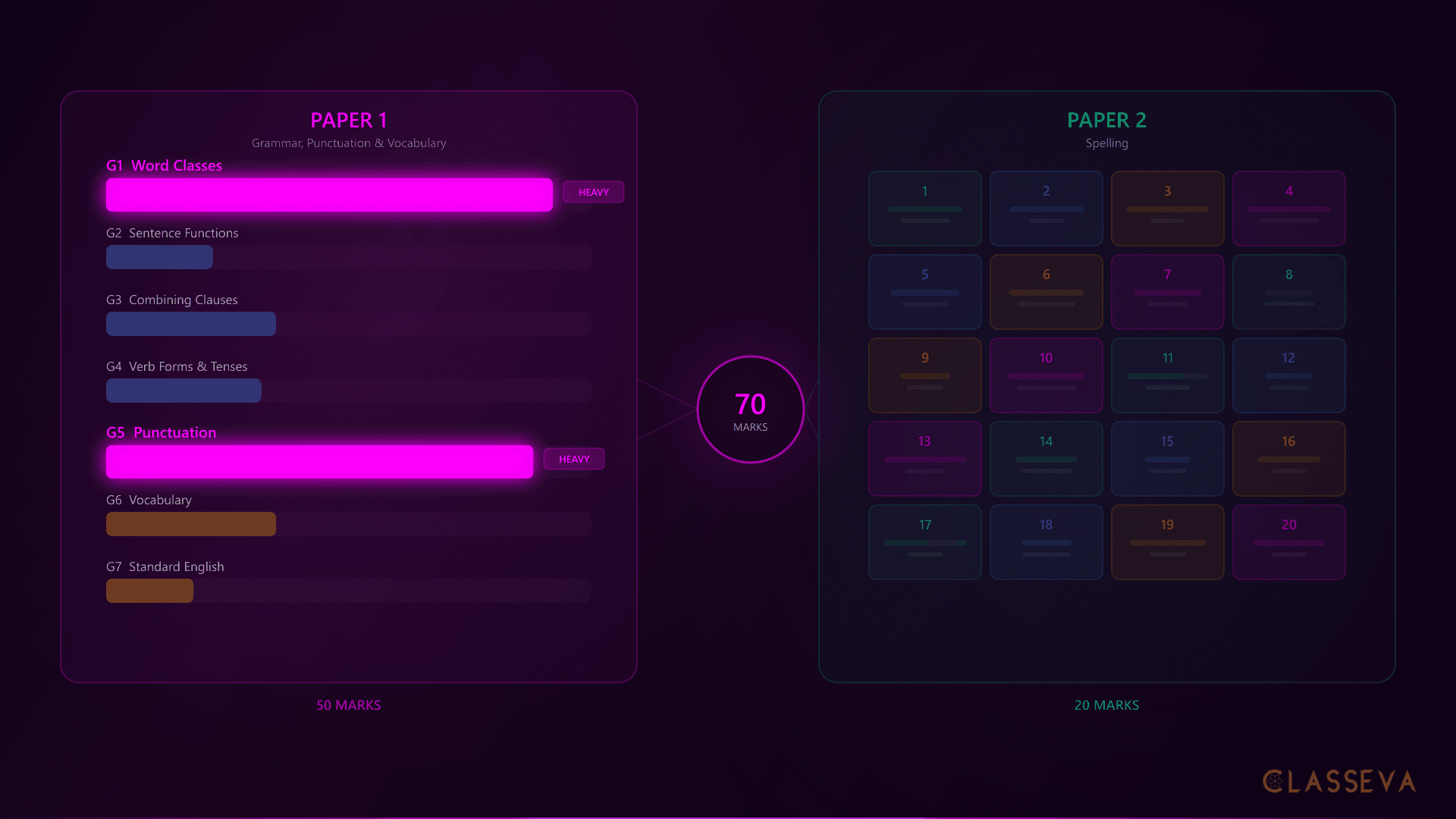
The KS2 SATs GPS test is a national assessment sat by every Year 6 child in England at the end of Key Stage 2. It tests grammar, punctuation, vocabulary, and spelling across two separate papers, worth a combined total of 70 marks. The test is formally called the English grammar, punctuation and spelling test by the Standards and Testing Agency (STA), but schools, parents, and teachers use “GPS” and “SPaG” interchangeably.
Unlike the KS2 reading test, which assesses comprehension of longer passages, GPS is a technical paper. It tests whether your child can identify word classes, apply punctuation rules, understand sentence structure, and spell words from the national curriculum word lists. The questions are short and specific. There is no extended writing.
GPS vs SPaG: Same Test, Different Names
If you have heard both “GPS” and “SPaG” and are unsure whether they are different tests: they are not. GPS (Grammar, Punctuation and Spelling) is the official name used on the test papers and in STA documentation. SPaG (Spelling, Punctuation and Grammar) is the older, informal name that many teachers and parents still use. The letters are simply rearranged. Your child sits exactly the same two papers regardless of which name their school uses.
The STA adopted “GPS” to align with the order in which the papers are sat: grammar and punctuation first (Paper 1), then spelling (Paper 2). You will see both terms in school communications, revision books, and past papers. They all refer to the same SATs GPS paper explained in this guide.
Two Papers at a Glance
The GPS test is split into two papers sat on the same morning. Here is what each one involves:
Paper 1: Grammar, Punctuation & Vocabulary
- •45 minutes, 50 marks
- •Short answer questions: multiple choice, fill-in-blank, rewriting sentences
- •Tests grammar terms, punctuation rules, and vocabulary
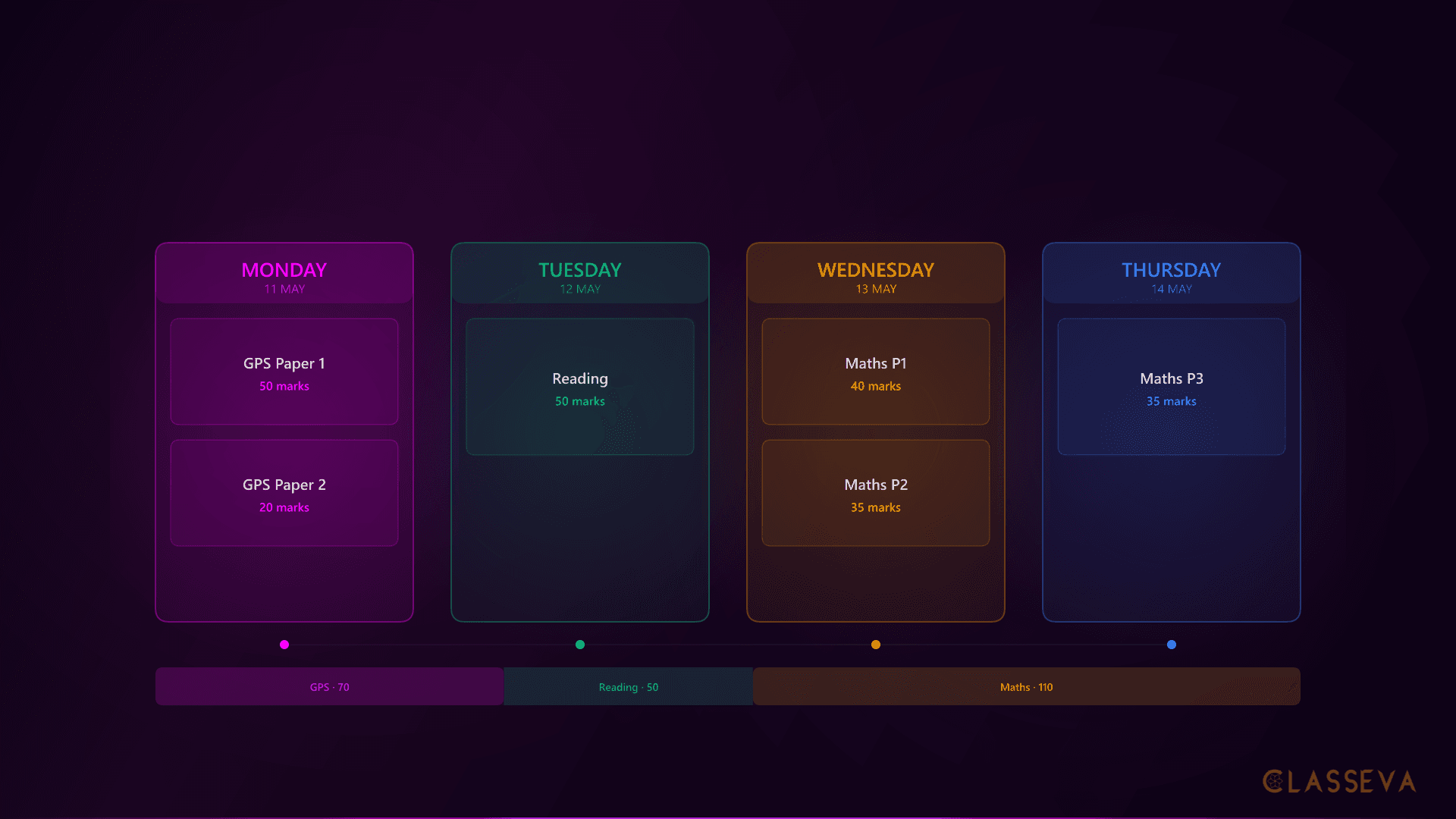
- •Monday 11 May 2026
Paper 2: Spelling
- •Approximately 15 minutes, 20 marks
- •Teacher reads 20 words in context sentences
- •Child writes the correct spelling of each word
- •Immediately follows Paper 1
Paper 1: Grammar, Punctuation and Vocabulary
Paper 1 is the longer of the two papers: 45 minutes to answer questions worth 50 marks. Questions range in difficulty from straightforward identification (“Circle the adverb in this sentence”) to tasks requiring genuine grammatical understanding (“Rewrite this sentence in the passive voice”). The paper tests your child across seven content domains, each covering a different area of English grammar, punctuation, or vocabulary.
What catches many parents off guard is the terminology. You might remember learning about nouns and verbs at school, but terms like determiner, subordinate clause, modal verb, and subjunctive moodwere not part of the curriculum when most of today's parents were at primary school. Your child, however, is expected to know and use these terms precisely.
The Seven Content Domains (51 Strands)
Paper 1 questions are drawn from seven content domains, labelled G1 through G7. Within these seven domains, there are 51 individual strands, each covering a specific grammatical or punctuation concept. Not all strands appear every year: the STA rotates which strands are tested, though some appear with much greater frequency than others.
| Domain | Focus Area | Number of Strands | Example Topics |
|---|---|---|---|
| G1 | Grammatical terms and word classes | 12 | Nouns, verbs, adjectives, adverbs, pronouns, determiners, prepositions, conjunctions |
| G2 | Functions of sentences | 4 | Statements, questions, commands, exclamations |
| G3 | Combining words, phrases and clauses | (included in G1-G7) | Subordination, coordination, relative clauses |
| G4 | Verb forms, tenses and consistency | (included in G1-G7) | Past tense, present tense, progressive, perfect, tense consistency |
| G5 | Punctuation | 15 | Full stops, commas, apostrophes, inverted commas, brackets, dashes, colons, semicolons, hyphens |
| G6 | Vocabulary | (included in G1-G7) | Prefixes, suffixes, synonyms, antonyms, word families |
| G7 | Standard English and formality | (included in G1-G7) | Formal vs informal language, subjunctive mood, standard verb forms |
Source: STA KS2 English GPS test framework. G1 and G5 (highlighted) carry the most marks.
Question Types on Paper 1
Paper 1 uses a variety of question formats, which is worth knowing so your child is not surprised on the day. Questions are not grouped by domain; instead, they appear in a mixed order throughout the paper, generally progressing from easier to harder.
| Question Format | What Your Child Does | Example |
|---|---|---|
| Multiple choice | Tick or circle the correct option from several choices | Which sentence uses a comma correctly? Tick one. |
| Fill in the blank | Write a word or punctuation mark in the gap | Add the missing apostrophe to the sentence below. |
| Identify / circle | Underline or circle a word, phrase, or clause in a given sentence | Circle the two adverbs in the sentence below. |
| Rewrite | Rewrite a sentence changing a specific feature | Rewrite this sentence in the passive voice. |
| Explain / name | Write a short explanation or name a grammatical feature | What type of word is "however" in this sentence? |
| Insert | Add punctuation or words to a passage | Insert a pair of commas to show parenthesis. |
Question formats on KS2 SATs GPS Paper 1. The rewrite and explain questions tend to appear later in the paper and carry more marks.
Most children find the multiple-choice and circling questions straightforward. The marks that separate expected standard from higher standard tend to come from rewrite questions (especially passive voice and subjunctive) and punctuation insertion tasks involving parenthesis, semicolons, or colons. Practising these specific formats with past papers builds both speed and confidence.
Which Content Domains Matter Most?
Not all seven domains are equally weighted. This is one of the most useful things to understand about the KS2 grammar punctuation spelling test, because it means your child can prioritise the areas that carry the most marks. The data from every GPS paper since 2017 makes the answer clear.
G1 and G5: Over Half the Marks
G1 (grammatical terms and word classes) and G5 (punctuation) collectively make up over half of Paper 1 marks. This is a consistent pattern across every paper since 2017. In practical terms, a child who knows their word classes thoroughly and can apply punctuation rules accurately has already covered the majority of what is tested.
Analysis of every GPS Paper 1 since 2017 reveals that a child who answered only G1 and G5 questions correctly could theoretically pass the test, without answering any G2, G3, G4, G6, or G7 questions at all. This is not a revision strategy (every domain should be covered), but it demonstrates just how heavily these two areas are weighted.
This weighting makes sense when you consider that G1 spans 12 strands (the most of any domain) and G5 spans 15 strands. Together, that is 27 of the 51 total strands. The STA draws most heavily from these pools because they cover the foundational knowledge of English grammar and punctuation.
Most Tested Strands Since 2017
Within those 51 strands, some appear far more frequently than others. Knowing which strands are tested most often helps you focus revision where it has the highest return.
| Strand | Domain | Times Tested (2017-2025) | What It Covers |
|---|---|---|---|
| G5.9: Punctuation for parenthesis | Punctuation | 17 | Brackets, dashes, or commas to mark off extra information within a sentence |
| G6.1: Synonyms and antonyms | Vocabulary | 15 | Words with similar meanings and words with opposite meanings |
| G1.1: Noun phrases | Word Classes | 12+ | Expanded noun phrases using modifiers and prepositional phrases |
| G5.8: Apostrophes | Punctuation | 12+ | Apostrophes for contraction and possession (including plural possession) |
| G1.6: Conjunctions | Word Classes | 10+ | Coordinating and subordinating conjunctions to join clauses |
Source: LbQ analysis of all KS2 SATs GPS papers 2017-2025. G5.9 (parenthesis) is the single most tested strand.
Paper 2: Spelling
Paper 2 is the shorter paper, lasting approximately 15 minutes and worth 20 marks. It tests your child's ability to spell 20 words correctly. The format is consistent every year: the teacher reads each word aloud within a context sentence, and your child writes the correct spelling in a gap on the answer sheet.
How the Spelling Paper Works
The teacher reads a sentence such as: “The explorers had to journey throughthe dense forest.” Your child hears the sentence and writes the target word (“through”) in the blank space. Each correct spelling earns 1 mark. There is no partial credit: the spelling must be exactly right.
The 20 words are drawn from two sources: the Year 3/4 statutory spelling list and the Year 5/6 statutory spelling list, plus words that test specific spelling rules (prefixes, suffixes, homophones, silent letters, double consonants). In 2025, three homophones were tested in a single paper (through, passed, scene), the most in any year to date.
The 2025 spelling paper tested some genuinely tricky words, including plaque and flourish. Three homophones appeared in the same paper (through, passed, scene), which was a record. Homophones are consistently one of the highest-error areas because children know the word aurally but write the wrong version.
Spelling Strategy: The Cushion Effect
Here is something that many parents miss about how GPS scoring works. The 70 marks are combined from both papers. In 2025, the pass mark (expected standard) was 35 out of 70. This means a child who scores 20/20 on spelling only needs 15 out of 50 on grammar to pass. That is a significant cushion.
The reverse is also true. A child who struggles with spelling but is strong on grammar can compensate. If your child gets 10/20 on spelling, they need 25/50 on grammar to reach 35/70. Both routes are viable, and knowing which way your child leans should shape how you allocate preparation time.
2025 Results and What They Tell Us
In 2025, 73% of Year 6 children met the expected standard in GPS, up slightly from 72% the previous year. The pass mark was 35 out of 70 (50%). Around 30% achieved the higher standard, down from 32% the year before.
These numbers tell us two things. First, GPS has the highest pass rate of the three SATs tests (reading and maths are typically lower). Second, the drop in higher standard attainment suggests the 2025 paper was slightly more demanding at the top end. This aligns with the trend towards questions that test genuine understanding rather than memorised definitions.
Trends from the 2025 GPS Paper
The 2025 GPS paper included some notable features that signal the direction of future papers:
The subjunctive returned after seven years
For the first time since 2018, the 2025 paper tested the subjunctive verb form ("If I were to help..."). This caught many schools off guard because some had stopped teaching it, assuming it had been quietly dropped. It has not. The subjunctive remains in the curriculum and can appear in any year.
Questions tested understanding, not just recognition
Recent papers increasingly place grammatical features in unusual positions within sentences. Fronted adverbials and relative clauses appeared in atypical positions, meaning children who had only memorised "a fronted adverbial is at the start of a sentence" may have struggled. The test rewards genuine understanding of how grammar works, not pattern-matching.
Three homophones in the spelling paper
The 2025 spelling paper tested "through," "passed," and "scene" as homophones. This was the most homophones in a single year. Homophones remain a consistent area where marks are lost because children write the phonetically correct but contextually wrong version.
Some revision resources omit the subjunctive because it was not tested for several years. The 2025 paper proved it can return at any time. Teach your child to recognise constructions like “If I were” (not “If I was”) and “The school requires that she bepresent” (not “is present”). These are the two most common subjunctive patterns in the test.
How to Prepare for SATs GPS
Preparing for the Year 6 spelling test SATs and Paper 1 does not require expensive tutoring or specialist resources. It requires consistency, the right focus areas, and knowledge of what is actually tested. Here is a practical plan that covers both papers.
Key Terms Your Child Must Know
The following grammatical terms appear repeatedly across every GPS paper. Your child should be able to identify and use all of them confidently. If any of these terms are unfamiliar to you as a parent, that is completely normal. Most adults were never taught explicit grammar terminology at school.
| Term | What It Means | Example |
|---|---|---|
| Noun | A word for a person, place, thing, or idea | The dog chased the ball. |
| Verb | A word expressing an action or state | She runs quickly. He is tired. |
| Adjective | A word that describes a noun | The tall building. |
| Adverb | A word that modifies a verb, adjective, or other adverb | She ran quickly. It was very cold. |
| Pronoun | A word that replaces a noun | She told them about it. |
| Preposition | A word showing position or relationship | The cat sat on the mat. |
| Conjunction | A word that joins clauses or sentences | I ran because I was late. |
| Determiner | A word that introduces a noun | The cat. A dog. Some water. This book. |
| Clause | A group of words containing a subject and verb | When it rained, we stayed inside. |
| Subordinate clause | A clause that cannot stand alone as a sentence | Although she was tired, she kept going. |
| Relative clause | A clause introduced by who, which, that, where, when | The boy who won the race smiled. |
| Fronted adverbial | An adverb or adverbial phrase at the start of a sentence | Cautiously, she opened the door. |
Key grammar terms tested in KS2 SATs GPS. Your child should recognise these in context, not just define them.
A practical way to build familiarity with these terms is to spot them in everyday reading. When your child reads a book or magazine, occasionally ask them to point out a subordinate clause or identify the determiners in a sentence. This makes grammar feel like a real tool for understanding language, not just a test topic.
Five-Step Preparation Plan
Master the key grammar terms
Focus on the 12 terms in the table above. Use flashcards or quick daily quizzes. Your child should be able to identify each word class in a sentence, not just define the term. Prioritise determiners, prepositions, and subordinate clauses, as these are the terms parents and children find most unfamiliar.
Practise punctuation rules systematically
Work through commas (in lists, after fronted adverbials, for parenthesis), apostrophes (contraction and possession, including plural possession), inverted commas for direct speech, and the difference between brackets, dashes, and commas for parenthesis. Punctuation for parenthesis (G5.9) is the single most tested strand since 2017.
Learn five spelling words per day from the statutory lists
The Year 5/6 statutory spelling list contains the words most likely to appear. Five words per day with a weekly test is manageable and effective. Focus particularly on homophones (their/there/they're, passed/past, through/threw) and words with silent letters or unusual patterns. Use the look-cover-write-check method.
Complete past GPS papers under timed conditions
Past papers are available free from GOV.UK. Time your child strictly: 45 minutes for Paper 1, 15 minutes for Paper 2. After each paper, review every wrong answer together and identify the content domain it belongs to. This reveals patterns in which areas need more work.
Use your child's spelling strength (or grammar strength) strategically
If your child is a strong speller, they have a built-in cushion. Spend more preparation time on the grammar areas they find hardest, knowing that 20 spelling marks are likely secure. If spelling is weaker, focus grammar preparation on G1 and G5 questions specifically, as these carry the most marks and offer the best return on time invested.
Past KS2 SATs GPS papers and mark schemes are available free from the GOV.UK practice materials page. These are the actual papers used in previous years and are the single best preparation resource available. The English programmes of study document also lists every grammar concept your child is expected to know by the end of Year 6.
If your child is preparing for SATs across all subjects, our KS2 SATs 2026 parent's guide covers the full timetable and what to expect. For the complete 2026 SATs dates, including reading and maths, that guide has every date confirmed. And once results arrive, our SATs scores explained guide breaks down exactly what the numbers mean and how scaled scores work.
The GPS test can feel intimidating because of the unfamiliar terminology, but the structure is predictable and the content is finite. Your child is not being asked to write creatively or interpret a passage. They are being asked to demonstrate specific, teachable knowledge about how English works. With focused practice on the right areas, particularly G1, G5, and the statutory spelling lists, that knowledge is entirely within reach.