A-Level English Literature Topics: What Your Child Will Study
A-Level English Literature is one of the most respected and versatile A-Levels your child can choose. In 2025, 34,685 students sat the exam across England, with 24.6% achieving A* or A. It is a Russell Group facilitating subject, which means top universities actively value it for entry to a wide range of degrees, not just English.
But parents are often surprised by what A-Level English Lit actually involves. This is not simply “reading books and answering questions.” Students study poetry, drama and prose spanning centuries, engage with literary criticism and theory, and produce extended coursework essays of 2,000 to 3,000 words. The set texts vary significantly depending on which exam board your child's school uses. This guide maps the full A-Level English Lit syllabus across AQA, Edexcel and OCR, so you know exactly what your child will study.
What Do Students Study in A-Level English Literature?
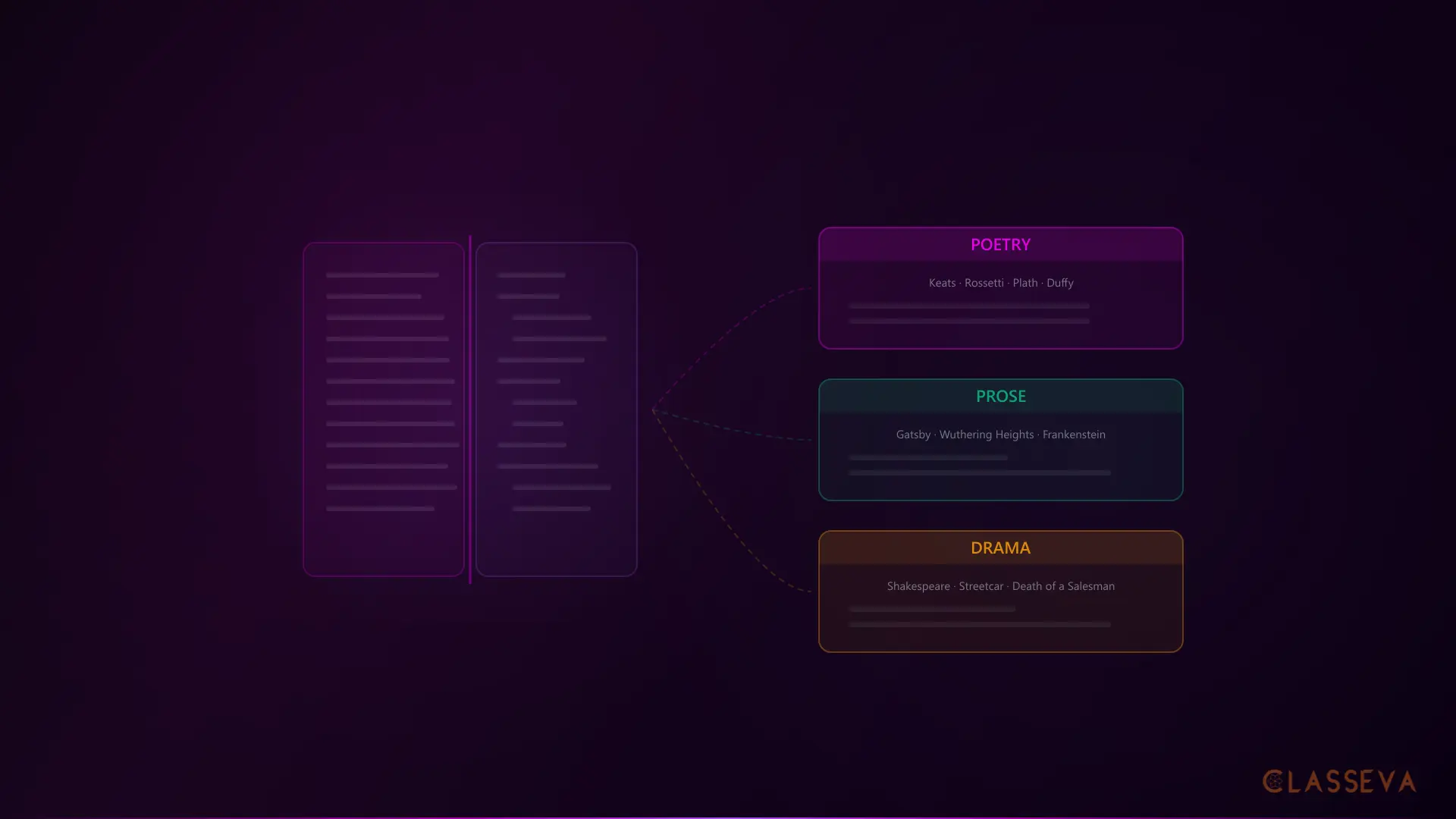
Regardless of exam board, every A-Level English Literature course requires students to study texts from three literary forms: poetry, prose and drama. They must cover work from different periods, including at least one text written before 1900 and at least one Shakespeare play. The depth of study goes far beyond GCSE, with students expected to analyse not just what a text says but how and why it says it, engaging with the historical, social and political contexts that shaped the writing.
The Three Literary Pillars: Poetry, Prose and Drama
Every board structures its course around these three forms, but the balance and grouping differ. AQA organises by theme or genre (love, tragedy, comedy). Edexcel separates the three forms into distinct components. OCR combines them through thematic comparative study. Understanding your child's board matters because it determines not just which books they read, but how they are examined on them.
How A-Level Differs From GCSE English Literature
If your child studied GCSE English Literature, they will recognise the basic structure: a Shakespeare play, prose texts, poetry. But the expectations at A-Level are in a different league. At GCSE, students analyse individual quotes and techniques. At A-Level, they must construct sustained, evidence-based arguments across entire texts, engage with different critical interpretations, and demonstrate understanding of the literary, historical and social contexts that shaped the writing.
GCSE English Literature
- •Analyse individual quotes and language techniques
- •Write essays of 30 to 45 minutes in timed exams
- •Closed-book exams (memorise quotations)
- •Study 4 to 6 texts across the course
A-Level English Literature
- •Construct sustained arguments with multiple critical perspectives
- •Produce coursework essays of 2,000 to 3,000 words
- •Edexcel exams are open book (clean copies allowed)
- •Study 8 to 12 texts plus critical essays and context material
AQA A-Level English Literature (Spec A and B)
AQAis unique in offering two completely different English Literature specifications. Schools choose one or the other, and the content, structure and assessment style differ significantly. From my experience working in tutoring, parents were often unaware that their child's school had chosen Spec A over Spec B (or vice versa), which made targeted revision advice harder to give.
Spec A: Love Through the Ages
AQA Spec A (7712) organises the entire course around the theme of love. Everything students read and write about connects to how love has been represented across different literary periods. This thematic approach means students build deep comparative skills, but they need to think about texts as part of a broader literary conversation rather than in isolation.
| Component | Title | Content | Weight |
|---|---|---|---|
| Paper 1 | Love Through the Ages | One Shakespeare play + poetry anthology (pre-1900 and post-1900 poems on love) + unseen poetry | 40% |
| Paper 2 | Texts in Shared Contexts | Option A: WW1 Literature OR Option B: Modern Times 1945 to present. Two texts studied in historical context. | 40% |
| NEA | Comparative Critical Study | Independent comparative essay on two texts of the student's choice (one must be pre-1900). | 20% |
AQA Spec A (7712): structured around the theme of love across literary periods.
If your child's school uses AQA, find out whether it is Spec A or Spec B. The content is entirely different. A student on Spec A studies love poetry and WW1 or post-1945 literature. A student on Spec B studies tragedy or comedy as a genre. Revision guides and past papers are not interchangeable between the two.
Spec B: Literary Genres (Tragedy or Comedy)
AQA Spec B (7717) takes a genre-based approach. Students study either tragedy or comedy as their central lens and examine how writers across centuries have used the conventions of that genre. This specification also includes an element of literary theory in the coursework, where students apply a critical lens (feminist, Marxist, post-colonial, psychoanalytic) to two texts of their own choosing.
| Component | Title | Content | Weight |
|---|---|---|---|
| Paper 1 | Literary Genres | Three texts studied within Tragedy OR Comedy (including Shakespeare) + unseen passage | 40% |
| Paper 2 | Texts and Genres | Three texts studied within a chosen genre + an unseen extract | 40% |
| NEA | Theory and Independence | Students apply a critical theory (feminist, Marxist, etc.) to two texts of their own choice. | 20% |
AQA Spec B (7717): genre-based study with critical theory coursework.
The Spec B coursework is distinctive because it introduces critical theory explicitly. Students who enjoy thinking about why we interpret texts differently, and who are drawn to philosophy or politics, often thrive on Spec B. The trade-off is that students must engage with abstract theoretical frameworks, which some find challenging.
Edexcel A-Level English Literature
Edexcel (Pearson) takes a more traditional, form-based approach. Each component focuses on a single literary form: drama, prose, or poetry. This makes the structure straightforward, and it also means students can revise for each exam with a clear focus on one form at a time.
| Component | Title | Content | Weight |
|---|---|---|---|
| Component 1 | Drama | One Shakespeare play + one other drama text + critical anthology extracts | 30% |
| Component 2 | Prose | Two prose texts: one pre-1900 and one post-1900 | 20% |
| Component 3 | Poetry | One studied poetry collection + unseen poetry comparison | 30% |
| Component 4 | Coursework | Comparative essay on two texts chosen by the student | 20% |
Edexcel A-Level English Literature: four components split by literary form.
The Open Book Advantage
The defining feature of Edexcel English Literature is that all exams are open book. Students can take clean, unannotated copies of their set texts into every exam. This sounds like it makes the exam easier, but in practice it shifts the challenge entirely. Instead of rewarding students who memorise the most quotations, Edexcel rewards those who can find relevant evidence quickly, select it precisely, and weave it into an analytical argument under timed conditions.
Students sometimes assume open book means less preparation is needed. The opposite is true. Because examiners know students have the text in front of them, they expect more precise, more detailed textual analysis. Students who know their texts deeply perform better than those who rely on flipping through pages during the exam.
OCR A-Level English Literature
OCR structures its course around two main components plus coursework. The most distinctive feature of the OCR specification is Component 2, which uses thematic groupings to enable comparative study across genres and periods.
| Component | Title | Content | Weight |
|---|---|---|---|
| Component 1 | Drama and Poetry pre-1900 | One Shakespeare play + one other pre-1900 drama + pre-1900 poetry | 40% |
| Component 2 | Comparative and Contextual Study | Three texts studied through a theme (e.g., The Gothic, Women in Literature, The Immigrant Experience) | 40% |
| Component 3 | Non-exam Assessment | Close reading of one text + comparative essay on two texts | 20% |
OCR A-Level English Literature: thematic comparative study is the defining feature.
The Thematic Comparative Study
OCR's Component 2 is where this specification stands apart. Instead of studying texts by form or period, students choose a thematic area and study three texts through that lens. The available themes include:
Popular OCR Themes
- •The Gothic (Frankenstein, Dracula, modern Gothic fiction)
- •Women in Literature (feminist readings across periods)
- •The Immigrant Experience (post-colonial literature)
- •American Literature 1880 to 1940
Why Themes Work
- •Develops strong comparative analysis across genres
- •Encourages contextual thinking naturally
- •Students choose a theme that interests them
- •Excellent preparation for English degrees
Common Set Texts Across All Boards
While each board has its own text list, certain A-Level English Literature set texts appear across multiple specifications. If your child is studying one of these, they are in good company: these are texts that universities expect incoming English students to be familiar with.
Shakespeare Across the Boards
Shakespeare is compulsory on every A-Level English Literature specification. The plays offered vary by board, but the most commonly studied include:
| Play | Boards Offering It | Common Pairing |
|---|---|---|
| Hamlet | AQA (A+B), OCR | Tragedy, revenge, existential themes |
| Othello | AQA (A+B), Edexcel, OCR | Tragedy, race, jealousy, manipulation |
| King Lear | AQA (A+B), Edexcel, OCR | Tragedy, family, power, madness |
| The Tempest | AQA (A), Edexcel | Post-colonial readings, comedy/romance |
| Measure for Measure | AQA (A+B), OCR | Problem play, justice, morality |
| A Midsummer Night's Dream | AQA (B) | Comedy, love, transformation |
Shakespeare plays commonly studied across A-Level English Literature exam boards.
Prose and Drama Highlights
Beyond Shakespeare, certain prose and drama texts appear across multiple boards. These are the texts your child is most likely to encounter:
| Text | Author | Period | Boards |
|---|---|---|---|
| The Great Gatsby | F. Scott Fitzgerald | Post-1900 | AQA (A+B), Edexcel, OCR |
| Wuthering Heights | Emily Brontë | Pre-1900 | AQA (A), Edexcel, OCR |
| Frankenstein | Mary Shelley | Pre-1900 | AQA (B), Edexcel, OCR |
| The Handmaid's Tale | Margaret Atwood | Post-1900 | AQA (A+B), Edexcel |
| Tess of the d'Urbervilles | Thomas Hardy | Pre-1900 | AQA (A), OCR |
| A Streetcar Named Desire | Tennessee Williams | Post-1900 | AQA (A+B), Edexcel, OCR |
| Death of a Salesman | Arthur Miller | Post-1900 | AQA (B), Edexcel, OCR |
| A Doll's House | Henrik Ibsen | Pre-1900 | AQA (A), Edexcel |
Commonly studied prose and drama texts across A-Level English Literature exam boards.
Skills Your Child Will Develop
A-Level English Literature develops a specific set of intellectual skills that are valued across a wide range of degrees and careers. These go well beyond “reading comprehension” and are closer to the critical thinking, argumentation and communication skills that universities and employers rate most highly.
Close Analysis and Critical Thinking
Close textual analysis is the foundation of everything in A-Level English Literature. Students learn to examine how individual word choices, sentence structures, literary techniques and formal features create meaning. But they also learn to step back and evaluate different interpretations of the same text. A passage from King Lear might be read through a feminist lens, a psychoanalytic lens, or a historicist lens, and students must assess which interpretation is most convincing and why.
This is the skill that most distinguishes A-Level from GCSE. At GCSE, there is usually a “right answer” to aim for. At A-Level, students must construct their own argument and defend it with evidence, while acknowledging that other readings exist. Universities describe this as learning to “think in shades of grey” rather than black and white.
Extended Essay Writing
The coursework component on all boards (AQA, Edexcel and OCR) requires essays of 2,000 to 3,000 words. This is a substantial piece of academic writing that requires planning, drafting, revision and independent research. Having seen how students approach this, the coursework is both the biggest opportunity and the biggest time-management challenge. Students who start early and go through multiple drafts consistently produce stronger work than those who write a single draft the week before the deadline.
Students who perform better with extended writing than under timed exam conditions have a genuine advantage in English Literature. The 20% coursework weighting means a strong NEA can lift a borderline grade. Encourage your child to start planning their coursework texts early in Year 12.
Is A-Level English Literature Hard?
The honest answer: A-Level English Literature is not hard in the way that A-Level Maths or Chemistry are hard. There are no equations to memorise, no practical experiments to perform, no right-or-wrong numerical answers. But it is demanding in its own way, and the pass rate (97%+) masks the difficulty of achieving the top grades. Only 24.6% achieved A*/A in 2025.
The Reading Load
The single biggest factor in what do you study in A-Level English Literature is the sheer volume of reading. Students study 8 to 12 texts across the course, plus critical essays, context material and wider reading. This is not just novels: it includes full Shakespeare plays (which are slow, dense reading), poetry collections (which require multiple re-readings to understand fully) and literary criticism (academic writing about the texts, which has its own vocabulary and conventions).
Students who genuinely enjoy reading for pleasure tend to manage this well. Students who chose English Literature because they “liked it at GCSE” but do not read independently outside school can struggle. The difference between a student who reads widely and one who reads only the set texts becomes visible in the sophistication of their essays.
Some students choose A-Level English Literature because they did well at GCSE or because they think it will be “easier” than sciences. If your child does not enjoy reading full-length books independently, this A-Level may become a slog. Speak to their English teacher before committing.
Coursework: The Grade Booster
On the positive side, the 20% coursework component gives students a genuine opportunity to boost their grade outside exam conditions. Students can choose their own texts (within board guidelines), take their time with research and drafting, and produce polished academic writing. The mark I saw most often from students who took the coursework seriously was higher than their exam performance, because they had time to revise and refine their argument through multiple drafts.
Choose texts early (start of Year 12)
Pick two texts that genuinely interest your child and that offer rich material for comparison. Teachers will guide, but engagement matters more than anything.
Read widely around the texts
Critical essays, historical context, reviews, and other works by the same author all strengthen the coursework. This wider reading is what examiners look for.
Plan before writing
A clear argument structure with a thesis statement, topic sentences and planned evidence is essential. The best coursework is carefully architected, not stream-of-consciousness.
Draft, get feedback, redraft
Teachers can give feedback on one draft (board rules). Make that feedback count by submitting a solid first draft, not a rough outline. Then revise thoroughly.
Where Does English Literature Lead?
English Literature is a Russell Group facilitating subject, which puts it in the same category as Maths, the Sciences, History and Languages for university admissions purposes. This means it is actively valued by top universities for entry to a wide range of courses, not just English degrees.
Degrees and Careers
| Pathway | Options |
|---|---|
| University degrees | English Literature, English Language and Literature, Law, Journalism, History, Creative Writing, Media Studies, Publishing, Philosophy |
| Graduate careers | Lawyer, journalist, editor, teacher, PR specialist, marketing manager, civil servant, publisher, broadcaster, academic researcher |
| Teaching bursary | English teachers qualify for a £26,000 tax-free bursary during teacher training (2025/26 figure) |
English Literature opens doors across humanities, law, media, and public service careers.
Law does not require any specific A-Level subjects, but English Literature is one of the most valued choices for law school admissions. The critical analysis, evidence evaluation and argumentative writing skills developed in English Lit map directly onto legal reasoning. Many law firms actively look for English Literature graduates.
Strong Subject Pairings
English Literature pairs well with subjects that complement its analytical and writing-intensive nature. The strongest combinations depend on where your child wants to go after sixth form:
For Humanities Degrees
- •English Lit + History + Politics
- •English Lit + History + Philosophy
- •English Lit + Languages + History
For Law or Media
- •English Lit + History + Government & Politics
- •English Lit + Psychology + Sociology
- •English Lit + Media Studies + History
Practical Advice for Parents
Having worked with parents navigating A-Level subject choices, the questions around English Literature tend to cluster around the same themes: is it the right fit, how can I help, and what should I watch for. Here is the practical guidance I give most often.
Confirm the exam board and specification
This is the first thing to establish. AQA Spec A and AQA Spec B are completely different courses. Edexcel's open-book format changes how revision works. Ask your child or their teacher which board and spec they are following.
Encourage reading beyond the set texts
Wide reading is the single biggest differentiator between A and A* students. If your child is studying The Great Gatsby, suggest other Fitzgerald novels, Jazz Age history, or critical essays about the American Dream. This broader context shows in their essays.
Have the "do you enjoy reading?" conversation
If your child did well at GCSE English Literature but does not read independently, A-Level may be a difficult two years. The volume of reading required is substantial, and students who see it as a chore rather than a pleasure tend to disengage.
Support coursework planning early
The NEA is worth 20% and gives your child control over their grade. Help them plan the timeline: choose texts by end of Year 12, research over summer, first draft by October of Year 13, final draft by December. Do not let it be a last-minute rush.
Know the subject pairing implications
English Literature pairs naturally with History, Politics, Psychology, Philosophy, or Languages. If your child wants to keep science options open, check university requirements carefully, as English Lit alone does not qualify for most STEM degrees.
Every exam board publishes its full specification as a free PDF on its website. This document lists every text, every assessment objective, and exactly how the exam is structured. Download it, read through the contents page, and you will understand more about your child's course in 20 minutes than most parents learn in two years.