A-Level Chemistry Topics: What Your Child Will Study
A-Level Chemistry topics span three enormous pillars: Physical, Inorganic, and Organic Chemistry. If your child has chosen Chemistry for sixth form, they are stepping into one of the most content-heavy and mathematically demanding A-Levels available. It is also one of the most rewarding, and one of the most important for competitive university courses.
This guide maps out every topic on the AQA A-Level Chemistry specification (7405), the most widely taught board in England, with a comparison to Edexcel and OCR at the end. Use it as a reference: knowing what is coming helps your child plan revision before content starts piling up in Year 13.
Why A-Level Chemistry Is So Demanding
Chemistry regularly appears near the top of “hardest A-Levels” lists, and there are concrete reasons for that. Having worked with students who chose it expecting a continuation of GCSE, I noticed the jump catches many off guard. GCSE Chemistry has 10 topics on a single exam board. A-Level Chemistry has three interlocking pillars, each with its own logic, its own language, and its own style of question.
Volume and Breadth
The sheer quantity of content is the first challenge. Physical Chemistry alone covers atomic structure, bonding, energetics, kinetics, equilibria, thermodynamics, electrode potentials, acids and bases, and rate equations. That is before your child opens an Inorganic or Organic textbook. The three pillars have minimal overlap between them, which means there are few shortcuts: understanding electrode potentials does not help with organic mechanisms.
The Maths Factor
At least 20% of A-Level Chemistry marksrequire mathematical skills. That is double Biology's 10%, and it includes logarithms (for pH calculations), exponentials (Arrhenius equation), algebraic rearrangement (equilibrium constants), and multi-step quantitative problems (Born-Haber cycles, Hess's law). Students who are not comfortable rearranging equations will find Chemistry significantly harder than it needs to be.
If your child is considering Chemistry, A-Level Maths alongside it is strongly recommended. The overlap is substantial: logarithms, exponentials, and algebraic manipulation all appear in both subjects. Students who take Chemistry without Maths consistently tell me the calculations are their biggest struggle.
The Three Pillars of A-Level Chemistry
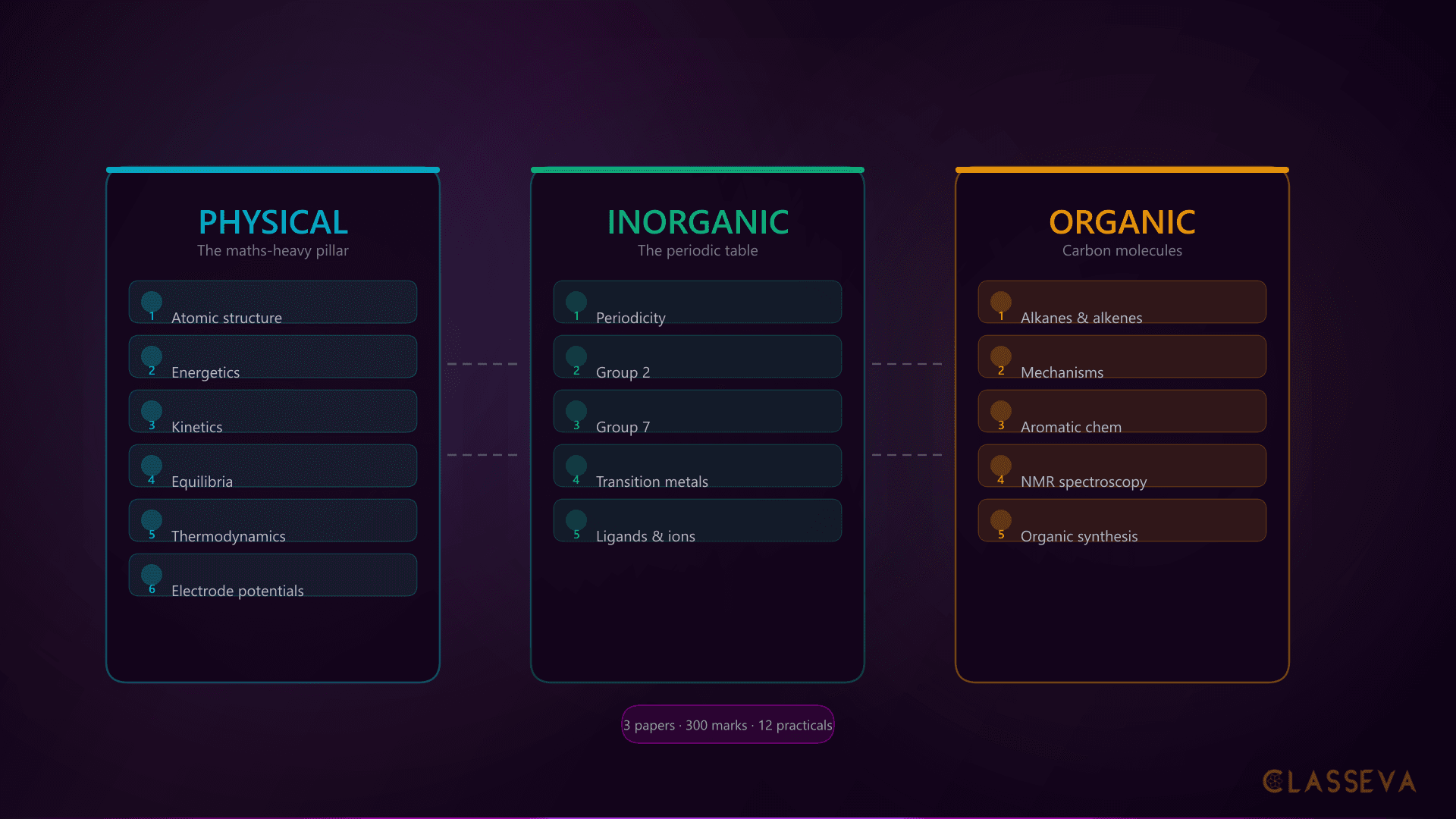
Every A-Level Chemistry specification divides the course into three broad areas. Understanding this structure early helps your child see the bigger picture instead of feeling overwhelmed by a wall of disconnected topics.
Physical Chemistry: The Maths-Heavy Pillar
Physical Chemistry is where calculations live. It covers the fundamental principles that govern how and why reactions happen: energy changes, reaction rates, equilibrium positions, and electrochemistry. This pillar appears in both Paper 1 and Paper 2, making it roughly 40% of the total exam. It is the single most important area to master.
AS-Level Physical Topics
These topics are taught in Year 12 and form the foundation for everything that follows. Students who do not solidify these early will struggle with the A2 content that builds directly on them.
| Spec Ref | Topic | Key Content |
|---|---|---|
| 3.1.1 | Atomic structure | Mass spectrometry, electron configuration, ionisation energies |
| 3.1.2 | Amount of substance | Moles, empirical formulae, ideal gas equation, concentration |
| 3.1.3 | Bonding | Ionic, covalent, metallic; shapes of molecules; electronegativity |
| 3.1.4 | Energetics | Enthalpy changes, Hess’s law, bond enthalpies, calorimetry |
| 3.1.5 | Kinetics | Rate of reaction, Boltzmann distribution, effect of catalysts |
| 3.1.6 | Equilibria | Le Chatelier’s principle, Kc expressions |
| 3.1.7 | Oxidation and reduction | Oxidation states, redox equations, half-equations |
AQA Specification 7405: Physical Chemistry AS content
A2 Physical Topics
The A2 Physical topics are where the difficulty escalates sharply. Thermodynamics introduces Born-Haber cycles and Gibbs free energy. Rate equations require students to determine reaction orders from experimental data. Electrode potentials bring in electrochemistry. Acids and bases demand fluency with pH, buffer calculations, and titration curves.
| Spec Ref | Topic | Key Content |
|---|---|---|
| 3.1.8 | Thermodynamics | Born-Haber cycles, lattice enthalpy, entropy, Gibbs free energy |
| 3.1.9 | Rate equations | Orders of reaction, rate constants, Arrhenius equation |
| 3.1.10 | Equilibrium Kp | Kp for gaseous equilibria, mole fractions |
| 3.1.11 | Electrode potentials | Standard electrode potentials, electrochemical cells, feasibility |
| 3.1.12 | Acids and bases | pH calculations, Ka, buffers, titration curves, indicators |
AQA Specification 7405: Physical Chemistry A2 content. Highlighted rows are where students most commonly struggle.
Physical Chemistry content appears in both Paper 1 and Paper 2. Paper 1 tests Physical alongside Inorganic. Paper 2 tests Physical alongside Organic. This means a weak understanding of Physical Chemistry affects two-thirds of the exam. It is not a pillar your child can afford to neglect.
Inorganic Chemistry: The Periodic Table in Depth
Inorganic Chemistry is the most fact-dense pillar. It focuses on the properties and reactions of elements across the periodic table, with particular depth on Group 2 (alkaline earth metals), Group 7 (halogens), and, at A2, the transition metals. The content is less mathematical than Physical Chemistry but requires strong memorisation of reactions, colours, and trends.
AS-Level Inorganic Topics
| Spec Ref | Topic | Key Content |
|---|---|---|
| 3.2.1 | Periodicity | Trends in atomic radius, ionisation energy, melting points across Period 3 |
| 3.2.2 | Group 2 | Reactions with water, oxygen; solubility and thermal decomposition trends |
| 3.2.3 | Group 7 (Halogens) | Halogen reactions, halide tests, displacement, disproportionation |
AQA Specification 7405: Inorganic Chemistry AS content
A2 Inorganic Topics
The A2 Inorganic content centres on transition metals, which are among the most visually memorable topics in the entire course. Students learn why transition metal compounds are coloured, how ligands bond to metal ions, and why these elements make effective catalysts. The reactions of ions in aqueous solution require students to recall a large number of specific tests and colour changes.
| Spec Ref | Topic | Key Content |
|---|---|---|
| 3.2.4 | Period 3 elements and oxides | Reactions, structure, and bonding of Period 3 oxides |
| 3.2.5 | Transition metals | Variable oxidation states, coloured ions, catalysis, complex ions, ligand substitution |
| 3.2.6 | Reactions of ions in aqueous solution | Precipitation, colour changes, confirmatory tests |
AQA Specification 7405: Inorganic Chemistry A2 content
Transition metal chemistry involves memorising dozens of specific colours: copper(II) is blue, iron(III) is yellow/brown, chromate is yellow, dichromate is orange, manganate(VII) is purple. Students who make colour flashcards early and revisit them regularly find this section far more manageable than those who try to cram it all before the exam.
Organic Chemistry: Carbon-Based Molecules
Organic Chemistry is where most students either fall in love with Chemistry or decide they wish they had chosen Geography. It is the study of carbon-based compounds, their reactions, and the mechanisms behind those reactions. At A-Level, Organic Chemistry demands a completely different skill from the other two pillars: the ability to draw curly arrow mechanisms from memory, showing exactly how electrons move during a reaction.
AS-Level Organic Topics
| Spec Ref | Topic | Key Content |
|---|---|---|
| 3.3.1 | Introduction to organic chemistry | IUPAC naming, structural and displayed formulae, functional groups, isomers |
| 3.3.2 | Alkanes | Combustion, free radical substitution mechanism (initiation, propagation, termination) |
| 3.3.3 | Halogenoalkanes | Nucleophilic substitution (SN1/SN2), elimination, ozone depletion |
| 3.3.4 | Alkenes | Electrophilic addition mechanism, polymerisation, test with bromine water |
| 3.3.5 | Alcohols | Classification (primary, secondary, tertiary), oxidation, dehydration, biofuels |
| 3.3.6 | Organic analysis | Mass spectrometry, infrared spectroscopy |
AQA Specification 7405: Organic Chemistry AS content
A2 Organic Topics
The A2 Organic content is where the course reaches its peak difficulty for many students. Aromatic chemistry introduces benzene and electrophilic substitution. Carbonyl compounds (aldehydes and ketones) bring nucleophilic addition mechanisms. NMR spectroscopy requires students to interpret carbon-13 and proton NMR spectra, essentially learning a new analytical “language” of peaks and splitting patterns. Finally, organic synthesis asks students to design multi-step reaction routes, connecting earlier topics into a coherent chain.
| Topic | Key Content |
|---|---|
| Optical isomers | Chirality, enantiomers, polarimetry |
| Aldehydes and ketones | Nucleophilic addition, Tollens’ test, reduction, oxidation |
| Carboxylic acids and esters | Esterification, acid reactions, polyesters |
| Aromatic chemistry | Benzene structure, electrophilic substitution, Friedel-Crafts |
| Amines | Preparation, reactions as bases and nucleophiles |
| Polymers | Condensation polymers, amino acids, proteins, biodegradability |
| Organic synthesis | Multi-step synthesis routes, retrosynthetic analysis |
| NMR spectroscopy | Carbon-13 NMR, proton NMR, chemical shift, splitting patterns |
AQA Specification 7405: Organic Chemistry A2 content. Highlighted: topics students find most challenging.
Exam Structure (AQA 7405)
Understanding the exam structure is essential for revision planning. AQA A-Level Chemistry has three papers, but the split is not as straightforward as “one paper per pillar.” Physical Chemistry is deliberately tested across two papers, which means it carries disproportionate weight.
| Paper | Content | Duration | Marks | Weight |
|---|---|---|---|---|
| Paper 1 | Inorganic + Physical Chemistry | 2 hours | 105 | 35% |
| Paper 2 | Organic + Physical Chemistry | 2 hours | 105 | 35% |
| Paper 3 | All content (synoptic) + practical skills | 2 hours | 90 | 30% |
AQA A-Level Chemistry (7405) exam structure. Paper 3 is synoptic and can test any topic from any pillar.
Papers 1 and 2
- •Short and long structured questions
- •Multiple choice (occasionally)
- •Extended response questions worth 6+ marks
- •Calculation questions with working shown
Paper 3 (Synoptic)
- •Questions can draw from ALL three pillars
- •Practical technique questions (15+ marks)
- •Data analysis and graph interpretation
- •Multiple choice section (40 marks)
A common revision mistake is treating the three pillars as equal-sized blocks and revising them one at a time. Because Physical Chemistry appears in both Paper 1 and Paper 2, it should be revisited throughout the revision period. Students who leave it until the end often find they have forgotten the Year 12 content by the time they reach the exam.
Required Practicals and the Practical Endorsement
AQA A-Level Chemistry includes 12 Required Practicals that students must complete during the course. These are assessed in two ways: through written exam questions (at least 15% of the total marks) and through the separate Practical Endorsement, which is a pass/fail assessment reported alongside the A-Level grade.
| # | Practical | Pillar |
|---|---|---|
| 1 | Make up a volumetric solution and carry out a simple acid-base titration | Physical |
| 2 | Measurement of an enthalpy change | Physical |
| 3 | Investigation of how rate of reaction changes with temperature | Physical |
| 4 | Carry out simple test-tube reactions to identify cations and anions | Inorganic |
| 5 | Distillation of a product from a reaction | Organic |
| 6 | Tests for alcohol, aldehyde, alkene, and carboxylic acid | Organic |
| 7 | Measuring rate of reaction by continuous monitoring method | Physical |
| 8 | Measuring rate of reaction by initial rate method | Physical |
| 9 | Investigating how pH changes during titrations (titration curves) | Physical |
| 10 | Measuring an electrochemical cell EMF | Physical |
| 11 | Preparation of an organic liquid | Organic |
| 12 | Preparation of an organic solid | Organic |
AQA A-Level Chemistry: 12 Required Practicals. Note how heavily Physical Chemistry features.
The Practical Endorsement is not graded; it is simply recorded as “Pass” or “Not classified” on the A-Level certificate. However, universities (particularly for science degrees) expect to see a Pass. The endorsement assesses practical competency across five areas: following procedures, applying investigative approaches, using apparatus, making and recording observations, and researching and referencing.
How Edexcel and OCR Compare
While AQA is the most common board for A-Level Chemistry in England, Edexcel and OCR A are also widely used. The core content is identical (it is all set by Ofqual), but the organisation and exam style differ.
Edexcel (9CH0) splits the content across 19 topic areas and 3 papers of equal weight (100 marks each). It has 16 Core Practicals that are linked to specific topics. The question style tends to be slightly more structured, with more scaffolding in multi-part questions.
OCR A (H432)uses 6 broad modules and Practical Activity Groups (PAGs), a more flexible system where teachers decide when to integrate practicals into the course. OCR's synoptic paper includes a multiple-choice component and unstructured questions that reward independent thinking.
Ask your child's school which exam board they follow. While the core content is the same, the paper structure affects how revision should be timed. AQA students, for example, need to revise Physical Chemistry for both Paper 1 andPaper 2, while Edexcel students may face a different topic split. The specification document (freely available on each board's website) is the single most useful revision document your child can have.
Where Most Students Struggle
During my time working with Chemistry students, I noticed the same trouble spots coming up repeatedly. These are the areas where targeted practice makes the biggest difference.
Organic mechanisms
Drawing curly arrow mechanisms accounts for roughly 20% of the harder Paper 2 questions. Students must show exactly where electrons move, which bonds break, and which form. The only way to learn this is repeated practice: draw each mechanism from memory until it becomes automatic. Reading about mechanisms is not the same as being able to reproduce them under timed conditions.
NMR spectroscopy
NMR is effectively a new language. Students need to match chemical shift values to environments, interpret splitting patterns (doublets, triplets, quartets), and determine molecular structures from spectra. It is one of the few topics where consistent practice with example spectra is the only reliable study method.
Multi-step calculations
Born-Haber cycles, pH calculations involving buffers, and Arrhenius equation questions all require students to chain multiple calculation steps together. A small error early in the chain cascades through the entire answer. Practising these under timed conditions builds the accuracy and confidence needed for the exam.
Linking the three pillars
Paper 3 is synoptic, meaning questions can draw from any pillar and expect students to connect ideas across them. For example, a question might ask about the thermodynamics (Physical) of an organic reaction (Organic) involving a transition metal catalyst (Inorganic). Students who revise each pillar in isolation often struggle with these cross-pillar questions.
The 2025 A*/A rate of 32.0% (down fractionally from 32.2% in 2024) is higher than Biology's 27.6%. This likely reflects self-selection: students who choose A-Level Chemistry tend to be among the strongest science students. It does not mean the subject is easier.
Practical Advice for Parents
You do not need to understand thermodynamics or NMR spectroscopy to help your child succeed in A-Level Chemistry. What matters is supporting the right habits and knowing enough about the course structure to ask useful questions.
What Helps
- •Ask: "Which pillar are you revising this week?"
- •Encourage past paper practice from Year 12
- •Make sure they have the specification printed or bookmarked
- •Support consistent organic mechanism practice (10 minutes daily)
- •Check they are pairing Chemistry with Maths if possible
What Does Not Help
- •Assuming Chemistry is "just like GCSE but harder"
- •Leaving all revision until Easter of Year 13
- •Re-reading the textbook without active recall
- •Ignoring Physical Chemistry because it is "just maths"
- •Comparing their grades to Biology students (different difficulty)
The AQA Chemistry specification lists every single thing that can appear on the exam. Nothing outside the specification will be tested. If your child has not read it, they are revising blind. Print it, highlight what has been covered, and use it as a revision checklist.
Chemistry is a subject that rewards consistent effort over time. The students I saw make the biggest improvements were not the ones who crammed hardest, but the ones who did a little organic mechanism practice every day, tackled Physical Chemistry calculations regularly, and used past papers and mark schemes to understand exactly what examiners wanted.
If your child is finding the content overwhelming, structured AI tutoring can help them work through specific topics at their own pace. Classeva's A-Level Chemistry sessions follow the exact AQA specification, so every session covers content that will actually be on the exam.