A-Level Computer Science Topics: What Your Child Will Study
A-Level Computer Science topics surprise many families. Parents often expect the subject to involve using software, building websites, or learning about social media. The reality is closer to applied mathematics: your child will study algorithms, data structures, Boolean algebra, and formal logic alongside practical programming.
From my experience working in tutoring, the students who struggled most with A-Level Computer Science were those who chose it expecting “ICT 2.0.” The ones who thrived were the problem-solvers, the puzzle-lovers, and the students who actually enjoyed the mathematical side of GCSE Computer Science. This guide breaks down everything your child will study, so there are no surprises on day one.
What Is A-Level Computer Science, Really?
A-Level Computer Science is a two-year course that teaches students to think computationally: to break complex problems into smaller parts, design algorithms to solve them, and implement those solutions in code. It is assessed through a combination of written exams, an on-screen programming exam, and a substantial coursework project.
A-Level Computer Science is notabout learning to use Word, Excel, or PowerPoint. There is no “ICT” A-Level any more. Computer Science involves writing real code, understanding how processors work at the hardware level, and studying formal mathematical logic. If your child wants a technology subject without heavy maths, look at BTEC Digital Information Technology or Cambridge Technicals instead.
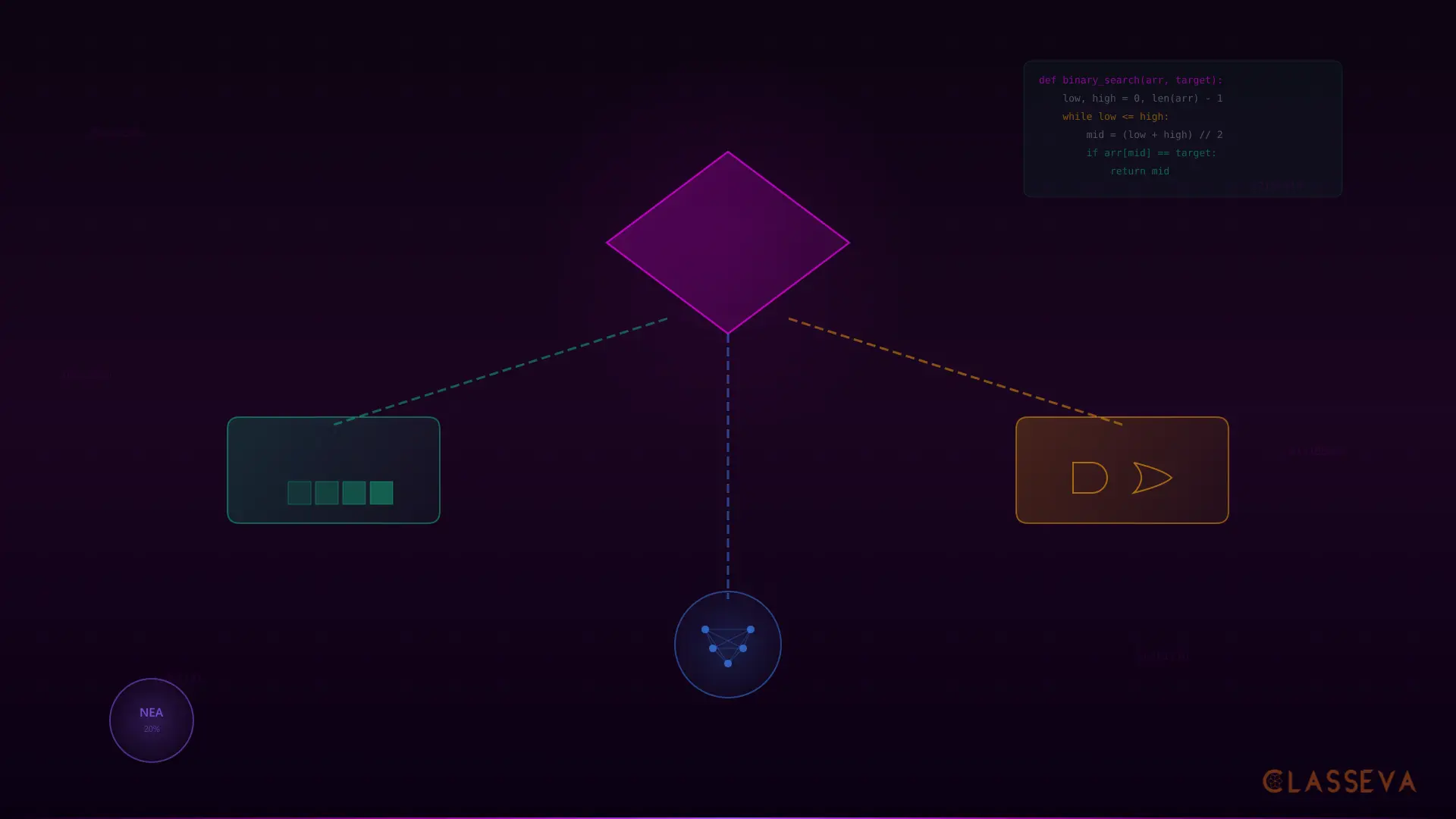
The A-Level computer science syllabus can be divided into two broad halves: the practical side (programming, algorithms, and the coursework project) and the theoretical side (computer systems, Boolean algebra, data representation, and networking). Both halves feed into each other. A student cannot write efficient code without understanding how computers actually process data, and the theory only makes sense when applied through programming.
Programming and Algorithms
Programming is the backbone of A-Level Computer Science. Students learn to write real code in a text-based language, not drag-and-drop blocks like Scratch. This is the practical half of the course, and it feeds directly into both the on-screen exam and the NEA coursework project.
Languages and Programming Paradigms
Schools choose which language to teach, usually from Python, Java, or C#. Python is the most common choice because its syntax is readable and it lets students focus on problem-solving rather than wrestling with semicolons. Regardless of language, students must understand:
- Procedural programming: writing sequences of instructions with functions, loops, and conditionals
- Object-oriented programming (OOP): classes, objects, inheritance, polymorphism, and encapsulation
- Recursion: functions that call themselves, a concept tested heavily across all exam boards
One pattern I noticed consistently: students who practised coding outside of lessons, even just 20 minutes a day on platforms like Codecademy or Project Euler, progressed twice as fast as those who only coded during school hours. Programming is a skill built through repetition, much like learning a musical instrument.
Object-oriented programming is where many students first hit a wall. The jump from writing simple functions to designing class hierarchies with inheritance is significant. If your child finds this challenging, it is completely normal. Most students need several weeks of practice before OOP “clicks.”
Data Structures and Algorithms
Data structures are ways of organising information so that programs can access it efficiently. Algorithms are step-by-step procedures for solving problems. Together, they form the most technically demanding part of the A-Level CS content.
| Category | Topics Covered | Why It Matters |
|---|---|---|
| Data Structures | Arrays, lists, stacks, queues, trees, hash tables, graphs | Choosing the right structure makes programs faster and more memory-efficient |
| Searching | Linear search, binary search | Binary search is exponentially faster on sorted data: foundational efficiency concept |
| Sorting | Bubble sort, merge sort, quick sort | Students compare algorithm efficiency using Big O notation |
| Graph Traversal | Breadth-first search, depth-first search, Dijkstra's shortest path | Used in navigation systems, social networks, and AI pathfinding |
| Complexity | Big O notation: O(1), O(n), O(n²), O(log n) | Understanding why some solutions are fast and others are impractical |
Core data structures and algorithms in the A-Level Computer Science syllabus
Big O notation is the mathematical language students use to describe how fast an algorithm runs as the input grows. A bubble sort is O(n²), meaning it gets dramatically slower with large datasets, while merge sort is O(n log n), far more efficient. This is where the maths and programming intersect most clearly.
Computer Systems and Theory
The theoretical half of the A-Level computer science syllabus covers how computers work at the hardware and software level. This is the content that most resembles traditional exam revision: facts, concepts, and structured written answers.
Hardware and Architecture
Students learn about the internal components of a computer and how they work together:
- CPU architecture: the Von Neumann model, fetch-decode-execute cycle, registers (program counter, accumulator, memory address register), and buses
- Memory types: RAM, ROM, cache memory, virtual memory, and how they differ in speed, volatility, and cost
- Secondary storage: magnetic, optical, and solid-state storage technologies
- Operating systems: memory management, process scheduling, file systems, and how the OS sits between hardware and applications
- Translators: the difference between compilers, interpreters, and assemblers
Students are expected to trace through the fetch-decode-execute cycle step by step, explaining what each register does at each stage. This kind of detailed, sequential reasoning is exactly what exam questions test.
Boolean Algebra and Data Representation
This is where A-Level Computer Sciencefeels most like a maths course. Boolean algebra uses logic gates (AND, OR, NOT, NAND, NOR, XOR) to build circuits, and students must simplify complex expressions using De Morgan's laws and Karnaugh maps.
Data representation is equally mathematical. Students convert between binary, hexadecimal, and denary; perform binary arithmetic including two's complement for negative numbers; and understand how floating-point numbers are stored. They also study how text (ASCII, Unicode), images (bitmap, vector), and sound are represented digitally.
At the abstract end of the syllabus, students encounter finite state machines, regular expressions, and (at some boards) Turing machines. These topics ask fundamental questions about what computers can and cannot solve. The halting problem, for example, proves that no program can determine whether every other program will eventually stop running.
Networking and Databases
Networking covers how computers communicate: the TCP/IP protocol stack, how DNS translates domain names to IP addresses, HTTP requests, packet switching, and the differences between client-server and peer-to-peer architectures. Network security topics include encryption, firewalls, and common attack vectors.
Databases cover the relational model, SQL queries (SELECT, INSERT, UPDATE, DELETE with WHERE, JOIN, and GROUP BY), normalisation through 1NF, 2NF, and 3NF, and entity-relationship diagrams. These are practical skills with direct industry relevance.
The Programming Project (NEA)
The Non-Exam Assessment is a substantial independent programming project worth 20% of the final A-Level grade at both AQA and OCR. This is not a weekend homework task. It typically requires 50 to 75 hours of work, and students must design, implement, test, and evaluate a complete software solution to a real-world problem.
The NEA is assessed on the complexity of the solution, the quality of the code, the testing methodology, and the written evaluation. Students who choose overly simple projects score poorly on complexity. Students who choose overly ambitious projects often cannot finish. The sweet spot is a project complex enough to demonstrate multiple data structures and algorithms, but achievable within the timeframe.
Strong NEA Project Ideas
- •A pathfinding simulation using graph algorithms
- •A database-driven stock management system
- •A game with AI opponents (chess engine, maze solver)
- •An encryption/decryption tool with multiple ciphers
- •A data analysis tool that processes CSV files
Weak NEA Project Ideas
- •A basic calculator (too simple for A-Level)
- •A static website with no backend logic
- •A quiz app with hardcoded questions
- •Anything that relies solely on external APIs
- •A project the student cannot explain line by line
The most common mistake is starting the NEA too late. Students who begin in January of Year 13 rarely finish to a high standard. The best students begin planning in the summer term of Year 12 and start coding over the summer holiday. By Christmas of Year 13, the project should be substantially complete, leaving time for testing and the written evaluation.
AQA vs OCR: Exam Differences
AQA and OCR are the two dominant exam boards for A-Level Computer Science. Both cover the same national curriculum, but they structure their exams differently. Your child's school will have already chosen one.
| AQA (7516/7517) | OCR (H446) | |
|---|---|---|
| Paper 1 | On-screen exam: programming tasks in chosen language | Written exam: computer systems theory |
| Paper 2 | Written exam: theory and computational thinking | On-screen exam: algorithms and programming |
| NEA | 20% of grade, independent project | 20% of grade, independent project |
| Programming language | Student chooses from approved list | Student chooses, plus OCR pseudo-code in Paper 2 |
| Unique feature | On-screen programming is Paper 1 (the first exam) | Uses its own pseudo-code alongside the chosen language |
Source: AQA and OCR A-Level Computer Science specifications
The key practical difference is that AQA's on-screen programming exam comes first (Paper 1), while OCR puts theory first and programming second. OCR also introduces its own pseudo-code notation that students must learn to read alongside their chosen programming language. Edexcel offers a similar structure but is less commonly taught.
For more detail on how these exam boards compare across other subjects, see our guide on how to choose A-Level subjects.
The Maths Connection
A-Level Computer Science has significant mathematical content, and parents should be aware of this before their child commits. Boolean algebra, binary arithmetic, Big O notation, set theory, and algorithm analysis all require strong mathematical reasoning.
A-Level Maths is not a formal prerequisite for A-Level Computer Science at most schools. However, it is very strongly recommended. Students who take both subjects find that the mathematical topics in CS are far more manageable. For Computer Science degrees at top universities (Oxford, Cambridge, Imperial), Further Maths is often required or expected.
Having seen many students attempt A-Level Computer Science without Maths, I can say the pattern is clear: they cope with the programming and system architecture, but struggle significantly when they reach Boolean algebra, algorithm complexity, and floating-point representation. Those topics are effectively applied mathematics, and without the parallel A-Level Maths course reinforcing the foundations, students have to learn the maths from scratch within CS lessons.
Is A-Level Computer Science Hard?
A-Level Computer Science is one of the more demanding A-Levels. It requires both abstract mathematical thinking and the practical ability to write working code under timed conditions. The on-screen programming exam is unlike anything else in the A-Level system: students must read, understand, and debug code, then write their own solutions, all within a fixed time limit.
GCSE Computer Science is helpful but not essential. Some students start the A-Level fresh. However, those with the GCSE will find the first term significantly easier, particularly the programming fundamentals. The bigger factor is mathematical confidence: if your child enjoys and performs well in maths, they will likely cope well with A-Level CS.
Students Who Tend to Thrive
- •Enjoy puzzles, logic problems, and pattern-spotting
- •Strong at maths (grade 7+ at GCSE)
- •Willingly code outside of class hours
- •Comfortable with trial-and-error debugging
- •Can work independently on long projects
Students Who May Struggle
- •Chose CS expecting to learn about apps and social media
- •Find maths stressful or confusing
- •Prefer subjects with clear right/wrong answers and set methods
- •Dislike spending long periods troubleshooting errors
- •Need constant teacher guidance to make progress
Where Does Computer Science Lead?
A-Level Computer Science is one of the most career-relevant subjects available. The UK technology sector has a significant skills shortage, and computer science graduates consistently rank among the highest earners at every career stage.
| Pathway | Examples | Notes |
|---|---|---|
| University degrees | Computer Science, Software Engineering, AI, Data Science, Cybersecurity, Games Development | Maths A-Level is required for most CS degrees; Further Maths helps at top universities |
| Direct careers | Software developer, web developer, data scientist, cybersecurity analyst, AI/ML engineer, DevOps engineer | Many roles accessible via degree apprenticeships as well as traditional degrees |
| Teaching | Secondary Computer Science teacher | CS is a shortage subject with a £29,000 bursary for teacher training in 2026 |
| Broader value | Any career involving data, logic, or systems thinking | CS complements economics, sciences, engineering, and even creative industries |
Career pathways from A-Level Computer Science
For a deeper look at which A-Level combinations lead to CS degrees, see our dedicated guide on A-Levels for a Computer Science degree. If your child is still exploring options, our subject choice guide covers how to balance interests, career goals, and university requirements.
Practical Advice for Parents
As a parent, you do not need to understand Python or Boolean algebra. But there are practical things you can do to support your child through what they study in A-Level Computer Science.
Understand what CS really is
Read through the first section of this guide with your child. Make sure they know this is not ICT. If they chose CS because they like gaming or social media, have an honest conversation about what the course actually involves before term starts.
Pair CS with Maths if possible
A-Level Maths is the single strongest companion subject. If your child is taking CS without Maths, they should be confident they can handle Boolean algebra, binary arithmetic, and Big O notation independently.
Encourage coding outside of school
Platforms like Codecademy, freeCodeCamp, Project Euler, and Advent of Code provide structured practice. Even 15 to 20 minutes a day builds fluency. Programming improves with volume, not just study sessions.
Watch the NEA timeline
The programming project is worth 20% of the grade. Planning should begin in Year 12, coding over the summer, and the project should be substantially complete before Christmas of Year 13. If your child has not started by January, raise it with their teacher immediately.
Know the exam board
Ask your child's school whether they follow AQA or OCR. This determines the exam structure and whether your child needs to learn OCR pseudo-code. The specification document (available free on the exam board website) lists every topic that can appear on the exam.
The exam board specification is the single most important document for any A-Level student. It lists every topic, every sub-topic, and every skill that can be examined. Students who work through the specification systematically, ticking off what they know and flagging what they do not, consistently outperform those who revise randomly. Download it from AQA or OCR and keep a printed copy.
A-Level Computer Science is demanding, but for the right student, it is one of the most rewarding and career-relevant subjects in the curriculum. The combination of mathematical thinking, practical problem-solving, and creative coding makes it genuinely engaging for students who enjoy logical challenges. If your child wants to understand how the technology around them actually works, and they have the mathematical foundation to support that curiosity, Computer Science is an excellent choice.
For more on the broader landscape of choosing sixth-form subjects, see the Informed Choices guide from the Russell Group, which highlights which A-Levels open the most doors for competitive university courses.