Equilibrium and Le Chatelier: Worked Examples
The equilibrium and Le Chatelier examples that trip students up in general chemistry are rarely conceptually hard. They fail because of setup errors: wrong species in the Kc expression, misaligned ICE table change rows, or misidentifying whether a reaction is exothermic or endothermic. This walkthrough works through five progressively harder examples in the order that matches how problems appear in a general chemistry course, with every step shown and the most common error flagged at each stage.
What Is Chemical Equilibrium?
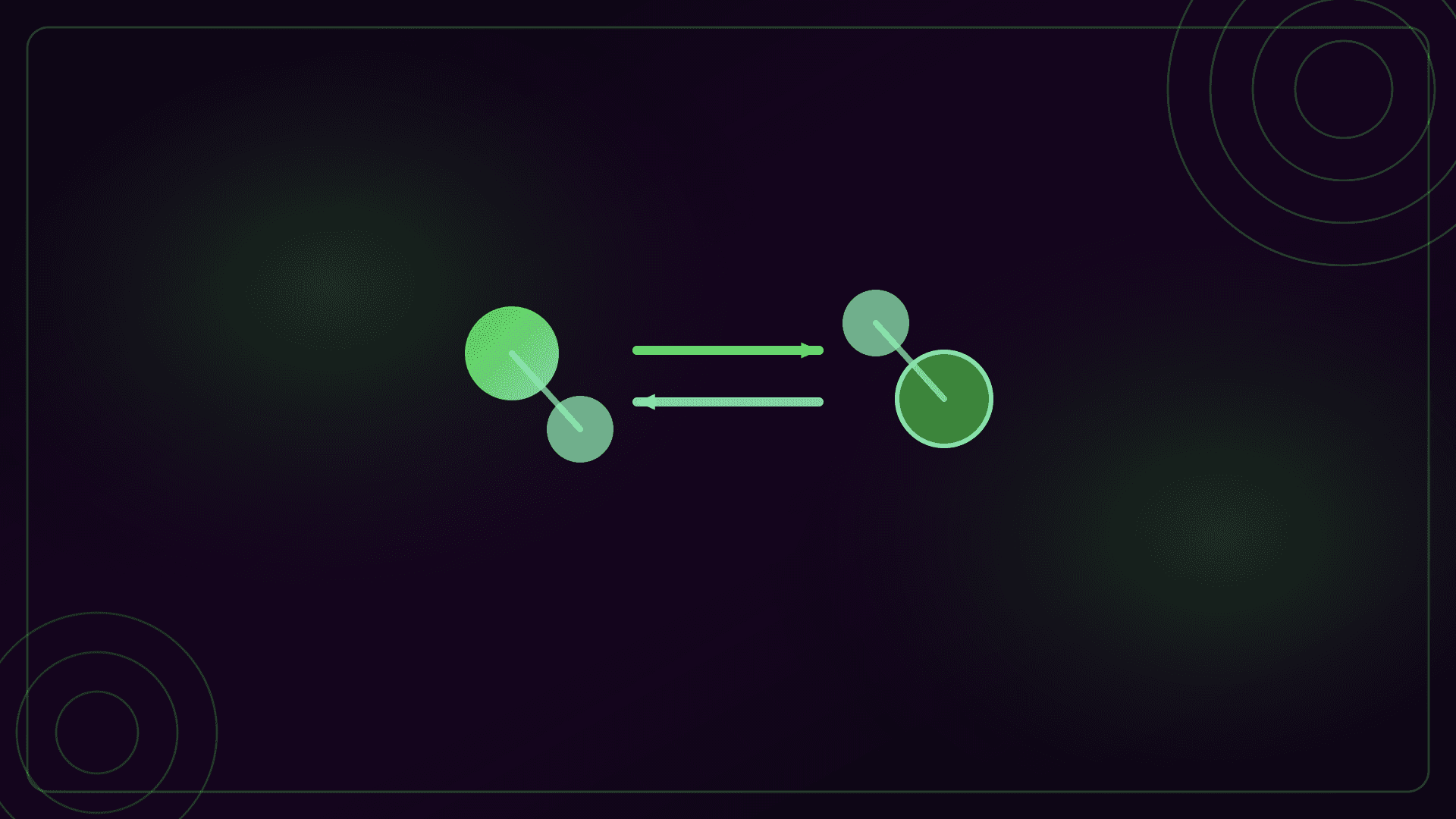
Chemical equilibrium is the state in which the forward and reverse rates of a reaction are equal, so the concentrations of reactants and products remain constant over time. The reaction has not stopped; both directions run simultaneously at matched rates. This is called a dynamic equilibrium.
According to OpenStax Chemistry 2e, Chapter 13, equilibrium is reached when the rate of the forward reaction equals the rate of the reverse reaction, and both reactant and product concentrations hold steady. The equilibrium constant K captures the ratio of product to reactant concentrations at that point.
Kc and Kp: What They Measure
Kc uses molar concentrations (mol/L). Kp uses partial pressures. For the general reaction aA + bB ⇌ cC + dD, the equilibrium expressions are:
| Expression | Formula | Units included |
|---|---|---|
| Kc | [C]^c [D]^d / ([A]^a [B]^b) | Concentrations in mol/L; pure solids/liquids excluded |
| Kp | (P_C)^c (P_D)^d / ((P_A)^a (P_B)^b) | Partial pressures; only gaseous species included |
| Relationship | Kp = Kc(RT)^(delta n) | delta n = moles gas products minus moles gas reactants |
Source: OpenStax Chemistry 2e, Chapter 13. R = 0.0821 L·atm/(mol·K); T in Kelvin.
The rule that eliminates pure solids and liquids trips up most students at least once. A solid has an essentially constant activity (defined as 1 by convention), so it contributes nothing to the ratio. Aqueous ions and dissolved species always appear; gases always appear. Solids and pure liquids never appear.
Example 1: Calculating Kc from Equilibrium Concentrations
The simplest equilibrium and Le Chatelier examples ask you to compute Kc when all equilibrium concentrations are given. The work is straightforward once the expression is correct.
Problem. For the reaction N2(g) + 3H2(g) ⇌ 2NH3(g), at 500 °C the equilibrium concentrations are [N2] = 0.115 mol/L, [H2] = 0.105 mol/L, and [NH3] = 0.439 mol/L. Calculate Kc.
Setting Up the Equilibrium Expression
All three species are gaseous, so all three appear in Kc. Products go in the numerator, reactants in the denominator, each raised to the power of its stoichiometric coefficient:
Kc = [NH3]2 / ([N2][H2]3)
Plugging In Concentrations
Substituting the given values:
Kc = (0.439)2 / (0.115 × (0.105)3)
Kc = 0.1927 / (0.115 × 0.001158)
Kc = 0.1927 / 0.0001332
Kc ≈ 1.45 × 10³
A Kc much greater than 1 (here, about 1450) means the equilibrium lies strongly toward products at this temperature. A Kc much less than 1 means the equilibrium lies toward reactants. A Kc near 1 means products and reactants are present in comparable amounts. For the Haber process example above, Kc of around 1450 at 500 °C tells you that, at equilibrium, ammonia concentration far exceeds the nitrogen and hydrogen remaining.
Example 2: Using an ICE Table to Find Equilibrium Concentrations
When you know Kc and initial concentrations but not equilibrium concentrations, you need an ICE table. ICE stands for Initial, Change, Equilibrium. The general chemistry equilibrium ICE method converts the algebra of equilibrium into a structured grid that prevents sign errors.
Problem. For the reaction H2(g) + I2(g) ⇌ 2HI(g), Kc = 55.3 at 430 °C. Initially, 0.500 mol of H2 and 0.500 mol of I2 are placed in a 1.00 L container with no HI present. Find the equilibrium concentrations of all species.
Building the ICE Table
Each column represents one species. The rows give the concentrations at three stages: Initial (before any reaction), Change (how much each species concentration shifts by the time equilibrium is reached), and Equilibrium (the final steady concentrations).
Solving for x
Substituting the equilibrium row into the Kc expression:
Kc = (2x)2 / (0.500 - x)2 = 55.3
Because both numerator and denominator are perfect squares, take the square root of both sides: 2x / (0.500 - x) = 7.437. Rearranging: 2x = 7.437(0.500 - x) = 3.718 - 7.437x. So 9.437x = 3.718, giving x = 0.394.
Equilibrium concentrations: [H2] = [I2] = 0.500 - 0.394 = 0.106 mol/L and [HI] = 2(0.394) = 0.788 mol/L.
The Most Common ICE Table Error
Students frequently set all three change-row signs to the same direction (all negative, or all positive) rather than using the stoichiometry to assign signs correctly. The rule is fixed: for every species consumed as the reaction proceeds forward, the change is negative; for every species produced, the change is positive, and its magnitude scales with its stoichiometric coefficient relative to the variable x. If you use x as the change for a species with coefficient 1 and the product has coefficient 2, the product's change row entry is 2x, not x.
A common error: writing the change for HI as +x instead of +2x in the H₂ + I₂ ⇌ 2HI problem above. The stoichiometric coefficient of HI is 2, so every x mol/L consumed of H₂ produces 2x mol/L of HI. Writing +x understates the product concentration and yields the wrong Kc. Check every change-row entry against its coefficient before solving.
Le Chatelier's Principle: The Core Rule
Le Chatelier's principle states: if a system at equilibrium is subjected to a stress, the system adjusts its position to partially relieve that stress. The OpenStax Chemistry 2e treatment of Le Chatelier's principle identifies three categories of stress: concentration changes, pressure changes (for gaseous systems), and temperature changes.
The word “partially” matters. The shift never fully eliminates the stress. It moves the equilibrium position enough to re-establish a ratio of concentrations consistent with the same Kc (unless temperature changes, which changes Kc itself).
Example 3: Predicting a Shift from Concentration Change
Problem. For the equilibrium N2(g) + 3H2(g) ⇌ 2NH3(g) at 500 °C, the system is at equilibrium with Kc = 1.45 × 10³. More H2 is added to the container at constant temperature. Predict the direction of the shift and explain why Kc does not change.
Adding H2 raises [H2] above its equilibrium value. This means the current ratio of [NH3]2 / ([N2][H2]3) is now smaller than Kc. In other words, Q is now less than Kc. The system responds by running forward: H2 and N2 are consumed, and NH3 is produced, until Q returns to the value Kc.
The equilibrium constant Kc remains 1.45 × 10³. Temperature did not change. Only the equilibrium concentrations shift to a new set of values that still satisfy the same Kc expression.
For any concentration or pressure change, compute Q with the new concentrations and compare to Kc. If Q is less than Kc, the reaction shifts forward. If Q exceeds Kc, the reaction shifts in reverse. This rule works for every concentration stress and replaces the need to reason from scratch every time. It also confirms your Le Chatelier shift-direction prediction before committing it to paper.
Example 4: Predicting a Shift from Pressure Change
Problem. For the reaction 2SO2(g) + O2(g) ⇌ 2SO3(g), what happens to the equilibrium position when the total pressure is increased by compressing the volume at constant temperature?
Count the moles of gas on each side. The reactants (2SO2 + O2) contribute 3 moles of gas. The products (2SO3) contribute 2 moles of gas. Compressing the volume raises all partial pressures. The system shifts toward the side with fewer moles of gas, which is the product side, to reduce the total number of gas molecules and partially relieve the pressure increase.
The equilibrium shifts to the right, producing more SO3.
Why Moles of Gas Determine the Pressure Response
The pressure effect only applies to gaseous species. Compressing a gas mixture doubles every partial pressure. The new Q value equals Kc times (new total molar concentration / original) raised to delta n. When delta n is negative (fewer moles of gas in products), increasing pressure reduces Q below Kc and the system shifts forward. When delta n is positive, increasing pressure raises Q above Kc and the system shifts in reverse. When delta n equals zero, no net shift occurs.
Example 5: Temperature Change and the Equilibrium Constant
Temperature is the only stress in equilibrium and Le Chatelier practice problems that changes Kc itself, not just the equilibrium position. This example shows how to determine whether Kc rises or falls.
Problem. The reaction N2O4(g) ⇌ 2NO2(g) has a positive standard enthalpy change (endothermic, delta H = +57 kJ/mol). Starting from equilibrium at 25 °C, predict what happens to both the equilibrium position and the value of Kc when temperature is increased to 50 °C.
Exothermic vs Endothermic: How to Tell Which Way Kc Moves
Treat heat as a species in the equilibrium. For an endothermic reaction, heat is a reactant:
N2O4(g) + heat ⇌ 2NO2(g)
Increasing temperature adds heat (the reactant). By Le Chatelier's principle, the equilibrium shifts right to consume the extra heat, producing more NO2. Because more product forms at the new equilibrium, [NO2]2 / [N2O4] is now larger. Kc increases.
For an exothermic reaction, heat is a product. Increasing temperature shifts the equilibrium left, consuming products, and Kc decreases.
| Reaction type | Temperature increase | Direction of shift | Effect on Kc |
|---|---|---|---|
| Endothermic (delta H > 0) | Add heat as reactant | Shifts right (forward) | Kc increases |
| Exothermic (delta H < 0) | Add heat as product | Shifts left (reverse) | Kc decreases |
| Either type | Temperature decrease | Opposite of above | Kc changes opposite direction |
Temperature is the only stress that changes the equilibrium constant. Source: OpenStax Chemistry 2e, Chapter 13.
For the N2O4/NO2 system, equilibrium constant data from the MIT OpenCourseWare 5.111 Principles of Chemical Science course materials show Kc rising by roughly two orders of magnitude between 25 °C and 100 °C. The endothermic character drives a steep increase in Kc with temperature, consistent with the Le Chatelier prediction.
Using the Reaction Quotient Q to Confirm Shift Direction
Q is computed from the equilibrium expression using current (non-equilibrium) concentrations rather than equilibrium concentrations. Comparing Q to Kc determines shift direction in every general chemistry equilibrium problem.
Problem. For the reaction CO(g) + 3H2(g) ⇌ CH4(g) + H2O(g), Kc = 3.93 at 900 K. In a particular mixture: [CO] = 0.200, [H2] = 0.100, [CH4] = 0.300, [H2O] = 0.800 (all in mol/L). Does the reaction proceed forward or in reverse?
Q = [CH4][H2O] / ([CO][H2]3) = (0.300)(0.800) / (0.200 × (0.100)3) = 0.240 / (0.200 × 0.001) = 0.240 / 0.000200 = 1200
Q = 1200 is much larger than Kc = 3.93. The ratio of products to reactants far exceeds the equilibrium ratio, so the reaction runs in reverse: CH4 and H2O are consumed, and CO and H2 are produced, until Q drops back to 3.93.
The subject calculators hub handles stoichiometry steps automatically for more complex reactions, including an equation balancer so you can focus on the equilibrium algebra rather than checking coefficient arithmetic. For a broader set of general chemistry tools, the hub covers stoichiometry, energy, and concentration calculations alongside equilibrium.
Equation Balancer
Balance reaction equations before setting up your equilibrium expression. Correct coefficients are required for accurate ICE table change rows and correct Kc exponents.
For practice working through equilibrium and Le Chatelier step by step problems on resonance and molecular structure that feed into understanding reaction thermodynamics, the resonance structures worked examples post covers curved-arrow mechanics and formal charge. The conservation of energy worked examples post shows how enthalpy sign conventions connect to the equilibrium temperature rules covered in Example 5 above.
For balancing the redox reactions that precede many equilibrium setups, the Batch-1 post on how to solve balancing redox reactions walks through the half-reaction method before you set up the equilibrium expression. And for building the broad study habits that make worked-example practice stick, the active recall study technique post explains why solving problems from a blank page beats re-reading worked solutions.
If you want to work through equilibrium and Le Chatelier practice problems with an AI tutor that explains each ICE table step, identifies the error in your shift prediction, and scales difficulty to where you are:
Key Takeaways
- Write the equilibrium expression with products over reactants, each raised to its stoichiometric coefficient. Exclude pure solids and pure liquids; include all gases and aqueous species.
- Use an ICE table when Kc is known and equilibrium concentrations are not: Initial row from the problem, Change row from stoichiometric coefficients (negative for consumed species, positive for produced), Equilibrium row by adding them. Check every change-row coefficient before solving.
- Le Chatelier's principle: adding a reactant shifts equilibrium right; adding a product shifts it left; compressing a gas mixture shifts toward fewer moles of gas; changing temperature shifts toward the endothermic side and changes the numerical value of Kc.
- Only temperature changes Kc. Concentration and pressure changes alter the equilibrium position but leave Kc unchanged.
- Calculate Q from current concentrations to confirm shift direction. Q less than Kc means the reaction shifts forward; Q greater than Kc means it shifts in reverse.
- For endothermic reactions, raising temperature raises Kc (heat is a reactant, adding it shifts right). For exothermic reactions, raising temperature lowers Kc (heat is a product, adding it shifts left).
- Adding an inert gas at constant volume does not shift the equilibrium because the partial pressures of reactive species are unchanged. Compressing the volume shifts toward the side with fewer moles of gas.